


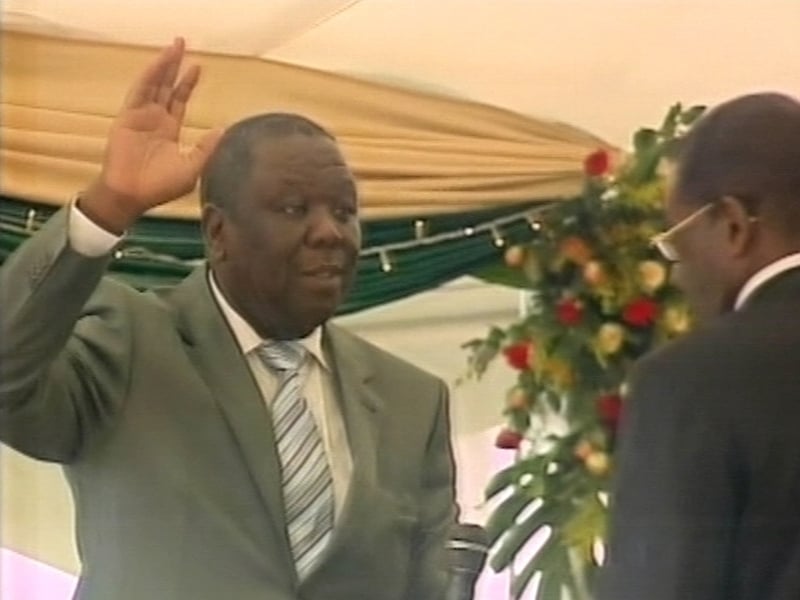
Zimbabwean Prime Minister Morgan Tsvangirai has made his first call for an end to international sanctions.
Mr Tsvangirai, who joined President Robert Mugabe in a unity government last month, said in his maiden speech to parliament that Zimbabwean efforts to solve the country's political crisis through power sharing needed to be recognised.
‘I therefore urge the international community to recognise our efforts and note the progress that we make in this regard and to match our progress by moving towards the removal of restrictive measures,’ he said.
The US and EU have targeted sanctions against individuals close to Mr Mugabe and some Zimbabwean companies.
Inflation is rampant and there are chronic food and fuel shortages.
Mr Tsvangirai said Zimbabwe, which is in the grip of a cholera epidemic that has killed nearly 4,000 people and infected almost 87,000, needs to re-establish relations with international donors.
He warned government officials that any future human rights abuses could lead to arrest and prosecution and said the days of police violently breaking up demonstrations and needlessly arresting people had to come to an end.
‘In future such activities could bring the threat of prosecution not only on those arresting or interfering with such activities but also on those that ordered such interference and arrests,’ Mr Tsvangirai said.
He added that the new unity government will start training programmes for police and the security forces to ensure respect for human rights.
Mr Tsvangirai, himself a victim of police brutality when he was injured as riot police broke up a political gathering in 2006, pulled out of a presidential run-off vote against Mr Mugabe last year, citing violence against his supporters.
He said last month that the cost of repairing the economy could be as much as $5bn (€3.98bn).
The regional Southern African Development Community plans to hold a heads of state summit to consider financing proposals presented by Zimbabwe.
The new Zimbabwean prime minister said invasions of farms had to stop and that the action to seize farms threatened $150m (€120m) worth of crops.
‘We must halt the wanton disruption of productive farming activities that are continuing as I speak,’ he said.
Thousands of white farmers have fled Zimbabwe since land seizures began in 2000, and the country's farmers' union said some white farmers were still being forced off land or being prosecuted for refusing to leave.
