


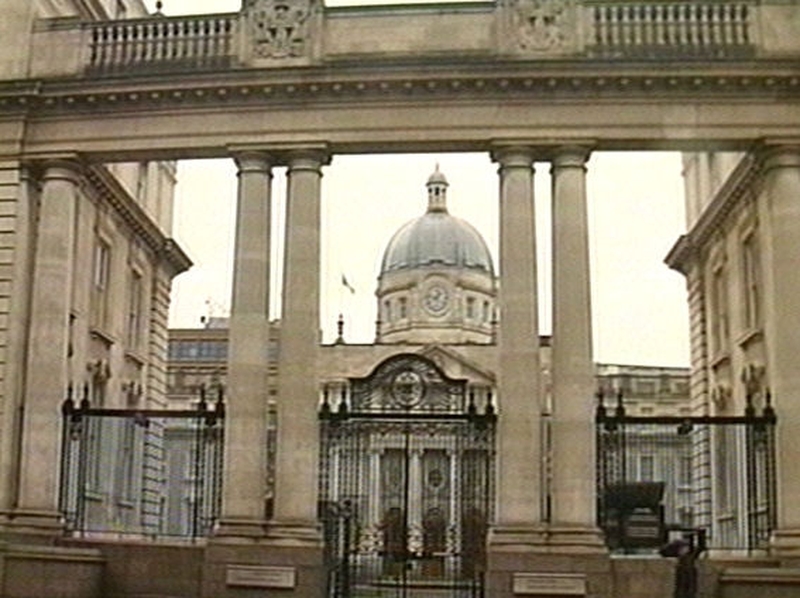
Talks at Government buildings on the formation of a plan to cut €2bn in public spending are progressing slowly according to those involved.
The talks have been taking place since early this morning and are set to continue for several hours.
The Government wants a package of measures agreed to put to tomorrow's cabinet meeting.
The Government needs to cut €2bn in public spending over the next twelve months, and how it plans to do that is beginning to become clearer.
Senior Department of Finance officials have told public service unions the 'lion's share' of the €2bn cuts in Exchequer spending this year will have to come from the public sector pay bill.
Union negotiators are now considering their position.
That would effectively mean that public servants would have to make greater contributions to their pensions.
There is also speculation that a levy of around 7% may be implemented.
Of course the amount of the levy would depend on the grade and salary of each public servant.
Earlier the talks adjourned for around an hour and a half but resumed shortly after 9pm this evening.
As yet it is understood that nothing firm has been put on the table.
The talks are likely to continue for several hours yet.
Union proposals
It is understood the Irish Congress of Trade Unions made proposals to Government on pension protection this morning.
The protection of private sector pensions could potentially leave the Government exposed to huge expense should a number of pension schemes get into difficulty. But unions want to see protection for the private sector as well as for public sector workers.
ICTU General Secretary David Begg said there was no way the unions could credibly come out of these talks with nothing on pensions when the national pension reserve fund had been used to recapitalise the banks.
He acknowledged that these were separate issues, but said he did not believe trade union negotiators could credibly explain it.
The talks must focus on public servants paying more for their pensions, Mr Begg said.
He said there are not many instruments available to make the needed savings for Government.
Mr Begg said the talks this morning had focused on a pension protection fund for the private sector, adding that this was an even more complicated issue than public sector pay cuts.
Jerry Shanahan of the trade union, Unite, said resolving the difficulties of staff at Waterford Crystal would be central to reaching agreement. He said Waterford would be a test case, because workers all over the country are facing a similar situation.
Blair Horan of the CPSU said he wanted to see solid proposals from Government on how it intends to save €2bn. He said it was difficult to say whether or not agreement could be reached without seeing Government proposals on how the best-off in society will take most of the burden.
The ICTU says it expects talks to take place well into the night, given the complexity of issues to be discussed.
Mr Begg said the aim to have a document ready for Cabinet to consider tomorrow helps the process, but a deadline of this afternoon is 'in no way reachable'.
The distribution of the burden of the €2bn in cutbacks needs to be discussed and assurances that balance in the burden is needed by the social partners, he added.
'The talks process this morning is about putting flesh on the bones of the framework agreed last week.'
Issues outstanding
Danny McCoy of the employers' group IBEC said a raft of issues still need to be tied up. He said a formula which starts to stabilise the economy is needed from the talks.
Mr McCoy said pay will need to be discussed. He said all sides are working towards having a document put forward for consideration by Cabinet tomorrow.
Government officials worked through the night on what were described as complex issues which arose during yesterday's session.
They were expected to present draft position papers on these issues to union representatives today.
Taoiseach Brian Cowen, who was at Government Buildings throughout yesterday, has indicated that he wants a plan in place within 24 hours, so that he can present it to the Cabinet tomorrow.
It is understood that Mr Cowen indicated that the Cabinet meeting tomorrow would decide on how to tackle the country's economic difficulties.
Government officials are also said to be anxious to get agreement before the international credit agencies bring out their assessment of Ireland on Wednesday.
Early Childcare Supplement
Health Minister Mary Harney has said she did not want to confirm or deny reports that the Government was considering cutting the Early Childcare Supplement, which, she said, comes from the office of Minister for Children Barry Andrews.
‘I'm not going to confirm or deny anything because it would be wrong of me to do so. The supplement costs in a full year about €400m. It goes to every single child regardless of their family means. It goes to all children under age five and a half.
‘Everything is being examined. We don’t have alternatives. These are huge challenges we face,’ she said.
She said she was hopeful that the Government's economic challenges could be met through partnership.
‘Tomorrow the Government will make decisions and I hope those decisions can be based on agreement with the other stakeholders in our society, the social partners.
‘I know the Taoiseach spent about 12 hours in dialogue and discussions at Government Buildings and I understand the talks over the weekend were very encouraging.’
In relation to the pay talks Ms Harney said what we needed was constructive criticism, not destructive cynicism.
She added that as part of the public health service, consultants would be annually affected by any decisions on public sector pay and pensions.
