

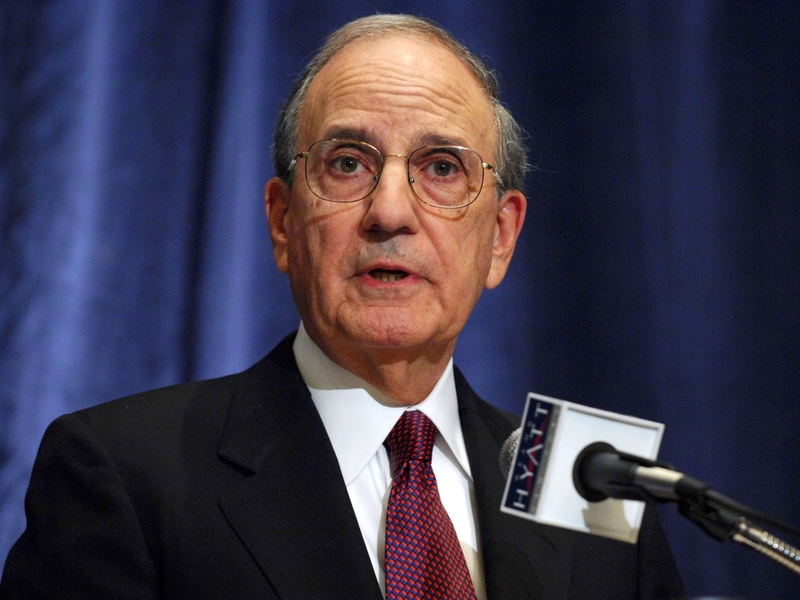
The new US Middle East peace envoy leaves tonight on a trip to the region to try to shore up the Gaza ceasefire to promote Israeli-Palestinian peace.
George Mitchell, a former US senator and a mediator who helped to resolve the Northern Ireland conflict, was named by Secretary of State Hillary Clinton last week to lead US efforts to end the six-decade-old conflict.
State Department spokesman Robert Wood said Mr Mitchell's trip, which will run until 3 February, aimed to consolidate the ceasefire that ended Israel's 22-day offensive in Gaza and to reinvigorate the peace process.
He is scheduled to visit Egypt, Israel, the West Bank, Jordan and Saudi Arabia.
Critics have faulted the Bush administration for what they viewed as its relative neglect of the Israeli-Palestinian conflict until its last year, when a US-backed effort to strike an agreement by the end of 2008 failed.
US President Barack Obama has made a deliberate effort to show that he is engaged on the issue from the start of his presidency, telephoning Arab and Israeli leaders on his first full day in office last Wednesday and attending the announcement of Mr Mitchell's appointment at the State Department a day later.
'The administration will actively and aggressively seek a lasting peace between Israel and the Palestinians, as well as Israel and its neighbours,' Mr Wood told reporters.
He said it was possible Mr Mitchell's schedule might change but, when asked if he might go to Syria, said, 'I don't believe that's planned at all'.
He also ruled out Mr Mitchell having any contact with Hamas, the group that rules Gaza and that the US regards as a terrorist organisation.
While on his trip, Mr Mitchell will seek to consolidate the Gaza ceasefire and to establish an anti-smuggling system to prevent Hamas from rearming, Mr Wood said.
Israel launched its offensive in Gaza in late December with the declared aim of ending Hamas rocket attacks on its southern communities.
About 1,300 Palestinians, at least 700 of them civilians, were killed during the offensive, while Israel put its death toll at 10 soldiers and three civilians.
Mr Mitchell will also seek to address the humanitarian needs of the 1.5m Palestinians who live in Gaza and to speed the reopening of border crossings into area, where Hamas seized control from the Palestinian Fatah faction in June 2007.
A U.S. official said Mr Mitchell will leave for Cairo tonight and then head to Israel for meetings there and in the West Bank on Thursday and Friday.
On Saturday he visits Jordan before flying to Riyadh, where he will have talks on Sunday.
He then travels to Paris and London before returning to Washington on 3 February to brief Ms Clinton and Mr Obama.
The official said Mr Mitchell hoped to visit Turkey, which has hosted indirect Israeli-Syrian peace talks, but this was not yet confirmed.
UK TV stations refuse to air Gaza appeal
Meanwhile, the BBC (right) and Sky are standing against intense popular criticism and refusing to air a charity appeal for the victims of Israel's offensive in Gaza.
13 of Britain's largest charities, who together constitute the Disasters Emergency Committee, have asked broadcasters to air an appeal this evening seeking donations for Palestinians affected by the conflict.
But the BBC and Sky, which have 24-hour news channels watched in the Middle East and have closely followed the three-week offensive, have said they will not broadcast the appeal because they do not want to be seen to favour either side of the conflict.
‘Our commitment as journalists is to cover all sides of that story with uncompromising objectivity,’ John Ryley, the head of Sky News, said in a statement on today, following the BBC's weekend announcement that it would not air the appeal.
‘That is why, after very careful consideration, we have concluded that broadcasting an appeal for Gaza at this time is incompatible with our role in providing balanced and objective reporting of this continuing situation to our audiences.’
Until Sky's decision, the BBC had stood alone against the appeal, drawing criticism from politicians, media commentators and the public, with 11,000 viewers registering complaints.
The Archbishop of York was one of those who complained, saying the money was not for Hamas, but for those who are hungry, sick, hurt or in need of shelter.
A Disasters Emergency Committee spokeswoman said she understood the BBC and Sky's decision but added: ‘Impartiality for us is meeting the humanitarian needs, which are massive.’
She said funds raised from the appeal, which will use television news footage to draw attention to the destruction in Gaza, would be directed only to Palestinians, and not to Israeli victims of Hamas rockets.
