


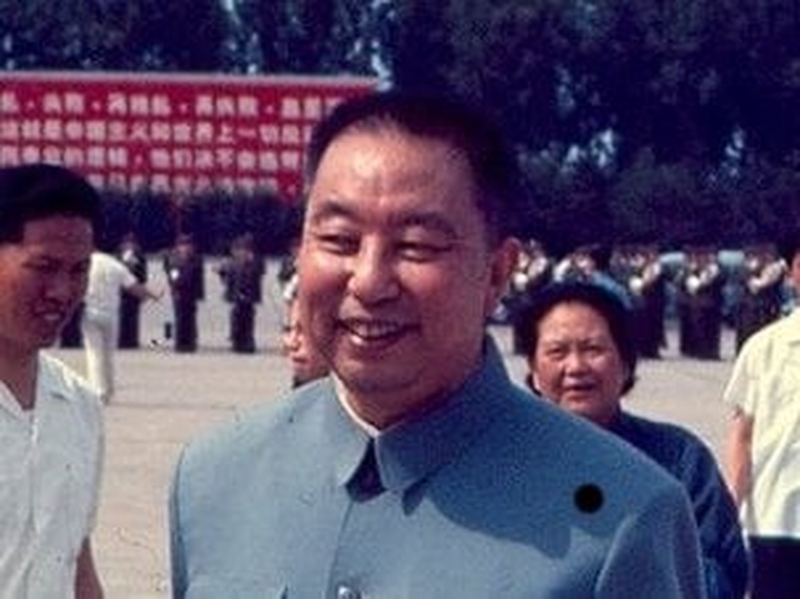
Hua Guofeng, Mao Zedong's successor as Chinese Communist Party chairman, has died. He was 87.
His death marked the passing of one of the last of an old guard of Communist leaders who had lived through the Mao era and helped ease the country out of the chaotic Cultural Revolution.
The official Xinhua news agency said Mr Hua had died of an unspecified illness that could not be cured at 12.50pm today in Beijing.
Hua Guofeng's short term in power was eclipsed by Deng Xiaoping, who re-emerged from political disgrace to take the leadership and lead China on a path toward economic reform.
Once fondly referred to by state media as the 'Wise Leader', Mr Hua became Communist Party chairman in September 1976 after Mao was quoted as saying at his death bed 'With you in charge my heart is at ease'.
Weeks later, he approved a military plot to arrest Mao's widow, Jiang Qing, and other members of her reviled Gang of Four who were blamed for Mao's excesses during the decade-long Cultural Revolution.
But after that he seemed indecisive. He embraced a so-called 'two whatevers' policy, imploring China to uphold whatever policies Mao had adopted and abide by whatever instructions the late chairman had made.
Hua was later accused of trying to build up a Mao-like personality cult around himself - he even had his hair styled in the same swept-back wave as the late Great Helmsman.
But before long, Deng Xiaoping was angling for power and the much younger Hua, who lacked the military's full backing, could not compete.
Born in the year the Communist Party was founded, Hua Guofeng, whose real name was Liu Zhengrong, then a county-level cadre, caught Mao's eye in 1954 as an effective yet idealistic agriculture expert.
Mao made him head of the Party office in Hunan province's Xiangtan prefecture, which has jurisdiction over Mao's birthplace of Shaoshan.
From there, Hua rose through the ranks. In 1959 he was made provincial Party chief. In the mid-1960s he weathered the early Cultural Revolution and was further elevated.
Finally, after Mao's second heir apparent, Lin Biao, died in a plane crash in 1971, Mao lined up Hua as a potential successor.
Hua was forced to step down as premier in 1980 and Party chairman the next year as reformist Deng Xiaoping took the helm.
