


Tributes have poured in from around the world for Nobel prize-winning Russian writer Alexander Solzhenitsyn, who has died aged 89 after a life devoted to exposing the brutal Soviet Gulag prison system.
Recognisable in later life by his flowing beard and ascetic clothing, he had been frail for several years and died of heart failure late yesterday.
'He had been ill many years, but nevertheless he was still able to work every day and he was of completely sound mind all this time, so his death, in fact, was sudden,' his son Stephan Solzhenitsyn said.
The author was working on corrections to a 30-volume set of collected works the day of his death, he said, adding that the family would treasure the many condolences they were receiving.
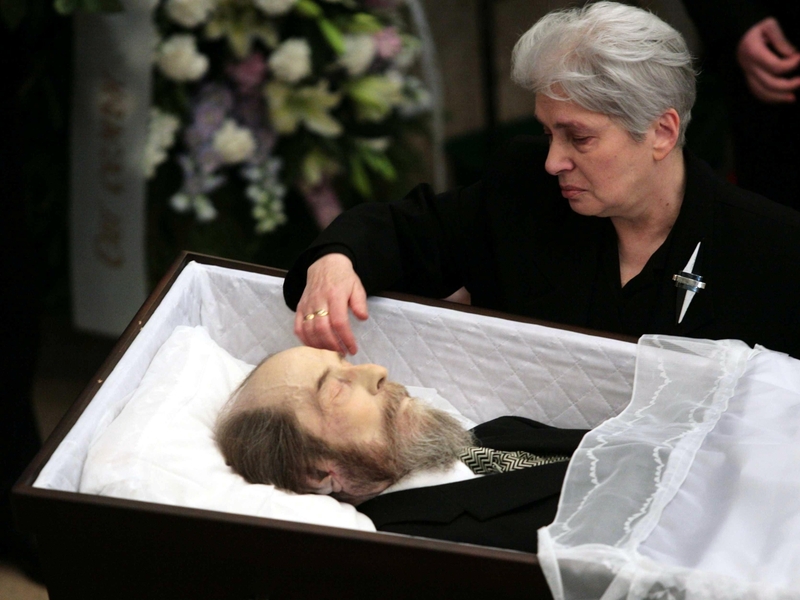
Alexander Solzhenitsyn's lying in state will take place at the Russian Academy of Sciences tomorrow ahead of his burial at the Donskoye cemetery in Moscow on Wednesday, an official from the writer's foundation said.
Some mourners left flowers by the wooden fence outside the dacha where he lived in the Moscow suburb of Troitse-Lykovo.
Russian President Dmitry Medvedev hailed him as 'one of the greatest thinkers, writers and humanists of the 20th century' and 'an irreplaceable loss'.
Mr Solzhenitsyn won the Nobel Prize for literature in 1970 after depicting in harrowing detail the Soviet labour camps, where he spent eight years from 1945.
He toiled obsessively to unearth the darkest secrets of Stalinist rule and his work ultimately dealt a crippling blow to the Soviet Union's authority.
His widow Natalya told Echo of Moscow radio that the writer had lived a difficult but happy life.
The Soviet Union's last leader, Mikhail Gorbachev, said Mr Solzhenitsyn's name will go down in Russian history.
'Until the end of his days he fought for Russia not only to move away from its totalitarian past but also to have a worthy future, to become a truly free and democratic country. We owe him a lot," Mr Gorbachev told Interfax.
Mr Solzhenitsyn played a key role in undermining Joseph Stalin's totalitarian regime, Mr Gorbachev said. His works 'changed the consciousness of millions of people, forcing them to think about past and present in a different way'.
In a telegram, Prime Minister Vladimir Putin said the death was a 'heavy loss for Russia', adding: 'We will remember him as a strong, brave person with enormous dignity.'
Russian Orthodox Patriarch Alexy II said he was 'talented and unique'.
French President Nicolas Sarkozy honoured Mr Solzhenitsyn as 'one of the greatest consciences of 20th century Russia', while German Chancellor Angela Merkel said he was a great and important writer.
Russian opposition leader Garry Kasparov called him an inspiration.
'The main thing I picked up from Solzhenitsyn was his experience fighting the system. And this knowledge is very helpful to me today,' he said in a statement.
On the streets of Moscow, older Russians voiced sorrow, but Mr Solzhenitsyn's passing had little impact on the post-Soviet generation.
'People are born, people die. I can't say I was beating my chest with grief, but I was sorry to hear about it,' sales manager Andrei Dryomov, 24, said.
'I'm very sorry to hear about (his death) because when it was forbidden to say things freely, he wrote 'The Gulag Archipelago', said Larisa Soshina, a middle-aged woman.
Born in 1918 in Kislovodsk in the Caucasus in the bloody aftermath of the Russian Revolution, Mr Solzhenitsyn was initially a loyal communist.
But he was sentenced to eight years in the camps in 1945 for criticising Mr Stalin in a letter to a friend.
He was released in February 1953, a few weeks before Mr Stalin's death and eventually became a maths teacher. He earned fame in 1962 with 'One Day in the Life of Ivan Denisovich'.
Published with official approval during the thaw under Mr Stalin's successor, Nikita Khrushchev, the book's description of the camps made a huge impact. But it was later banned and for decades Russians could only read clandestine editions of his work.
He was awarded the Nobel Prize in 1970 but refused to travel to receive it for fear of not being allowed to return home.
By then Mr Solzhenitsyn was working on his massive labour camp portrait, 'The Gulag Archipelago'. He was expelled from the Soviet Union in 1974 after the authorities discovered manuscripts of the book.
After a spell in Switzerland he moved to the US. He returned home in 1994, but found the new Russia was as alien to him as America had been.
In June last year, Putin awarded Mr Solzhenitsyn the State Prize, Russia's highest honour.
