

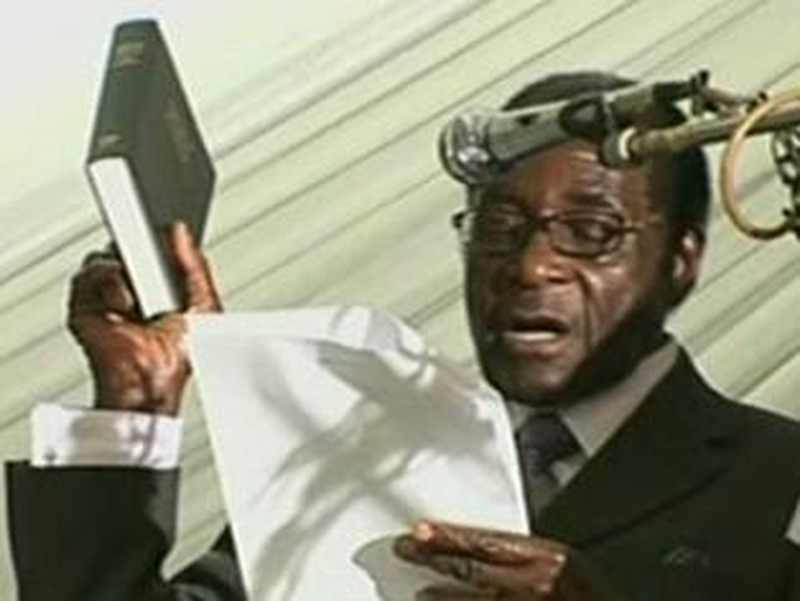
Zimbabwean President Robert Mugabe has been sworn in after being declared overwhelming winner of an election, which observers said was scarred by violence and intimidation.
Mr Mugabe was the only candidate and went ahead with the vote despite a wave of international censure. The US, which says it is preparing new sanctions, has called for strong international action.
Opposition leader Morgan Tsvangirai withdrew a week ago saying a systematic campaign of violence, which killed nearly 90 of his followers, had made a free and fair vote impossible.
The electoral commission said Mr Mugabe won 85.51% of the vote. He had 43.2% in elections in March, which Mr Tsvangirai won with 47.9%, short of the absolute majority needed for a first-round victory.
The commission said turnout was 42.37%, almost exactly the same as in March.
Human rights groups and witnesses accused pro-Mugabe militias of forcing people to vote in some areas.
Pan-African parliament observers, one of the few groups able to monitor the ballot, said it was so flawed it should be rerun.
The Southern Africa Development Community (SADC) observer mission said the poll had been marred by pre-election violence and did not reflect the will of the country's people, dealing a serious blow to Mugabe's legitimacy.
The regional group, which has stood by the veteran leader in the past, said the vote did not conform to regional election guidelines, despite voting on election day being peaceful.
The electoral commission released Friday's results in under 48 hours, compared to five weeks for the March poll.
Mr Mugabe, 84 and in power since independence from Britain in 1980, was quickly sworn in for a new five-year term in a ceremony on the lawns of state house, with a military band, marching honour guard and judges in red robes and white wigs.
Movement for Democratic Change (MDC) leader Tsvangirai rejected Mugabe's invitation to attend the swearing-in and dismissed it as meaningless.
Mr Tsvangirai added he would ask African Union (AU) leaders meeting in Egypt on Monday not to recognise the re-election.
Mr Mugabe says he will confront his African critics at the meeting and the quick inauguration enables him to attend with a new five-year mandate.
Mr Mugabe is under pressure from within Africa to enter talks with Mr Tsvangirai to end his country's deep crisis, which has ruined a once-prosperous economy with hyperinflation and sent millions of refugees fleeing into neighbouring states.
In an apparent response to that pressure, he said in his inaugural speech that he was committed to dialogue with the MDC.
Mr Tsvangirai said the opposition was also committed to AU-sponsored talks, although no negotiations had started.
The AU seems reluctant to back Western calls for sanctions, favouring instead a Kenya-style power-sharing transition.
The Egypt summit may be split between critics of Mugabe, like Kenya, and opponents of any action against him led by South African President Thabo Mbeki, who has been widely criticised for taking a soft line with his neighbour.
Mr Mugabe paid tribute to Mr Mbeki, describing him as a statesman. ‘Zimbabwe is indebted to his untiring efforts to promote harmony and peace,’ he said
Kenya's Prime Minister Raila Odinga was quoted as saying that the AU should deploy troops.
But AU security chief Ramtane Lamamra played down the prospects of peacekeepers being sent.
There was strong international reaction to his victory.
US Secretary of State Condoleezza Rice said ‘It is really now time for the international community to act strongly, but we are consulting about the measures that might be taken.’
German Chancellor Angela Merkel said ‘Mugabe has lost all his legitimacy as president. I would expect the Africa Union to take action at their meeting in Cairo... There's got to be an end to the suffering of the population that Mugabe's arbitrary style of rule as brought to untold victims.’
British Africa Minister Mark Malloch Brown said: ‘This is Mugabe against the world and that makes both sanctions and other political pressures much more plausible because they will be universal.
The former Archbishop of Capetown, Desmond Tutu, has called on the international community to intervene in Zimbabwe - militarily, if necessary.
In a BBC interview, the Nobel Peace Prize Laureate also said that the African Union nations should refuse to recognise Mr Mugabe as Zimbabwe's president.
'If you were to have a unanimous voice, saying quite clearly to Mr Mugabe ... you are illegitimate and we will not recognise your administration in any shape or form - I think that would be a very, very powerful signal and would really strengthen the hand of the international community,' he said.
'The Mugabe regime held a sham election,' said US President George W Bush, adding Washington would impose new sanctions as well as urge the UN Security Council to implement a travel ban on Zimbabwean officials and an arms embargo.
