

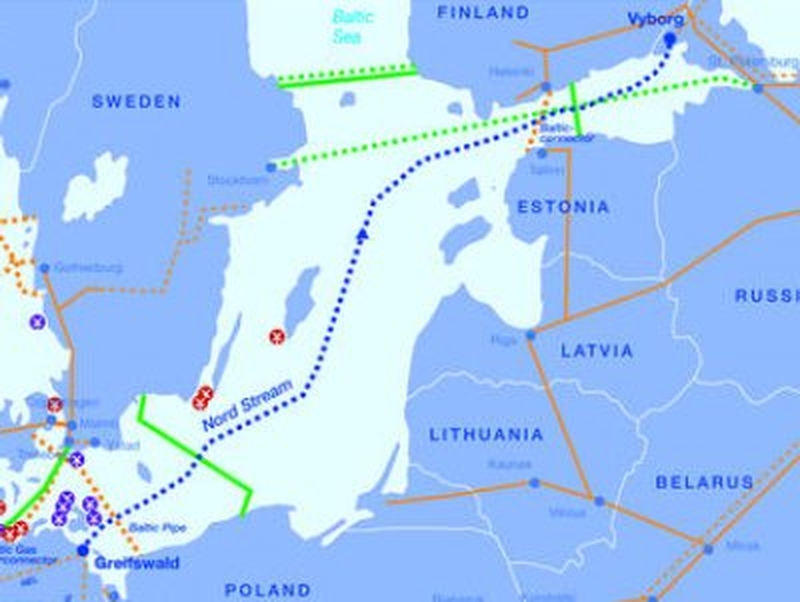
Gas giant Gazprom has hired the Russian navy to clear the Baltic Sea bed of dangerous, even explosive, ship wreckage for a major underwater gas pipeline to Germany.
'After a detailed survey of the relief of the sea bed, six major objects were found which had not been previously marked on navigation charts' said Russia's navy chief, Admiral Vladimir Masorin.
The six are four torpedo boats, probably with munitions on board, and two 'historical objects'. None of them are thought to be named 'Red October.'
The pipeline has sparked environmental criticism in some countries, with activists worried that construction work could cause damage to sea life, stir up poisonous material on the seabed or disturb unexploded ordnance left from World War Two.
Gazprom, known in Russia as 'a state within a state', is Russia's biggest company by market capitalisation and is viewed by the Kremlin as a key instrument of geopolitical influence. It is majority owned by the state.
Russia's parliament this month handed Gazprom the right to form its own armed units instead of contracting outside security firms.
The pipeline, majority owned by Gazprom, runs 1,200km from Vyborg on the Gulf of Finland under the Baltic Sea to Greifswald on the northern coast of Germany.
Germany's BASF and E.ON have minority stakes in Nord Stream, and have agreed to admit Dutch firm Gasunie as a fourth member with a 9% stake.
Nord Stream hopes to begin pumping 27.5 billion cubic metres of gas per year in 2010, with a second pipeline later doubling capacity to 55 bcm.
