


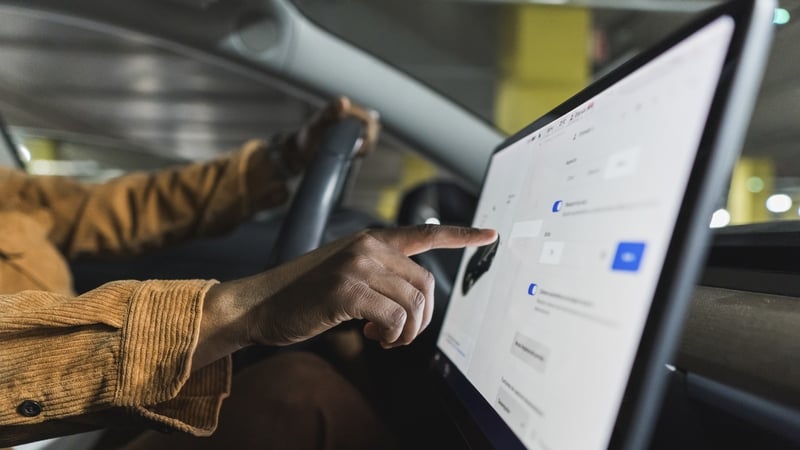

In the last few years, I've driven countless new cars whose functions were increasingly sophisticated in terms of their screen technology, which meant the virtual disappearance of physical buttons.
Then came the moment when I tried to adjust the wing mirrors of a car while driving on a motorway, and discovered the only way to do so was to dig into the screen menus and find the appropriate control.
This wasn’t just a distracting exercise - it led me to veer into the inside lane.

Car companies are now being forced to rethink this emphasis on attractive, but potentially flawed, tech.
Euro NCAP, the European crash testing and safety organisation, is now insisting that to achieve maximum safety ratings, car companies "must provide dedicated physical controls for core functions including indicators and hazard lights, windscreen wipers, the horn and SOS e-call functions".
In my view, all core functions, such as instant de-misting of a windscreen, should also be easily controlled without having to punch on a screen and being distracted.
Euro NCAP says it will now take into account "the placement, clarity, and ease of use of essential controls" after receiving much consumer feedback.
Even the boss of Volkswagen, CEO Thomas Schäfer, has had enough of purely on-screen controls.
"There was a spirit of iPhone-ish kind of design and utilisation that you could see coming through in many companies," he recently told BBC’s Top Gear. "It was a little bit difficult to get the designers off that idea.
"I said, listen, there are two things that are absolutely non-negotiable for me: door handles and buttons'. I don't understand why anybody would have [touch-sensitive] sliders."
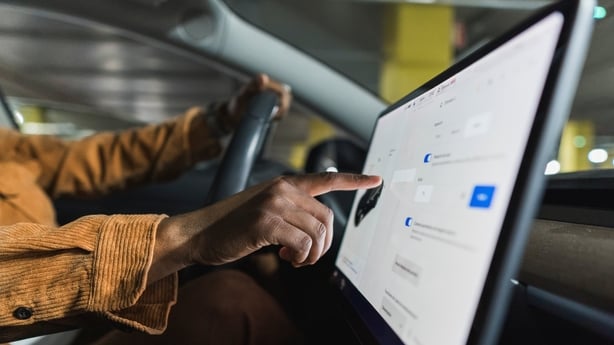
Politico, which covers EU affairs, reports that the matter has become a serious safety concern.
"What we now see is we have more and more ... crashes where people are having collisions because they're being distracted," Matthew Avery, NCAP's director of strategic development, told Politico.
Avery told the site that 'touchscreens and displays, along with other assisted-driving features, can distract a driver's attention from the road for anywhere from five to 40 seconds — with potentially fatal consequences.
He says if the displays don't have tactile feedback, ‘drivers can be distracted by having to poke at the screen — unsure if the controls are registering’.
"The problem with touchscreens is that there is inherently a lag in them, and more importantly, there is no haptic feedback. You spend more time looking at the touchscreen to verify what you've asked for is going to happen."
There is another serious issue with screen-only controls for countries like Ireland. Most cars in the world are engineered for left-hand drive, meaning the screen is controlled by the right hand.
For our right-hand drive market, the driver is usually using their left hand, as some 75 per cent of people are right-handed. This means that using your left hand to control functions is counterintuitive.
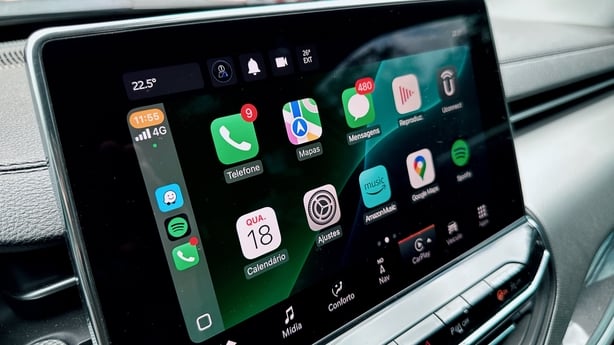
There is yet another issue. According to the American Academy of Ophthalmology, the right eye is usually the dominant one, and you are more likely to be right-eye dominant if you are right-handed.
This means that in Ireland and the UK, for example, it is your less capable eye that is looking at the screen.
The pushback against screen-only controls is now well underway. Expect to see a lot more buttons in cars from now on.
