


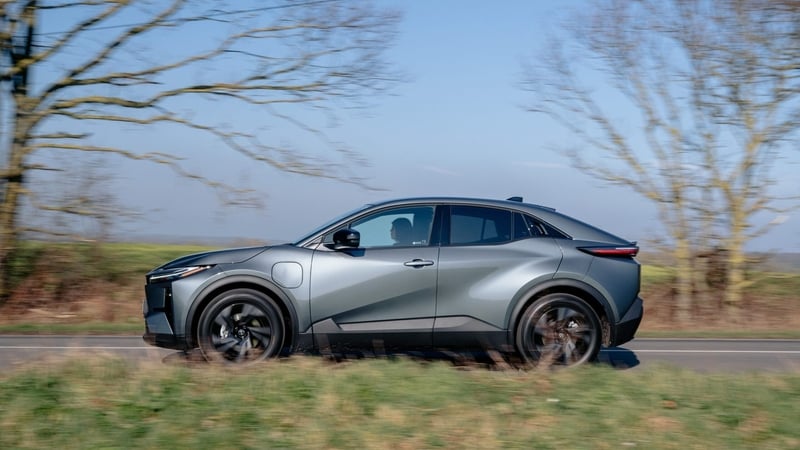

Remarkably, Toyota's new C-HR + is only the company’s second electric car. Years after other companies rushed into fully electric mode, Toyota has been conservative in its offerings by committing so much to hybrid technology.
After resistance to fully-electric from Akio Toyoda, the grandson of Toyota’s founder, who argued only two years ago that battery EVs would never account for more than 30% of global vehicle sales, "no matter how much progress EVs make", the mood has changed.
His successor, Koji Sato, has committed to introducing up to 30 EVs across the Toyota range, and the new C-HR+ is one of the first of that new generation of cars.
The C-HR+ is an interesting proposal because it stands alongside the current hybrid car of the same name, offering customers a continuing choice of either technology option. Thus, buyers can choose what suits their circumstances best and make the move to electric if they are ready.
Home charging is, of course, a prerequisite in order to do so, as it is to live comfortably with all EVs in Ireland.
It should be of interest to many current C-HR drives though.
When you look at the pricing for this new car, it’s an even more interesting proposal. The entry-level Sport version starts at €42,160, after grants. For a comparable Škoda Enyaq, you would be looking at about €47,000, and for a Kia EV, about €52,000.
The C-HR+ comes with an impressively large 77kWh battery. Sufficiently large, Toyota claims, to give you up to 606 kilometres of range, but the usual caveat about claimed ranges and real-world conditions applies here.
That said, during our introductory drive, an indicative average consumption showed the car to be using about 14.2 kWh on average per 100 kilometres, indicating that this car may stand up pretty well to its claimed average. We will wait to see, however.
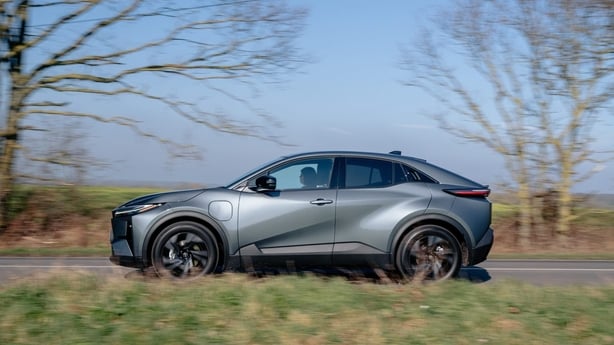
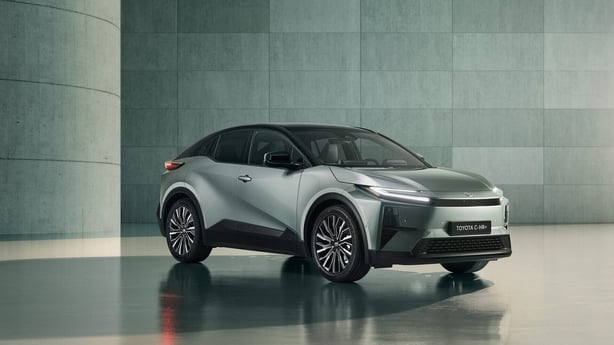
The design of the car is heavily influenced by its larger BZ sibling and the existing C-HR because it has elements of both - another indication of Toyota’s evolution rather than revolution philosophy.
It measures 4.6 metres long, 1.8 metres wide and 1.5 metres high, so it has a somewhat imposing profile, accentuated by sharp lines, recessed rear door handles, LED light bars front and back and a sloping roofline.
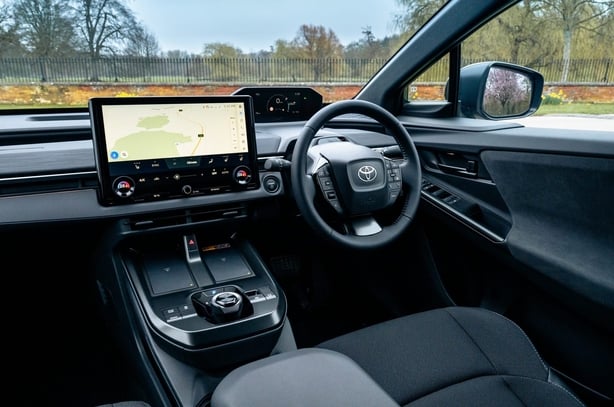
Inside, it is spacious and comfortable, but the roofline imposes itself a little for taller passengers in the rear. The cabin is dominated by a 12.8" infotainment screen, which has a much-improved operating system now and features crisp displays and functions quickly and efficiently.
The smaller driver display is challenged, however, by the smaller steering wheel Toyota has been using recently, because if you are a tall driver, you may find the wheel practically sitting on your thigh as you adjust your seating position to view the screen properly.
The screen brightens up the cabin, but I can’t help but wonder why Toyota doesn’t strive to lighten things up a little and therefore offset the effect of black or grey that is there in waves. A little coloured stitching across the dashboard would make a significant difference, as even budget brands like Citroen have shown.
Our drive revealed a well-balanced car that was firmly set up for cornering, even if the steering was deceptively light, and the ride quality seemed refined. It’s also quiet, and we had little wind noise to contend with.
There is a choice of 18" or 20" wheels, depending on whether you might opt for the Sport version or the Premium version, which starts at €51,840, but I thought the smaller wheels were the more appealing option. The Premium gets extras such as the panoramic roof. The Premium has a slightly lower predicted range of 549 kilometres, and that has a lot to do with the wheels.
Otherwise, standard equipment is pretty impressive. Along with Toyota’s full Safety Sense package (blind spot monitoring, pre-collision detection, rear camera, adaptive cruise control, automatic high beam and so on), you have things like two wireless phone charging pads, privacy glass and daytime LED running lights.
Toyota says charging on a home charger should take about 8.3 hours to reach from 10 to 80 %, four hours on a public 11kWh charger, 2.2 hours on a public 22 kWh charger and 30 minutes on a 150 kWh fast charger.
There is a five-year all-EV parts warranty and eight years, or 160,000 kilometres, warranty on the battery.
All in all, the C-HR+ looks like a very attractive proposal; it is very well equipped, and it is certainly well priced. I look forward to seeing that claimed range figure stack up.
