


Video by Leah Carroll. Words by Donal Byrne.
It was only after our brief drive in Kia's new K4 last week that I realised how long it had been since I drove a traditional hatchback.
What’s more, the K4 had a 1.0 litre engine matched to a manual gearbox, an increasing rarity on the Irish market, which is dominated by crossover design and automatics.
Kia seems to be catering to a slightly older cohort of customers with this car, which replaced the Ceed but is bigger than the Ceed, with a length of 4.4 metres.
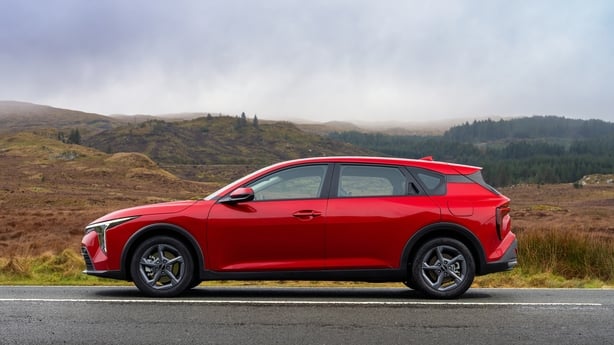
On the other hand, it just might be trying to catch some of the magic dust that Cupra has spread to this segment of the market because it’s possibly the nearest competitor to Cupra’s design creativity and appeal. This segment was traditionally dominated by more conservative cars like the Volkswagen Golf and the Ford Focus.
The K4, by comparison, is a lot sharper in its lines and slightly bigger than average wheel arches. It’s a very nice-looking car, with touches like rear LED lights in the shape of an inverted L and the recessed rear door handles.
It is also a more spacious car than its outward looks - such as the low bonnet - might suggest, and there is a very decent boot to make it an attractive option for families. There is also a starting price to add to that attraction.
The K4 starts at €31,500 for the 1.0 litre three-cylinder version, which has 115 horsepower output. It’s not exactly a firecracker, but it should be adequately suited to sedate urban driving. At the moment, there is only this one mild-hybrid engine version, but a 1.6 petrol hybrid is on the way.
The entry-level mild hybrid is well priced - an entry-level VW costs €34,630 and a Ford Focus €37,704.
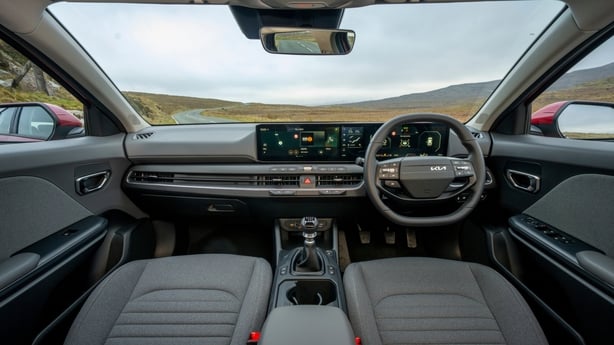
The interior is impressively familiar, with comfortable seats and nearly 30 inches of screen running along the dashboard. Of course, this makes it like every other car Kia has introduced in the last few years, but it still looks modern and attractive.
The infotainment screen is a 12.5" unit, as is the driver’s display screen. Curiously, the entry-level version has a two-spoke steering wheel, and the GT line has a three-spoke wheel.
And there are buttons - physical buttons - to adjust functions such as temperature. It’s a welcome move from yet another car manufacturer as more move back to buttons and away from sliders and screen menus to control basic things in the car.
Standard equipment includes 16" wheels, LED headlights, heated front seats and front and rear sensors, along with a suite of safety features.
