


Words by Donal Byrne, video by Leah Carroll.
Škoda has long been synonymous with value for money cars, but it was also a bit of a trailblazer with its RS performance models back in the day. The rather cheeky Škoda RS cars gave several established manufacturers with bigger budgets a run for their money in international rallying, to much surprise.
While the keen value for money appeal has lessened in recent years as Škoda improved and refined its offerings as part of the wider Volkswagen Group - it is now in the top five list of best-selling cars in Ireland - it hasn't let go of the RS badging tradition.
The latest Škoda model to get the RS treatment is the Elroq electric SUV. That a large EV would move to being a high-performance model seems a bit counterintuitive, as most EV drivers probably rate energy consumption as one of their priorities.
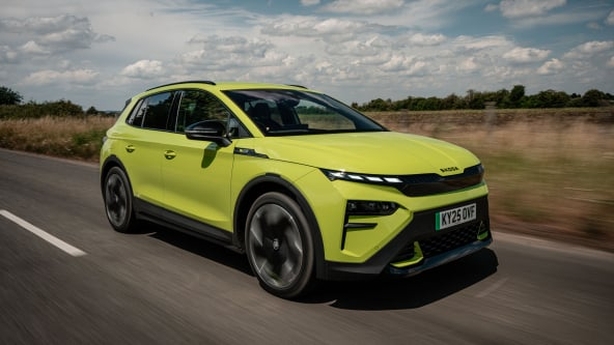
Not that the Elroq RS is a massive consumer of energy - it does quite well in the 450 to 500 kilometre range, as do its VW Group siblings - but it has to shift significant bulk.
The car weighs over two tonnes, is 4.6 metres long, 1.8 metres wide and 1.6 metres high. Those figures do make it a rather energy-hungry prospect in urban driving conditions, and it takes a bit of non-urban driving to iron out the best overall consumption figures.
The RS version also has four-wheel-drive as standard, something mostly urban drivers won’t need very often, and there is a weight factor involved also.
The fact that it doesn't have a heat pump, which helps greatly with consumption in colder weather, as standard, is a surprise. Kia’s EV 3, for example, would not be found wanting in this regard.
Its dimensions mean it is a spacious and comfortable car to drive. One of the RS touches is the fact that the rally-style bucket seats, which are high, are very comfortable, as are the rear seats.
Like the standard Elroq, it’s a pretty ideal car for family driving, as long as you moderate your use of the accelerator. Soft faux suede is used in abundance, including across the top of the dashboard.
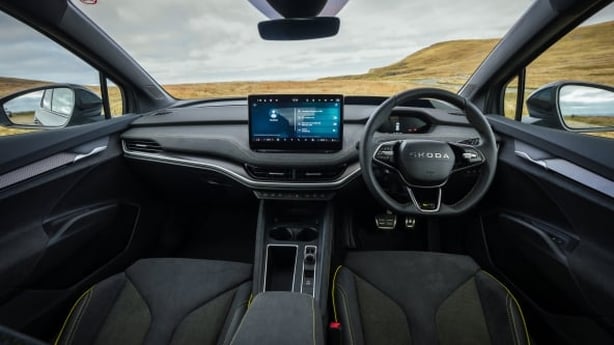
There’s a 13" centre screen, which has a very decent display, but the smaller driver’s information display is a bit too small. I found myself having to squint in poorer light to read it. The smart dials found on other Škoda models seem to have been dispensed with here, which is a pity.
The 84 kW battery delivers in terms of performance, but just about manages to power the car’s weight. The overall comfort levels are impressive, though, and give the car a strong appeal. The 21" wheels on the car I drove proved a little harsh for Irish road surfaces, and the 20" option would be more appropriate.
The list of standard equipment is both lengthy and impressive, with everything from three-zone air conditioning, four USB charging sockets, a 360-degree camera, emergency braking and pedestrian detection, head-up display, LED Matrix headlights and even aluminium sports pedals.
Whether any family car in Ireland really needs four-wheel-drive is a debatable point, but it certainly doesn’t need it on a regular basis.
Which brings us back to the standard Elroq, with a 63 kWh battery. It starts at €43,790, while the RS starts at €61,470 for the car I drove.
The basic Elroq is one of the best electric family SUVs around and has an achievable range of over 400 kilometres. It’s big, comfortable and cleverly laid out.
The price difference here of €17,680 is an appreciable one.
The views expressed here are those of the author and do not represent or reflect the views of RTÉ
