


Words by Donal Byrne, video by Leah Carroll.
There are some who think the latest iteration of the Toyota Land Cruiser isn't quite innovative enough looking, but that is rather to miss the point.
This is a vehicle - especially when looked at in a global perspective - designed and built purely as a workhorse that is as likely to be found in the world's most challenging environments as it is on an Irish farm.
You don't look to a Land Cruiser for its looks or levels of refinement because, quite frankly, both are just about relevant with the commercial version at least. Aesthetics are not as important as what a Land Cruiser is expected to do best - tackle almost everything that a wild terrain will throw at it and still keep going.
The main requirements for its owners - and the customer base is quite specific - are durability, reliability and off-road capabilities. Such are these characteristics that I've previously noted. Someone selling a good second-hand one can practically auction it, such is the demand.
The Land Cruiser holds its second-hand value way above other brands because of that dependability and longevity, as the parking area of any mart in the country will attest.
Almost all sales of the latest version will be commercial versions, with farmers, vets, self-employed people in the construction industry and people whose hobby or business involves horse boxes among those most likely to be customers. Towing capacity is a major consideration, and the ability to haul some 3,500 kg is among the vehicle’s attributes. Plenty of storage space in the rear is another.
This is the fifth generation of the vehicle - it’s been around for 70 years, believe it or not - and Toyota has been careful not to tinker too much with the fundamentals. It has, however, been given a retro-modern styling to reflect its heritage and is a deal slimmer than its predecessor.
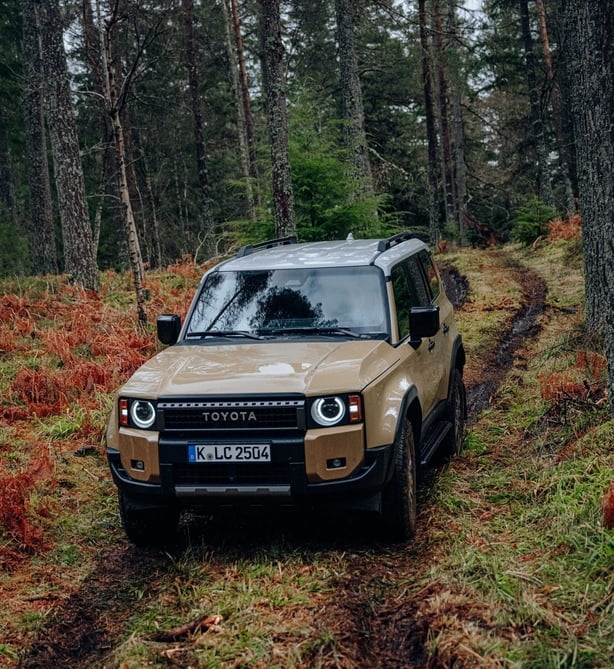
With virtually every commercial Toyota still powered by diesel, the Land Cruiser is no exception. The engine is the 2.8 litre four cylinder unit with 205 horsepower and already shared with the Hilux. Some might argue that a six-cylinder might have been a smoother option and that this one may have some gruffness, but it’s more than adequate for the job.
Smoothness is one of the surprising attributes on tarmac, when the Land Cruiser isn't going about its more challenging work.
Electric power steering is now a very welcome innovation, and it gives the vehicle a precision it didn’t have before.
The essence of the vehicle is its off-road capability. It has full-time four-wheel drive, which adds to consumption - the best consumption averages out at about 10 litres per 100 kilometres - but that full-time system makes it remarkably sure-footed.
Even without engaging its extra capabilities, the Land Cruiser can deal with conditions that could be considered extreme without much effort. When you engage what is called "Crawl Control" - used when making a steep ascent or descent, the vehicle begins to work independently.
All you have to do is steer in these conditions - keeping your feet off the brakes and accelerator - while the system tackles obstacles or very rough and muddy terrain. You can hear it judge the conditions wheel by wheel as it makes its way forward - rather like an expert rock wall climber, gaining traction all the time. If you're a lone farmer in a tricky situation, it is reassuring.
Most of my driving was with the commercial version, and such are this vehicle's abilities that very little is beyond its range. Rivers, rock-strewn tracks, mountain trails and mud have all been part of the vehicle’s testing regime, and the result is a bit of a marvel of engineering.
On normal roads, the Land Cruiser can be a slightly wallowy, but it was only when I got back into the older version that I realised how much had improved with this version.
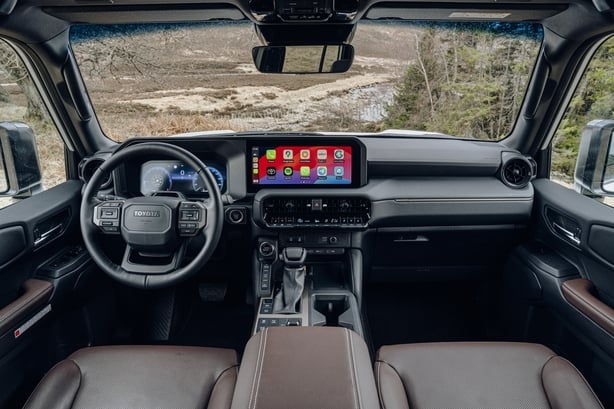
The interior has also been given quite an upgrade, but at least with the commercial version, it's still a utilitarian space. There are now digital screens with a touchscreen for main functions. There are, however, a number of very welcome physical buttons. Trying to navigate tricky conditions while scrolling through screens can be avoided.
Some parts of the driving menu can be a little hard to read at times - especially with the sun behind you - but they’re not functions you’ll be changing all the time. A bigger touchscreen than the 9" one that is standard on the commercial would also be welcome. You now get your Apple/Android connection too.
The seating position is even more commanding, and up front is now a very comfortable place to be. On the commercial version, however, it could have a tad more driver seat travel for the taller driver.
Interestingly, a new eight-speed automatic gearbox - with two gears more than before - has now replaced the manual one and is well-mated to the engine for smoothness of power delivery.
All this comes in at €57,192 for the commercial version, after the VAT rebate
There is a passenger version that comes in at a rather ridiculous €140,830 because of a corresponding VRT rate of 41% and there has been some demand for it, but this is a vehicle for work, rather than play.
The views expressed here are those of the author and do not represent or reflect the views of RTÉ
