

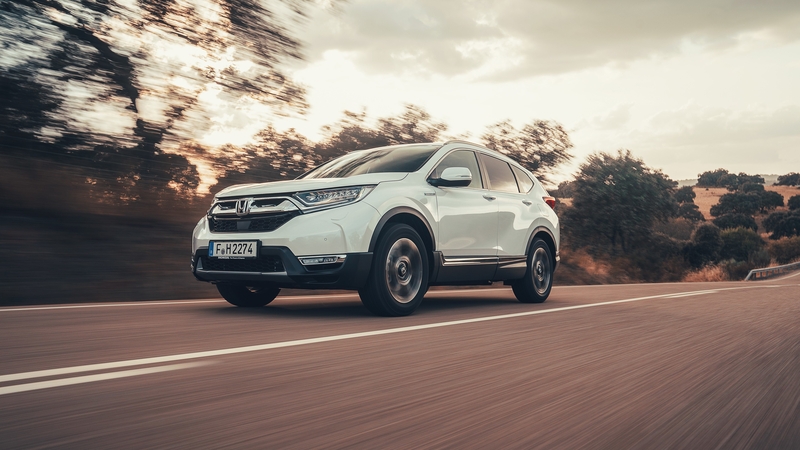

The technology behind Honda's new hybrid SUV is complex but it's intent is straightforward - moving away from diesel. Our Motoring Editor, Donal Byrne, has been driving it.
Explaining in detail just how Honda's latest drive system works would be one way of distracting you from understanding whether or not it is as revolutionary a system as Honda might like you to think. Or whether it is the kind of technology that might encourage you to spend appreciably more on a hybrid car than you might want or need to. Or whether its benefits in terms of cleaner and greener motoring put the new Honda system ahead of its competitors.
So let's explain the system simply. Honda describes the latest version of its SUV as "an electric car with a petrol engine." (Now you see where the complexity and contradiction emerges.) It has a 2.0 litre petrol engine, a battery and two motors, allowing it to move from pure electricity to hybrid to petrol. So is it an electric car ? Certainly not in the conventional sense, as its pure EV mode capacity is less than a few kilometres. Is it a hybrid ? Yes, for most of the time. Is it a petrol-powered car ? Occasionally and depending on the weight of your foot on the accelerator. Thus you move from one to the other and the mode is determined by a power control unit.
A key element of the system is that there is no gearbox - essentially only one gear us used and engine speeds are managed. Again engine speeds and gearing are being managed for you.
When you set off, the EV mode has you purring away and the move into hybrid is pretty seamless. There is very little noise and this is the case in most driving circumstances. If and when you hit the accelerator hard then that's when the noise becomes a bit of a din. However, driving cars like this is a bit of a learned experience, as is the case with most hybrids and automatics. If you want to get the best out of them then you need to be a good deal more relaxed in your driving style. Otherwise, it is not the most satisfying experience, with the car labouring under acceleration for which its engineering is not geared. The optimum for the car's engine is when it is running at between 1200 RPM and 2800 RPM, which illustrates where the middle of the road style of driving comes in most efficiently.
While all the whirring and hybriding were going on, I was keeping an eye on the consumption. This triple-powered driving resource seemed to offer the promise of some very keen fuel returns. Driving the 2.0 litre petrol version offered about 6.9 litres per 100 km (40 MPG is old money), while the all-wheel drive version averaged about at 7.3 litres per 100 KM. These are not hugely impressive figures. Admittedly, the CR-V is bigger than a Prius and the Toyota CH-R, which offers about 5.2 litres per 100 km consumption, or 54 MPG. But then you will have to ask whether the smaller CH-R might just suit your needs and whether you need that bit of extra space.
Then there is the price. The entry-level Honda comes in at €38,000 and goes up to €43,500 for the elegance version. The entry level four wheel driver version starts at €43,500. Honda cars don't come cheap but they do have a reputation for reliability and excellent second-hand values. However, there is a premium on the price.
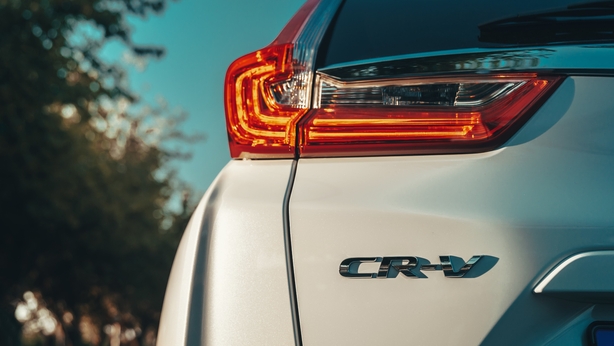
Styling is intended to satisfy all markets.
The CR-V is a car with a global influence in its design. Honda is a relatively small company with an international reach, so what it produces has to appeal to many markets. It has a big presence on the American market and you can see the CR-V fitting in very well in a country that is quite conventional in its choice of family cars. I did like the styling of the new car, but it's not in any way radical and very much continues the character of the original. You'll know it's a Honda, which is perhaps the whole point.
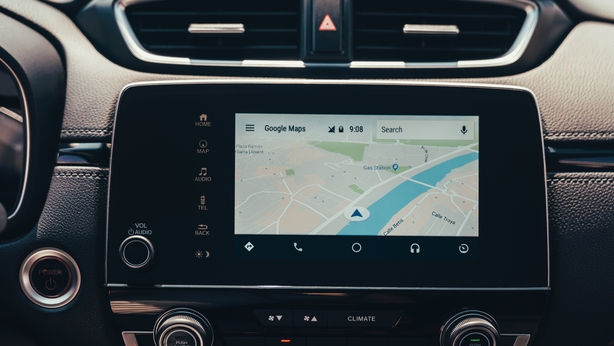
Display and graphics are a little dated.
The new CR-V is also a bigger car than the one it replaces, although the boot space has been reduced slightly to accommodate the battery and hybrid technology. The cabin is well finished but it's not exactly space age and the graphic display shows how the budget was eaten up by the driving technology as distinct from the finish.
There is plenty of space for four adults, with the middle rear seat a little cramped. It rides very well but the handling can be a little soft, as can be the steering. Again, these are characteristics of many family cars in the U.S., so they are not unexpected. Nor are they a major source of complaint for a car like this.
By 2025 Honda says two thirds of all its vehicles will be electrified in some form or other and the new hybrid is a sign of what is to come. The next time you will see this type of technology is when the new Jazz comes on stream. It is ironic that hybrids are not favoured by Government policy here. The State wants only electric cars on the road in the future and is adamant that cars - even partially powered by petrol or diesel - are not part of the long-term plan.
We'll have more on the CR-V after a lengthier test drive.
