


It's been awarded the prestigious European Car of the Year title but how did Volvo's new XC 40 compact SUV deal with Storm Emma? I sat into the driving seat to find out.
It was fortuitous that as Storm Emma began to bite, my appointment to drive it coincided with some pretty challenging driving conditions. What better time, then, to discover whether Volvo's new compact SUV was of such outstanding ability as to be named European Car of the Year ? It emerged as winner from a fairly impressive long list and on that list were a number of compact SUV's - now the type of car that is replacing the traditional small family car - so what made the XC40 stand out to the extent it did ?
It has been described as funky and is said to by its designer to have been inspired by the kind of modelling applied to small robots. Which leaves us where, exactly ? Given that this car is almost more important on the Chinese market than anywhere else (Volvo is now owned by the Chinese giant, Geely, and the car, incidentally, is built in Belgium) the design is a curious mix of traditional Volvo styling and an Eastern theme. The design is not the car's strongest point, for sure, but it does have a sufficiently strong Volvo character to it, especially at the rear. It could have been far more adventurous though but that is clearly not what was thought appropriate for global appeal.
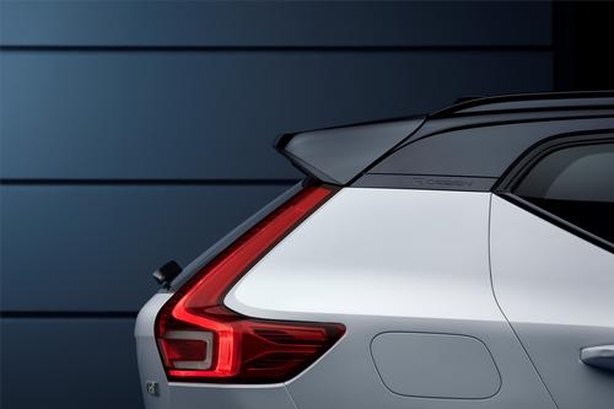
The rear design elements are strongly Volvo in character.
In terms of Storm Emma, what marked the car out was that it had full-time four wheel drive, which made things an awful lot easier. Most compact SUV's don't have this capacity, even though their styling suggests they are capable of more than they actually are. The XC 40 pretty much sailed around in moderate to serious conditions but there was'nt a point I reached where even four wheel drive was stopped in its tracks by threatening snow drifts. With a few inches of snow there was'nt ever a serious loss of traction, even with underlying icy layers. It made me think how much more impressive it could be with winter tyres fitted. So, the Volvo came through where other compact SUV's would never have and was more than able for the occasional snow storms we get in this country.
What I liked most about the car, however, was its ease and comfort of driving. A long list of extras not fitted to the standard car were featured on the R version I drove, which had heated leather seats and even a heated steering wheel. The extras do mount up, however. The entry level XC40 comes in at €38,900 but all the extras fitted to the R, which as a more sporty driving dynamics set up, brought it up to a very hefty €63,425 and that is an awful lot of money for a compact SUV. The Park Assist package, for example, has a truly impressive 360 degree camera that looks like it is giving you an overhead drone view of everything sorrounding the car, but the pack costs an extra €1,500.
The version I will be keeping a close eye on is the three-cylinder hybrid due out next year.
The automatic gearbox is fluid and ideally matched to the 190 horse power diesel engine. The automatic gearshift also has a feature that makes you do not inadvertently select the wrong gear - it's a little frustrating at first and takes some getting used to but it's a neat system.
You do have the option of paddles on the steering column to shift but they are seldom, if ever, necessary. There is plenty of power on tap and a 0-100 KPH time of just under eight seconds. Volvo diesel engines are solid but they can be a little thrashy when opened up, which is also the case with the XC40.
The car will smooth out the bumps well but you are conscious of the weight of the car doing the absorbing. There is a good sense of control when you push the car and ride quality is very good. I'm not a fan of the R Design harsher suspension and could have done very well without it.
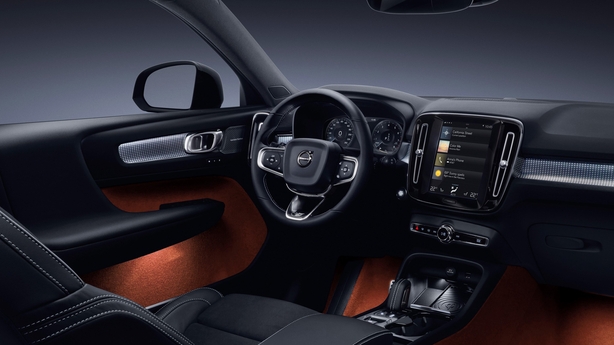
The interior layout and infotainment screen should be looked at very closely by Volvo's competitors for its practicality and functionality.
Inside, the car benefits from the large format infotainment screen we saw first on the XC 60 and the XC 90. This is a big, practical and intuitive screen that sets the benchmark for such systems. The swiping is easy and not at all over-sensitive. Other manufacturers should take a really close look at at before committing to their own systems, which are often just frustrating and not precise to use.
The seats are excellent but you will still only get two in the back with comfort. The boot is 460 litres, which is not the biggest around, but is more than capable of taking a very good load indeed.
Fuel consumption came in around 8.8 litres (32 MPG in old money), which is not at all bad for a car as heavy as this one and some of the driving was done in off-road mode. Long distance driving was not an option during the bad weather but the car should do even better on fuel at cruising speeds.
In short, the XC 40 was a sheer pleasure to drive. More maneuverable than the bigger XC 60 or the 90 and with a much more practical footprint, it had the best of compact qualities about it. Standard equipment includes the Volvo City Safety technology pack, which can detect a pedestrian or a cyclist. You will also get as comprehensive a list of safety equipment as is on the market currently. I'll pass on the harsh suspension of the R Design version because I'm already saving up for the hybrid version.
