


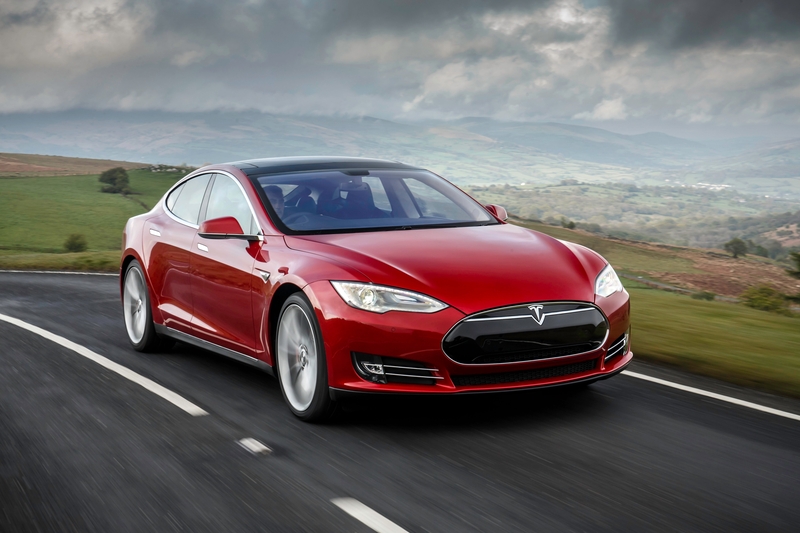
To those who see more attraction in high technology and green living than exhaust fumes and engine noise, on paper it sounds like possibly the perfect car.

The Tesla Model S
The Model S is the much vaunted sedan from US manufacturer Tesla, that has (in headlines at least) blazed a trail in the evolving story of electrically powered and partially-automated vehicles.
The car has been on sale in the US for four years and is gradually becoming available in a number of other countries around the world, including here in Europe.
Occasionally, the odd one can be spotted on Irish roads, most likely imported from the UK where the company has a growing presence.
Last month, however, Tesla founder Elon Musk tweeted that the firm will start selling in Ireland during 2016 – though the manufacturer won’t yet say when or where.
But a clear indication of its intent to take on the Irish market came this week with the company bringing four Model S cars over from the UK for Irish journalists to test drive.
So what is it like?
From the outside it has the appearance of a slick but fairly typical premium executive hatchback – not all that dissimilar to a Jaguar XF for example.
But tug the zero profile door handles, which slide out automatically when the key is nearby, and you open up an entirely modern style interior.
The first thing you notice is the lack of clutter - the cabin space is minimalist in the extreme.
The high-spec red 90D we drove had a smart all leather tan interior, with a large open storage well situated between the driver and passenger seats.
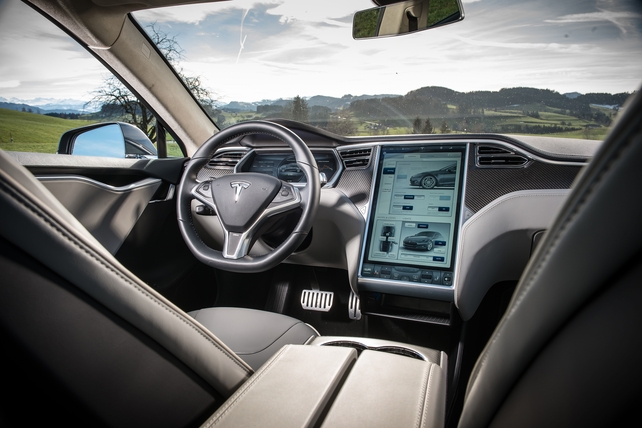
The plush interior
It was also fitted with an optional front and rear panoramic glass roof, which made the interior feel bright and airy.
The boot on the model we tried contained two more optional pop up rear facing seats to make it into a 7-seater, but there was still more than adequate luggage space.
Because it’s electrically powered, there’s also another smaller storage space under the bonnet where the engine would otherwise be.
There are just two buttons on the dashboard – one for opening the glove box, the other for the hazard lights.
Everything else is operated through the enormous 17 inch touchscreen which takes up the entire centre console of the dash.
In the relatively short period we had with the car, the user interface seemed simple and straightforward to use.
Through it you access and operate the AM/FM/DAB+ radio, online radio, recently added Spotify streaming service and USB and Bluetooth connected audio devices.
It’s also the home of the Google Maps powered mapping system and GPS navigation, as well as the HD reversing camera and calendar.
Personalised seat settings and other preferences can be recorded through the touchscreen, and it’s also the hub for climate and cabin controls as well as the energy consumption and range monitoring system.
The Model S is essentially a powerful and sophisticated internet connected electrically powered computer, on wheels.
That computer is always online via a (subscription free) 3G connection, and periodically the operating system will automatically download and install over the air software updates.
The car comes with a range of other premium features you’d expect with such a price tag – like twelve-way power adjustable heated front seats, and safety features like front and side collision avoidance, as well as blind spot and lane departure warning.
And speaking of safety, the car also scores a perfect five on the Euro Ncap safety tests.
So far so good then, on appearances and comforts at least. But how does it drive?
The first thing you’ll notice, unless you are used to driving an electric vehicle (EV) or hybrid, is the noise – or to be more precise, the lack of it.
It is, as it should be, very quiet at all speeds.
The second is the head jerking acceleration when you put your foot to the floor.
The Model S is an all wheel drive vehicle - though the entry level model , the 70, does come in a rear wheel drive option.
The 90D comes with a 259hp motor front and rear, producing a combined 417hp of power.
The net result of the combination is 485lb-ft of torque, which can propel the vehicle from 0-60 mph in 4.2 seconds, and carry it to a top speed of 155 mph.
The top of the range model, the P90P with optional “Ludicrous Speed” upgrade , takes it to another level – packing up to 532hp, and pushing it from 0-60 in 2.8 seconds.
Range is the car's standout feature when compared to other electric cars, with Tesla promising that the car can make it up to 340 miles on a full charge, depending on the driving style and temperature. No range anxiety, then.
Using a Tesla Super Charger station (not yet available in Ireland, and the company won’t reveal its plans in this regard), the car can be charged to a level that will give it 170 miles of range in 30 minutes.
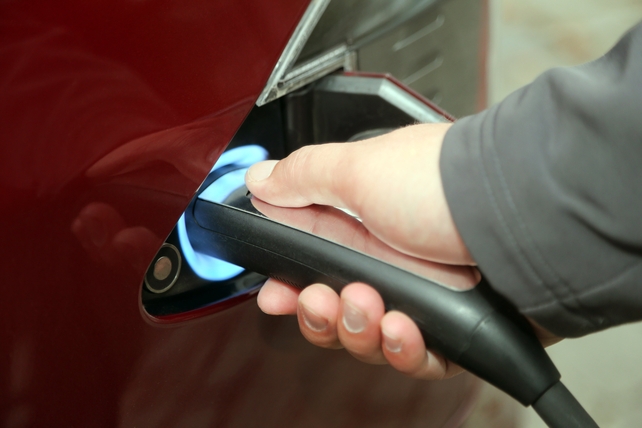
The Model S can use the ESB’s network of charging points, but the charge time will be slower.
The drive is solid and smooth – punctuated only by the slightly severe feeling regenerative braking system, which takes a little getting used to.
The real fun starts, however, when you engage the Auto Pilot function.
Since late 2014, all new Model S have been fitted with sensors, radar, cameras etc necessary to allow the company start to introduce certain semi-autonomous driving features.
Last October, Tesla announced it was starting to push out the software updates enabling that hardware to work.
The result is a suite of convenience and safety features that allow the car to guide itself in certain conditions, while all the time still under the ultimate control of the driver.
It can detect parking spots and self parallel park, maintain itself at a preset distance from the car in front using traffic aware cruise control, automatically centre itself in a lane and change lanes with the flick of the indicator and even steer automatically.
Tesla recommends that the latter feature is only used on motorways with good line markings, as the vehicle maintains its position on the road using them.
It’s not designed for use in built up urban areas, where lane markings are not consistent.The car can recognise and adapt to speed signs, buy doesn’t react to traffic lights or regular traffic signs.
Tesla says Auto Pilot is as much about safety as it is about convenience, relieving drivers of the most tedious and potentially dangerous aspect of road travel.
It’s at pains to point out, however, that the car is not autonomous or self-driving.
The drivers’ hands must remain on the steering wheel at all times, and if they are removed the pressure sensors will activate an alarm and eventually disengage the Auto Pilot.
The driver can disengage Auto Pilot themselves at any stage by touching the brake, turning the wheel, or pressing the button on the end of the Auto Pilot stalk.
And that’s a critically important point, because current road traffic law here presumes that a mechanically propelled vehicle is being driven by a person.
It’s hard to describe the feeling of driving with Autosteer engaged though.
As you corner with your hands on the wheel, and feel that wheel move in your hands by itself, you are torn between feeling sheer terror and laughing out loud.
Using it for the first time it’s difficult to know when you should intervene and when you shouldn’t - although that insight would no doubt come with time and experience behind the wheel.
Changing lanes using the AutoPilot is similarly nerve-wracking.Once you activate the indicator, the car will look for hazards around it before it moves. But you as the driver in control also have to look around you as normal, because the vehicle might not spot another one coming from behind at high speed, for example.
It’s hard not to wonder whether it would be easier to relax in a fully autonomous vehicle.
After all, this halfway house offered by the Tesla means you are still in control and fully responsible for the vehicle, even though it is debatable as to whether you completely are.
Personally speaking, this correspondent can’t wait for fully self-driving cars to arrive on our roads.
For safety, convenience and efficiency theoretically autonomous vehicles will have many advantages.
But much has yet to be worked out.
The technology needs to be perfected – something Google and other leading manufacturers in the space say won’t happen before 2020.
Road traffic law here is grey when it comes to self-driving vehicles, and will require a thorough overhaul to prepare and future-proof it for the inevitability coming down the road.
Insurance companies and car manufacturers have much to discuss when it comes to working out liability.
With so much data passing between vehicles, manufacturers and other parties, data protection concerns will have to be overcome.
And with the cars themselves so dependent on software and internet connectivity, security will have to be of paramount importance to prevent hacking.
But these are issues which can and will be addressed.
The experience of driving a Tesla Model S has underlined in my mind, however, that the single biggest hurdle to be overcome in all this is that of driver perception.
And that will be no easy task.
The Tesla Model S starts at stg£58,000 new in the UK for the entry level rear wheel drive 70 model, including VAT but excluding extras like Auto Pilot, Smart Air Suspension, Rear Facing Seats, certain paint finishes, interior packs etc. Irish prices are not yet available.
Comments welcome via Twitter to @willgoodbody
