

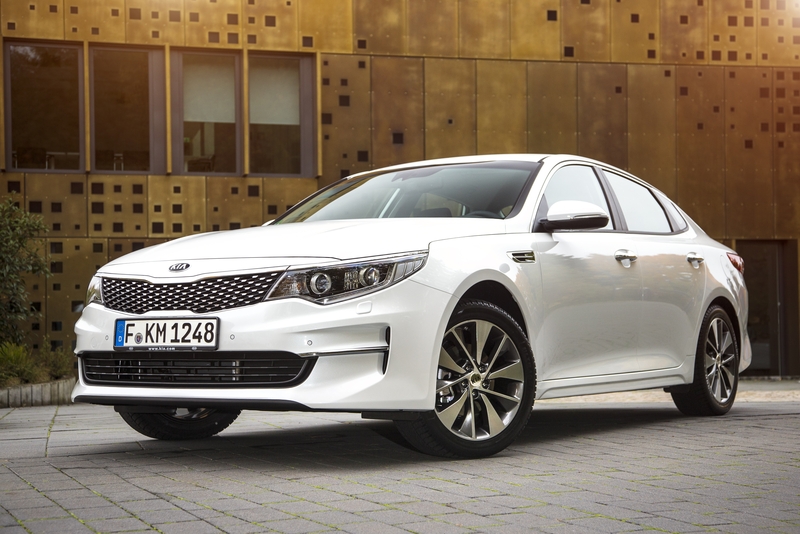
Looking at the new Kia Optima and the Hyundai 140, it’s difficult to appreciate how closely related they are – both being produced by the same parent company in Korea. Yet, Hyundai seems to be the favoured sibling when it comes to promotion and sales profile. The new Optima is a project designed to tilt the balance a little more in Kia’s favour and will be launched in January.
It certainly deserves to, as it is a better looking car than the i40 and can even put it up to the bigger and more established names when it comes to specification and spaciousness.
The logic behind the Optima’s design is to offer a premium car at reasonable prices. The Optima does’nt quite manage to pull this off.
There is an undoubted feeling of space and comfort when you get into the car but you won’t have a real feeling of premium build quality when you get out of it. The same, however, can be said of many Japanese and Korean cars that feel less solidly constructed than their European counterparts.
When it comes to price ‘though, these cars can have a real advantage. The entry level 1.7 diesel – an improved version of an existing unit – may not be the most refined, whether from the external or internal perspective but it delivers plenty on the open road. It goes on sale in January at Euro 27,950 with 17” alloy wheels; a 7” navigation screen; lane assist; half-leather seats; cruise control and LED lights.
The car drives well in the city but one is conscious of a slight thrashing from the engine that settles down on motorways, though is still noticeable. Also noticeable is the vagueness of the steering when it is compared to that of competitors. Otherwise, handling and grip are good and more assured than one might expect. The use of more high-strength steel has given the car a more rigid feel.
What gives the Optima an advantage is its presence on the road. It looks long and low and it has quite a sporty profile. On the inside, the dashboard has a slightly slab-like profile and stitching that runs along the moulding could have been used and highlighted more effectively to give it a quality feel.
The interior space is generous and does help to add to the Optima’s quality credentials. Adding 10 mm to the length of the wheelbase and re-shaping the seats has allowed for much more legroom for rear seat passengers. The wider body and higher roofline have also added to extra space and comfort. The boot is also generous though it won’t match the Skoda Superb for cavernous capacity.
The 1.7 diesel engine will be the standard and only offering for the Optimum on the Irish market, the other option being a redundant 2.0 litre petrol. It will be available in three levels of specification. The second level will have full leather seating; heated memory seats and xenon lights. It will cost Euro 31,450. A third level of specification will offer extras such as a full sunroof; 10 speakers; smart key and an 8” screen. It will cost 34,450. Wireless phone charging is only available on automatic versions to allow the phone to sit in a console-mounted charging bay, though there must be a way around this for the convenience non-automatic drivers.
The Optima has come a long way from its humble first generation and its new looks should certainly be able to attract new customers, as will the level of standard equipment. It is’nt a Jaguar but it does’nt have a Jaguar price tag either. Nor is it a Passat or Skoda Superb but it is no longer as far behind them either.
Donal Byrne
Motoring Editor
