


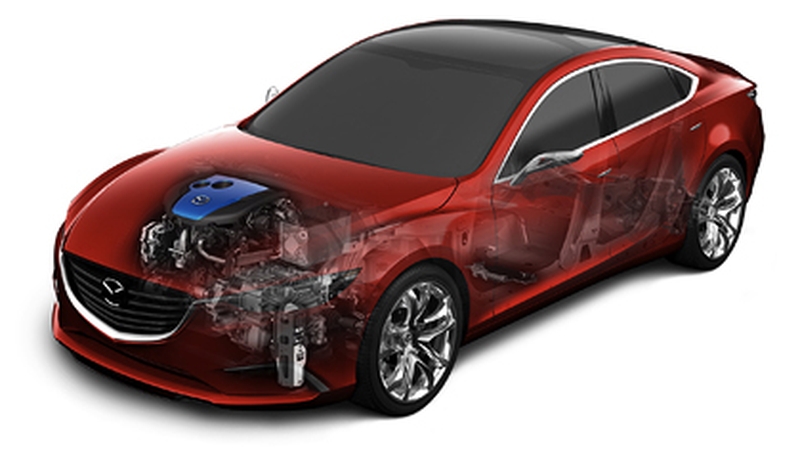
The groundbreaking system, which Mazda calls 'i-ELOOP', will begin to appear in Mazda's vehicles in 2012.
In real-world driving conditions with frequent acceleration and braking, 'i-ELOOP' improves fuel economy by approximately 10%.
Mazda's regenerative braking system is unique because it uses a capacitor, which is an electrical component that temporarily stores large volumes of electricity.
Compared to batteries, capacitors can be charged and discharged rapidly and are resistant to deterioration through prolonged use.
'i-ELOOP' efficiently converts the vehicle's kinetic energy into electricity as it decelerates, and uses the electricity to power the climate control, audio system and numerous other electrical components.
Regenerative braking systems are growing in popularity as a fuel-saving technology.
They use an electric motor or alternator to generate electricity as the vehicle decelerates, thereby recovering a portion of the vehicle's kinetic energy.
Regenerative braking systems in hybrid vehicles generally use a large electric motor and dedicated battery.
Mazda examined automobile accelerating and decelerating mechanisms, and developed a highly efficient regenerative braking system that rapidly recovers a large amount of electricity every time the vehicle decelerates.
Unlike hybrids, Mazda's system also avoids the need for a dedicated electric motor and battery.
