


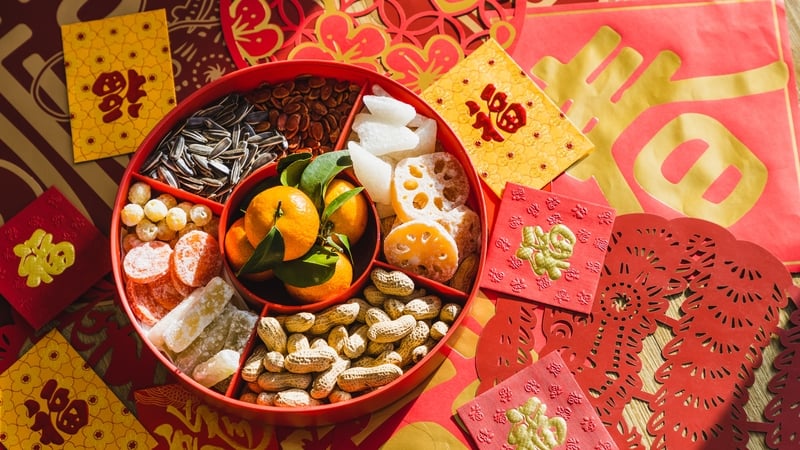

The Lunar New Year celebrates the arrival of spring and the beginning of a new year on the lunisolar calendar. Although famously celebrated in China, the annual holiday is marked across Asia as a time to let go of the past and start afresh.
Beginning on Tuesday, 17 February, and continuing for about 15 days, the celebration will see 2026 welcome the Year of the Horse.
"The horse is a very important symbol in Chinese Culture," says Asia Market's Managing Director, Eva Pau. "It's associated with success and power, energy and movement. It's really positive."
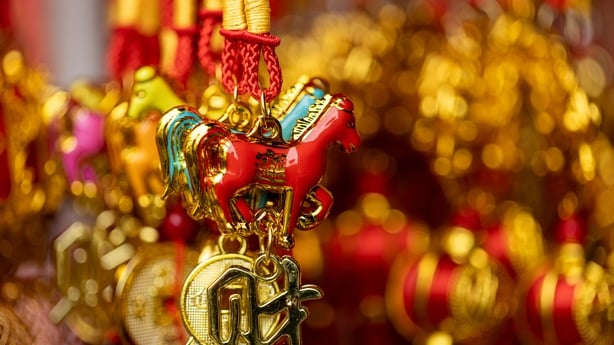
The 12-cycle Lunar Calendar is named after the 12 animals: Dog, Pig, Rat, Ox, Tiger, Rabbit, Dragon, Snake, Horse, Sheep, Monkey and Rooster.
Superstition says that the year in question, and any person born in that particular year, will take on the traits of that year's animal. Seventh in the zodiac cycle, the horse is said to be full of energy and strength.
"It's a really good symbol for the year," confirms Eva, who notes that there are plenty of foods, traditions, and even colours associated with the celebration.
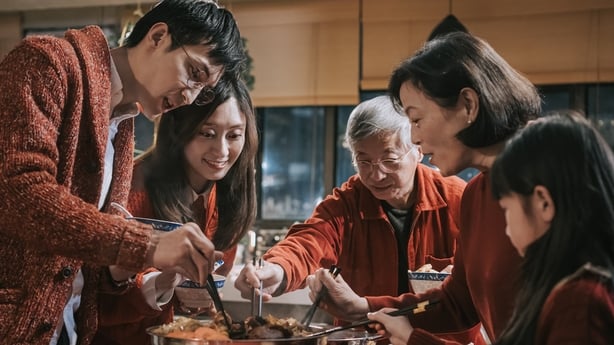
"The night before, we usually have a family reunion dinner," she explains. "Usually, I would prepare a fish - a steamed whole fish with the head and the tail - to symbolise a good beginning to the new year."
The fish will be served whole to symbolise togetherness, while long noodles will be served to symbolise longevity.
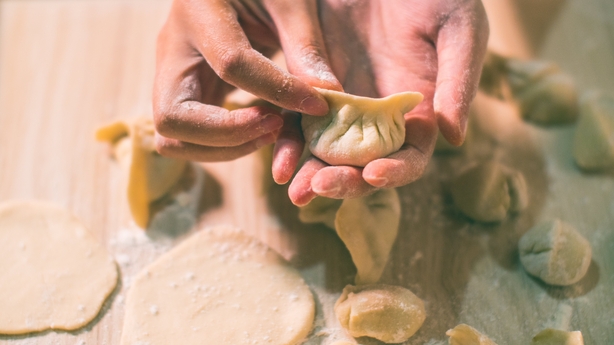
Dumplings are another staple of the dinner table, as the shape resembles that of ancient Chinese gold ingots, thus representing good fortune: "The more dumplings you eat, the more prosperous you get!"
Similar to a ring being baked into a barmbrack in Ireland, some parts of Northern China will place a coin into their batch of homemade dumplings, bringing extra luck to whoever finds it - hopefully, not swallowing it in the process!
Another fun dish to enjoy is an auspiciously named salad containing a mix of ingredients, ranging from raw salmon to peanuts.
"There's a dish in Singapore called the Prosperity Toss," says the TV Chef, explaining that diners will gather around the bowl and toss the salad with chopsticks.
"You try to toss it as high as you can, and it symbolises good fortune for the new year. While you're mixing it, you say something like, 'wishing everyone forever beauty in the new year' or 'a prosperous new year', or something lucky, basically."
Traditionally, fish, prawns, chicken, rice, and dumplings will be devoured before finishing with a delicious pudding. In southern China, the steamed delicacy will be prepared to become sweet and chewy, while in northern China, you are more likely to enjoy a more savoury, stir-fried version.
When preparing the feast, Eva says it's important to keep the number of dishes you serve in mind, as some numbers are luckier than others. While the number seven should be avoided (it is heavily associated with ghosts), even numbers are generally good, so 8 or 10 dishes are the aim.
The most important aspect of any Lunar New Year meal, though, is the act of sharing, placing multiple dishes to be shared among family and friends.
"Food definitely plays a huge part in Asian culture," laughs Eva, noting that the two-week festival will involve plenty of visits to friends, family, and more distant relatives.
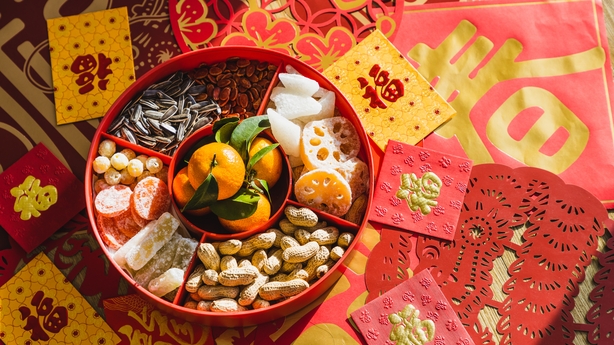
"During the two weeks, you would visit family and friends, and, usually, I would prepare a candy box. It's a round box with quadrants that can be filled with peanuts, watermelon seeds, candied fruit, or candied lotus fruit seeds," she lists.
The candy boxes can be very decadent, made from wood or mother of pearl, and are round to symbolise togetherness, while the sweet fillings symbolise sweet beginnings for the new year.
If you want to try out some of these incredible delicacies and traditions, you can make your way to Dublin's Asia Market this February, as there is a spectacular array of events and a full family-friendly festival experience taking place as part of the Dublin Lunar New Year programme.
The whole month will be jam-packed, with everything from a Chinese banquet and authentic Asian eats to a two-day festival experience, in-store tastings, live performances including traditional and colourful Lion dancing and Guzheng (Chinese harp) music, plus hands-on cooking workshops and face painting.
Pau and her team will bring a Chinese-style banquet at Ka Shing Restaurant on Thursday, 12 February, from 6pm. This will be followed by a two-day Lunar New Year Carnival at Asia Market in Ballymount on Saturday, 21 February and Sunday, 22 February from 12pm to 5pm.
For more information, visit asiamarket.ie.
