


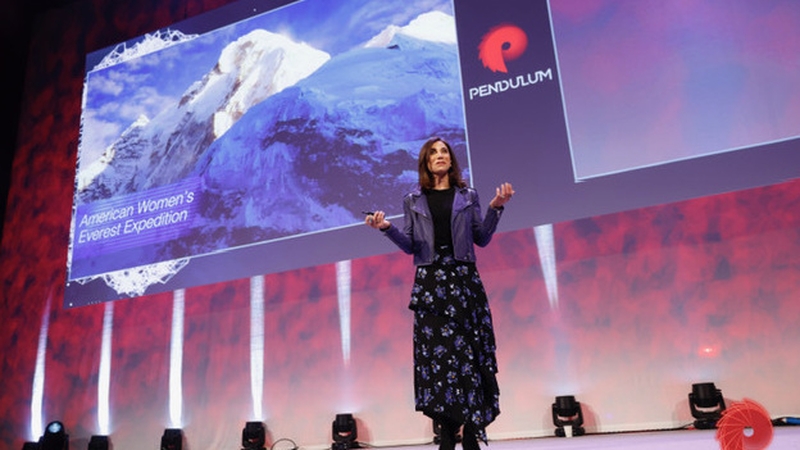

Alison Levine is an impressive woman. Not only did she captain the first American Women's Everest Expedition, but she has climbed the highest peak on every continent and skied to both the North and South Poles—a feat known as the Adventure Grand Slam, achieved by fewer than 20 people worldwide.
Now a renowned keynote speaker and best-selling author, Levine joined the Pendulum Summit in Dublin's Convention Centre to share her insights into leadership, perseverance, and self-esteem.
Speaking with RTÉ Lifestyle following the presentation, she explained that one of the most important lessons in mountaineering was the importance of knowing your self-worth.
"Any mountain is just a pile of rock and ice; you can always go back," she smiles. "But if you do something dumb up there, you may not have the opportunity to go back."

When journalists would ask how she would 'top' her latest achievement or 'stay relevant', she would reply: "I'm just going to be a nice person".
"We're all relevant," she continues. "We don't have to risk our lives on a big mountain or in any kind of risky situation to prove our worth. We're all relevant just by the human interactions we have every day.
"I just have to remind myself that standing on top of a mountain doesn't really change the world, but we all have an opportunity - every single day - to have a positive impact on the people around us.
"Sometimes just a few kind words of encouragement shared with somebody that's going through a tough time can completely change the outcome of a situation."
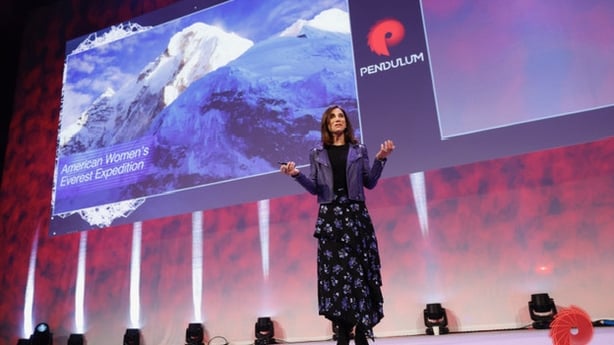
Despite her record-breaking expeditions, the On the Edge author insists that, although setting goals is important, finding a balance of priorities is essential.
"It's so easy to get completely wrapped up in the business because you want it to succeed and you want to give it your all, but you have to save the best of you for the people that are important to you," she says. "What good does it do to achieve these incredible things if you don't have anything left in you to share with the people that you love?"
"I think about that 'go big or go home' mantra, right? We hear that all the time," she continues. "We want to push ourselves and chase the dreams and all that stuff. Over the years, I've seen too many people I know go big and not go home."
"I'm sort of on this one-woman mission to change that mantra from 'go big or go home' to go big and go home'.

When it comes to turning her exceptional experiences into actionable lessons for corporate interactions, Levine says that lessons in leadership are a clear bridge. Knowing how to build trust in a team and navigate tricky situations is a universal need for those in positions of power.
"One of the most important things is making sure that everybody on your team has a voice," she explains. "You're not always going to be able to implement everybody's ideas, and you're not always going to be able to go in the direction everybody wants you to go, but if you give people a voice, that makes them feel valued."
Wrapping up our conversation, Levin discussed the importance of breaking down unthinkable summits into small and achievable goals.
At certain altitudes, the mountaineer would have to take five full breaths to get the energy to take one single step.
As a woman of smaller stature (5 feet, 4 inches), she knew she was never going to be stronger or faster than many of the men climbing mountains, but she knew that she could be one of the most determined.
"You don't have to be the fastest or the strongest," she promises. "You just have to be the person who will not quit. The people who get to the top of Everest aren't necessarily the best, fastest, strongest climbers; they're the people who are willing to put one foot in front of the other - even when it's incredibly uncomfortable."
