



From exercising more and changing jobs to taking up a new skill or making more time for friends, the new year is full of resolutions for many of us, but one that can feel particularly intimidating is learning to drive.
With tests, lessons, buying a car and more, learning to drive takes time and can feel stressful, so what are some tips for mastering the skill this year?
Motoring Editor at the Irish and Sunday Independent, Geraldine Herbert, joined Laura Fox on 2FM to talk about what to expect when learning to drive and how best to get through the test. Listen back to the full interview above.
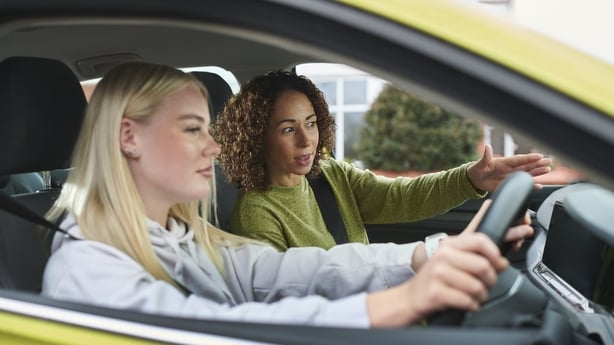
First step is to pass the theory test, Herbert said. The computer-based test awaits anyone wanting to learn to drive, and you can't get a learner's permit until you've passed it.
Visit theorytest.ie to book your theory test, as well as read up about revision materials for the test.
Herbert suggested spending time with these materials for a few weeks to get comfortable with them: "They're basically the rules of the road, so they're things you're going to have to need; they'll all go into your brain. You'll never have to learn them a second time."
Having conquered driving herself with Herbert's advice, Laura recommended using The Driver Theory Test Learning App from theorytest.ie which lets you revise points on the go and recreates the multiple choice format that you'll encounter in the real test.
Herbert agreed that the key to success is to "Practice, practice, practice" to the point that the theory becomes "second nature" to you on the road.
"You cannot be over-prepared, you can't know too much."
Once you've passed the theory test, you will get a learner permit, which is "literally just a permit to get on the road, so it's not a driver's license", Herbert said.
With this, you have to drive with a qualified accompanying driver who has had their license for at least two years. You also can't go on the motorway, and you're subject to lower drink driving limits.
Next, you must do 12 hours of essential driver training, which was introduced in 2011. Herbert stressed, however, that this doesn't include motorway training, which is one of the big obstacles for new drivers. She added that some driving schools offer post-license lessons for driving on the motorway.
Between the lessons, Herbert said it is recommended that you do three hours of practicing between each lesson. "So ideally you would do two lessons a month, it would take you six months to do the whole thing, it will cost you about €500 or €600 for these instructions, and then you're still doing three hours [in between].
"This, I find, is the biggest problem when you talk to learners - is having access to somebody to actually do that with them, because you might have somebody who's working nights and they're free during the day, but nobody else is.
"You might have somebody who's moved away from home, they don't have anybody available. You might have somebody that's new to the country, they don't have any family, they don't have any friends in the country."

So, in an ideal world with all factors looked after, how long will it take someone to fully get on the road as a licensed driver?
Herbert said that 12 months is "feasible" but invariably "lessons get cancelled, work comes up, you run out of money", she added, so 18 months is more realistic.
When booking your test, Herbert suggested shopping around for a date that suits. You can sit a test anywhere, and Herbert recommends doing it where you can - even if you're on unfamiliar roads.
"Yes, they're unfamiliar, but remember you're going to get a license that permits you to drive anywhere in the country, anywhere in the world, so you should be confident enough."
"People don't fail the test because they do something catastrophic; they fail it because they keep doing repeated errors, and the repeated errors are because they're not in control of the car or they're not conveying the feeling of 'I know what I'm doing' to the instructor or to the tester.
"You only get that from experience."
For more tips, listen back to the full interview above.
