


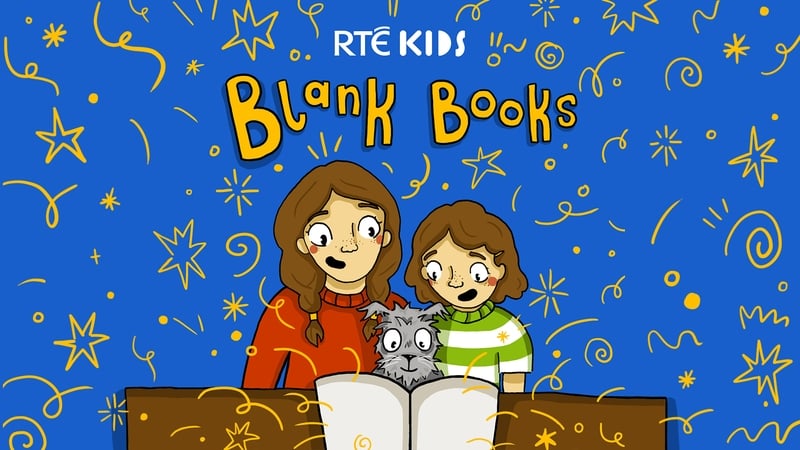
In RTÉ Kids' new audio drama podcast Blank Books, 10-year-old Rosie, her sister Alice, and their dog Bobby find themselves transported into some of history’s most famous (and infamous) stories - including Treasure Island, Dracula and Romeo & Juliet.
Rosie’s well able to handle it – after all, she loves books. She also has Dyslexia.
Although approximately one in 10 people in Ireland is thought to have Dyslexia, it remains one of the most misunderstood neurodivergences. Generations of children have been raised on the idea that if you’re dyslexic, you’ll never be a big reader. For many children, like Rosie, this isn’t true.
This was the case for Emily Gillmor Murphy, the writer of Blank Books, who, as a child, found herself having to balance the challenges Dyslexia caused her with a love of literature of all styles and genres.
With Blank Books, Emily has written many of her own experiences into Rosie, informed by her memories from when she was that age.
If the idea that dyslexic children will never be big readers is a myth, what other misconceptions might there be? To find out, we asked another Rosie – Rosie Bissett, CEO of Dyslexia Ireland – for her take on some of the most common myths floating around the internet.
MYTH – Dyslexia Is All About Reading

While at its core, Dyslexia centres itself around reading in literacy, the way it manifests itself can go far beyond that. Working memory and processing speed are two examples Rosie comes across often.
"Working memory is our ability to retain information in the short term and then do something about it. So if the teacher says, ‘let’s get out our geography books and go to chapter 3, paragraph 2.’
In that case, you have to remember those pieces of information and also do that action. So that is often a challenge. Processing speed is how fast you can perform that task."
MYTH – You Can Outgrow Dylsexia

"One of the things we know about Dyslexia is that it has a genetic origin. If they’re Dyslexic at 6, they’re Dyslexic at 96," says Rosie.
Instead, it’s your environment that changes. While a child’s early years are spent in school being asked to do a lot of the things you find most challenging every day – once they leave, they can pick a career that plays to their strengths.
"Whether you’re sitting a Leaving Cert English exam, or painting a picture, or out playing a hurling game. You’re Dylsexic in all those situations. But in some of them, it doesn’t have as much of an impact."
MYTH – Dyslexia Affects Boys More Than Girls

Going back decades, a common myth would say that instances of Dyslexia were more prevalent among boys than girls. Today, research shows it affects both almost equally.
"I think maybe the origin of that theory is, sometimes, girls can mask a little more. They tend to be a little more quiet," says Rosie. "Boys can fall into that thing of acting out. And if you become the class clown as a way to deflect from your challenges – that’s more obvious than the girl at the back keeping her head down."
MYTH – Dyslexia Leads to Superpowers

"I can understand why people like to think that Dylsexia is a gift and that all Dyslexics have these superpowers and strengths in other areas, but the scientific evidence does not back that up."
While it’s important to celebrate every individual’s skills and abilities, Rosie worries that the narrative around superpowers can lead to a toxic positivity that can actually hurt some children. She recounts a story of one teacher who had a 9-year-old boy come to her in tears after an art competition where he didn’t place.
"He thought he was a ‘failed Dyslexic’ because he was meant to be really creative. I think it’s important to bring it back to seeing the individual"
MYTH – The Signs Are Always Easy To Spot

With Dyslexia, there are some telltale signs to watch out for. But Rosie cautions about making assumptions.
"It’s important to say the experience is quite individual. You can have 100 Dyslexic individuals in a room, and their profiles will be a little bit different."
When it comes to spotting the signs, Rosie suggests keeping a close eye on their progress early on in school, and in particular, if it’s making sense to them.
"One thing to watch for is, with those early reader books, there are often a lot of pictures as well. So you can nearly guess what the text is. And what some kids do is they memorise, which is a bad habit to get into because it means they’re hiding that they can’t read."
Ultimately, Rosie advises that if a parent has a concern, they should talk to the school and see if they can get an assessment.
"You want to be an ally to the teacher and be honest with what you’re seeing at home and let them know you want them to be honest with you. Because sometimes teachers can be a bit afraid to bring up the word because they’re not sure how parents may react.
"So if a parent is saying to a school, ‘look, we’re concerned. What do you think?’ Then that maybe gives a teacher the confidence to have a more frank discussion with you if they’re seeing it as well."
Blank Books is available on the RTÉ Radio app or wherever you get your podcasts. And if you’d like to learn more about Dyslexia, more resources can be found at www.dyslexia.ie.
Dyslexia Ireland’s online learning hub for parents and children can be found here, and free professional learning resources for teachers are available here.
