


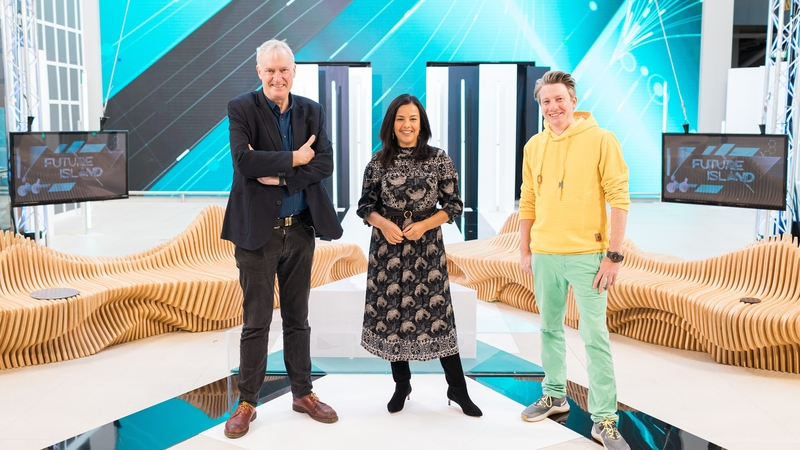
Science has never been so important - so say Future Island presenters Liz Bonnin and Luke O'Neill. Exactly one year ago, the two were discussing the news of the first vaccine showing efficacy against COVID-19. One year on and we're beginning to hear about the first anti-viral drug.
So, as we can see, a year is a long time in science. But what will the next year bring? Future Island, airing across three nights during Science Week on RTÉ, attempts a look ahead.
With a mix of live studio guests, entertainment and short pieces filmed across the country to inform and entertain viewers on the huge kaleidoscope that is science, there was a lot to take in on last night's show. Here are some of our highlights...
1. The future of invention is bright
Paying a visit to Scoil Mhuire in Carrick-on-Shannon and St, Mary's primary school in Dublin, the Future Island crew captured a snapshot of just some of the amazing inventions that the country's young minds are dreaming up.
From time travel and body shrinking to an eco-friendly smart bin and cleaning robots, there were some creative ideas coming from the little ones. Check out some of their thoughts on the future of food in the video below!
We are not excited for future food if it's going to taste like this 😱😱#FutureIsland, tonight, 7pm #ScienceWeek2021@scienceirel pic.twitter.com/tHn1xFIoOK
— RTÉ One (@RTEOne) November 10, 2021
Back in studio, Liz sat down with 21-year-old Shannon O'Shea, a Munster Technological University who was recently named the National Winner of the James Dyson Award for her invention, EleSkate.
Having competed in figure skating for over four years, O'Shea told Liz that she was determined to find a way for skaters and coaches to get more data on the technical jumps that figure skaters often spend years on perfecting.
Measuring the speed, height, distance, and speed of rotations of the jumps in real time, EleSkate is a sports analysis device that assesses the most important metrics, all while fitting seamlessly underneath a boot.
As project manager, O'Shea worked with a team of her of her peers - Bartlomiej Rys, Jamie O Leary, Ellen Keating, Aaron Ahern - as well as her mentor, Dr. Hugh O'Donnell. She told Liz that the team had to make the device as small and user friendly as possible before adapting it to other sports such as gymnastics.
2. Working robots exist - and they're called Dave
Professor Luke O'Neill paid a visit to Professor Derek O'Keefe of University Hospital Galway and his robot, Dave.
According to O'Keeffe, Dave is a "droid audio/visual educator" that helps to remind people to wash their hands. Recent data published by UHG showed that Dave's digital nudges improved hand washing at the hospital by 20% - a very significant improvement.
In fact, Dave was working so well, he was given a promotion. Now, not only does he promote hand hygiene, but he shares information on diabetes while patients are attending O'Keeffe's clinic.
Great to catch up with @laoneill111 on #futureisland @ScienceWeek & discuss how our DAVE robot research is improving patient education & health behaviour outcomes 🩺🤖 #STEMM pic.twitter.com/CaulmRZpOX
— Prof Derek O'Keeffe (@Physicianeer) November 10, 2021
Keeping Dave company in studio was Bellabot, a robot server that works at The Jasmine Palace restaurant in Limerick. Carrying food and drinks from point A to point B, this hard-working bot can carry five times the weight that a human could lift and runs about 12 hours a day - only needing about 3-4 hours for a full charge.
As if that wasn't enough, Bellabot has a cheery disposition and impressive social skills. Under escort mode, the robot can direct guests to their seats, while birthday mode will have her singing Happy Birthday while delivering cake to the table.
Take me to your leader meow 🤖
— Arc Imaging (@ArcImaging) September 24, 2021
This is Bella aka #Bellabot the new delivery robot in The Jasmine Palace ⛩ Tasked with helping her co workers & eventual world domination...#Limerick #thejasminepalace pic.twitter.com/n7KKvvcADk
Next up, Luke had the pleasure of meeting Fergus Timmons from The Alzheimers Society of Ireland, and a therapeutic robot seal named Paro.
Filled with sensors, Paro can pick up sound, touch and light and is designed to feel and look like a cuddly toy. Found to reduce stress and stimulate interaction, this cuddly robot is the perfect companion for those suffering with dementia.
Anna Konrad, of @MU_Hamilton, demonstrating TIAgo on #FutureIsland with @laoneill111. @jmcdonald_mu @RudiVilling @MU_CompSci @MaynoothEEng pic.twitter.com/h7EamS82IS
— Maynooth University Hamilton Institute (@MU_Hamilton) November 10, 2021
Finally, O'Neill was introduced to Anna Konrad, a PHD student from Maynooth University and her robot companion, Tiago.
This tall-standing robot is programmed to work as an aid for those who many need some assistance with every day tasks such as carrying in the shopping, putting things away or fetching objects from around the house.
3. Sports and science are a match made in heaven
Ireland's Fittest Family coach and RTÉ 2FM breakfast co-host Donncha O'Callaghan sat down with Liz to discuss the science behind sport. As a former rugby star, the Cork man says that the science and technology used to measure and improve athletes' performance has come on in leaps and bounds.
"When we started out, it was very much one size fits all," Donncha told Liz. "Everyone followed the same programme, it wouldn't matter if you were a power athlete or an endurance athlete. You could have someone like Peter Stringer following the same training programme as someone like John Hayes."
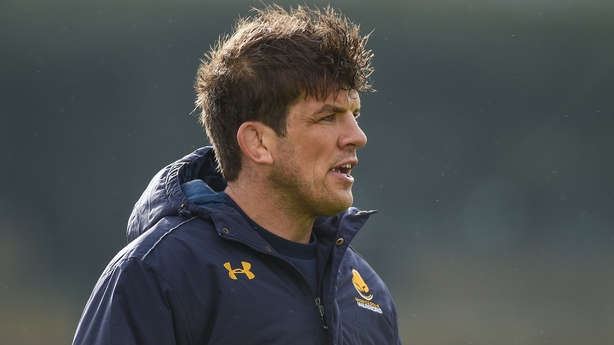
According to the Munster man, a weighing scales and a watch was all that was needed when he started training. As time went on, though, the science of sport quickly progressed.
"By the time I ended up finishing in the game, there was everything from recovery protocols like cryotherapy. There was also brilliant wellness programmes to make sure you were always in a great state to train and perform. It really got better as it went on."
During his rugby career, O'Callaghan said he was most interested in what he called the 'readiness to train', an extensive programme that would see the player's data being collected, whether it be via blood samples or the quality of their shoulder and hip rotation.
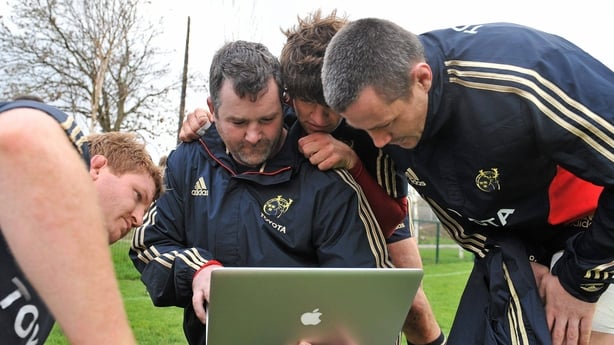
"I find that bit fascinating," he explains, "that we're using science now in the right way to support our brilliant strength and conditioning staff and our brilliant coaches to help them make informed decisions."
Going forward, the broadcaster says he hopes that technology will advance in a way to support athletes in terms of the "mental game", giving them an edge when it comes to their mentality.
Future Island will be broadcast live from Explorium, Dublin’s sport and science centre in Sandyford on RTÉ ONE, 7pm on Tuesday 9th, Wednesday 10th, Thursday 11th November.
