

With so many parents continuing to work from home this year, and with schools slowly phasing into a reopening, it's important to establish a good routine at home for kids and grown-ups alike.
To lend a helping hand, Home School Hub and After School Hub air on RTÉ2 and RTÉ Player, will be delivering three hours of television daily, offering a helping hand to parents. Young viewers can find all corresponding worksheets, podcasts and third-party content will be housed here and can be watched back on the RTÉ Player.
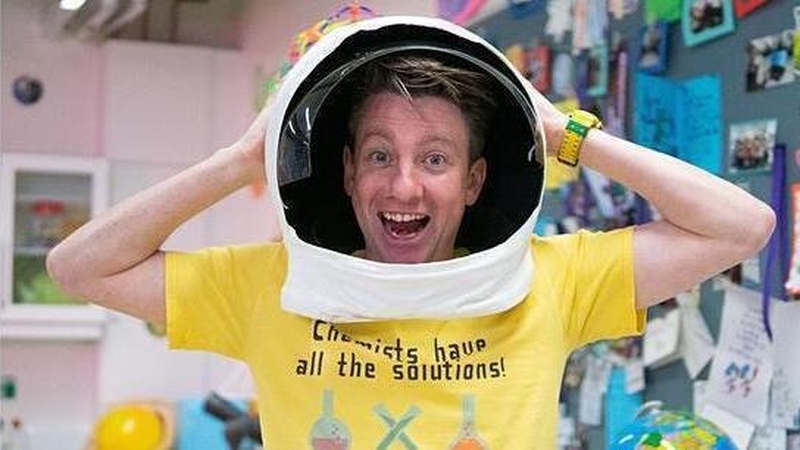
We caught up with Scientist Phil to find out more about the show and the fun experiments he's showing kids how to do at home.
How do you see your role on Home School Hub?
I suppose what I always try to do is show kids the value of themselves through science. It's not that they need to know everything - or anything, in fact - but by understanding a process they can use to solve any problem they may have. Most human endeavours start with a question and kids always have questions, it's like their job - they have loads of 'whys'.
Sometimes adults are afraid of not having all the answers so my job is to have a bit of fun with the 'whys' and go off in lots of different directions. Ultimately kids learn the process of how to work scientifically which is often linked inextricably to the science curriculum which always start with a question.
Do the kids at home interact with you and the HSH gang?
The reactions have been incredibly positive. When you get thanked by parents and kids it's really great but, it's really not about the thanks... it's when kids go off and do an experiment and then come back with more ideas and questions and ask for my help on their own ideas. They really take ownership of it.
Sometimes I get a lot of messages on social media asking me to do a shout out and I always say yes. I don't care if it takes the whole day because for a kid to get a message from someone they perceive to be a celebrity or someone doing something they like on TV... they see value in themselves then. And then they get inspired to go off and do their own thing or be sound to someone else. That's gold for me and it fuels me to do more.
Have there been any questions or experiment requests sent in from the kids?
Yes, there's been lots of questions. One in particular was great because I care a lot about sustainability and this kid gave me a report - almost like a six month review in a new job - and said 'Philip, you're doing a great job on Home School Hub and I like the fact that you're re-using plastic bottles instead of buying new ones. Keep up the good work. I have an idea for a robotic dog that can eat plastic.'
It was amazing, it was like I was getting an appraisal and he had noticed that we were re-using things. We always encourage them to ask questions like the other day we were asked why spiders have eight eyes and we didn't know so we had to go and find out! It's great.
Home School Hub came about as a result of COVID, has the show changed as time has gone on?
It hasn't changed in that you just try to do the best you can, always. I try to be honest with kids by saying 'ok, this is the way the situation is and this is how we deal with it' or 'this is what we have and we try to make the best out of it'. Everything doesn't have to be magic or amazing, we try to do things in a way that brings the kids on the journey - we want them to take part.
Our job is to present in the most entertaining and educational way possible. The show is honest and doesn't patronise kids and it takes them on a journey and meets them on their level. We don't just cater to kids either, we want everyone to watch as a family - there are bad jokes for everybody!
We want it to be equal and accessible to any kid because anyone who is on their own or has spent any time on their own - and a lot of us have at this stage - know that having someone say good morning or showing you something you can do, can be great.
How do you make the show for kids of all ages and backgrounds?
You're trying to keep everyone in mind but at the same time not everyone is going to like everything you do and that's perfectly fine, that's part of the honesty. They might like the next one, that's the good thing about science - it's everything! So, you're not going to make it for everyone but you make it accessible to everyone.
When I'm thinking of examples of things, I try to think of who might be watching so I'll say: 'Imagine the best pilot ever. What does she look like?'. Sometimes it just gives people a different outlook. I'm very conscious that I'm a white male in science so I want to be mindful of that and making sure everyone is welcome and has value.
