





On This Week: Irish moments from history (April 27th - May 3rd)
Welcome to On This Week, where we delve into the standout stories from the years gone by, featuring standout news stories, major sporting events, and pop culture highlights that helped shape Irish life. Here's your dose of Irish history from April 27th - May 3rd.
This week in Irish life and news
1916: the Easter Rising ends in surrender
On Sunday 30th April 1916 the Rising was finally over. After six days of fighting Dublin city lay in ruins. In these 1966 interviews, the veterans of the other garrisons recall what it was like when they heard the news of the surrender order that morning.
Liam O Brian, 'F' Company 1st Battalion talks of his shock when he was told by his Commanding Officer that they were to surrender.
It had never come into my head this idea of surrendering.
Paddy Buttner, an Irish Citizen Army Boy Scout in 1916, explained just exactly why Michael Mallin did not occupy the buildings surrounding Stephen's Green Park in response to criticism that was made against his Commanding Officer.
You'd want about two or three hundred men to occupy the Shelbourne Hotel, we hadn't got them.
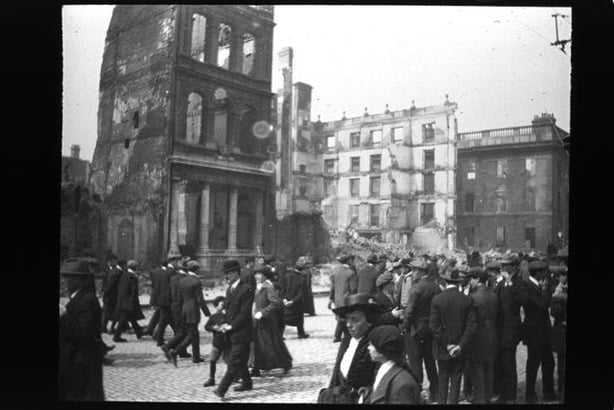
Captain Simon Donnelly, 3rd Battalion, Irish Volunteers recalls that the garrison in Boland's Bakery were initially hostile when they were told of Pearse's order. No one was willing to carry the white flag of truce ahead of the garrison. The City Hall garrison were held in Ship Street Barracks until Sunday evening and brought up to Richmond Barracks. Emily Hanratty recalls that while they being marched up to the barracks they were jeered on by the crowds. She and her female comrades, including her sister Annie, were taken the next day to Kilmainham Gaol.
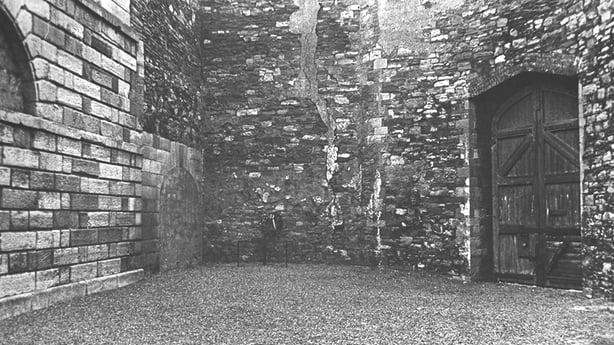
Mattie Connolly who had also fought with the City Hall garrison describes the treatment he received when he was taken prisoner to Kilmainham Gaol.
We were beaten there, there was a couple of soldiers in the tunnel as we entered the gate and each one of them had a crack as we passed through.
John O'Connor, 'F' Company, 1st Battalion remembers that when he woke on Sunday morning, the Rotunda was completely surrounded by British Officers, and detectives from Dublin Castle.
They were treating some of our fellows very badly, particularly poor 'oul Tom Clarke.
Roddy Connolly, son of James, was also taken to Richmond Barracks. He had been told to give a false name if asked by the authorities. Quite a number of boys under sixteen had taken part in the Rising, Roddy Connolly among them. He recalled that they were all called together by an officer who,
Admonished us for having been so foolish and told us on account of our age we would be released.
1981: Aer Lingus flight is hijacked
On 2 May 1981 Aer Lingus flight EI 164 from Dublin to London Heathrow was hijacked and diverted to Le Touquet airport in France. The hijacker, Australian Larry Downey, had initially demanded to be flown to Iran but settled for France when he was told that the plane had insufficient fuel.
The plane landed at Le Touquet airport, where negotiations went on for eight hours. Larry Downey's demand was that Pope John Paul II make public the Third Secret of Fatima. Following hours of tension, the hijacker was overpowered by French paratroopers and the passengers were freed.
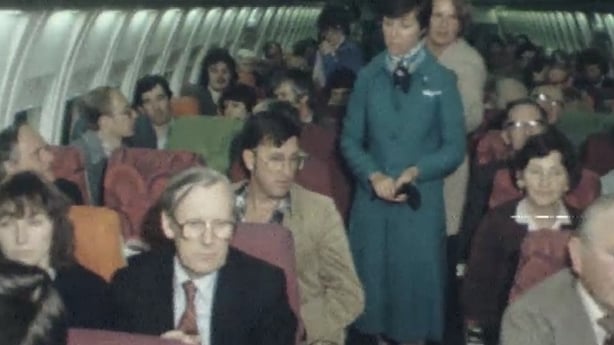
First onboard to meet the passengers was the Minister for Transport Albert Reynolds, who told the media how events had unfolded. Albert Reynolds had been involved in the negotiations throughout the hijack. He describes how the hi-jacker had a small bottle of liquid, which he claimed was cyanide, and also had petrol sprayed over him.
This fella had a small bottle of liquid which he claimed was cyanide... He certainly had petrol sprayed over him and petrol as you know will not show up on a scanner like other liquids.
RTÉ News spoke to Captain Eddie Foyle, the crew and passengers about the ordeal. Terry McCormack describeed her first impressions of the hijacker when he boarded the plane and sat next to her and her daughter.
He looked like a very prosperous business man... He was very polite to us... We didn't suspect anything.
The reporter is Eddie Barrett.
1993: Being gay in early '90s Ireland
Following a lengthy campaign by Senator David Norris and the Campaign for Homosexual Law Reform, it was found that Irish laws prohibiting homosexual activities were in contravention of the European Convention on Human Rights. The findings meant that the Irish government must change the law which made homosexual acts criminal.
On an episode of Prime Time broadcast on April 29th 1993 and presented by Olivia O'Leary, Stephen Lewis described his experience living as a gay man in Ireland at a time when homosexuals were viewed under the law as criminals. For Stephen, Ireland had a problem in dealing with sexuality in general and being gay made it twice as hard to feel accepted in society. He felt he and others like him are treated as second-class citizens and that the current law is shameful.
Ireland is a difficult place to be gay in.
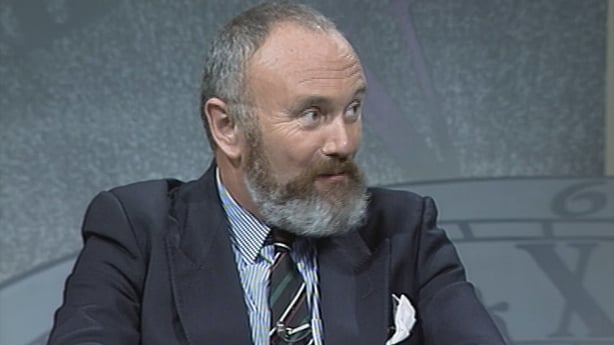
In studio, academic and gay rights campaigner Senator David Norris argued his case against Fine Gael TD Brendan McGahon who was opposed to decriminalisation and described homosexuality as "an abnormality".
I do find the physical act absolutely revolting in the extreme.
David Norris described the current law as "a violation of fundamental human rights."
Under Minister for Justice Máire Geoghegan-Quinn, homosexuality was decriminalised in Ireland with the passage of the second phase of the bill to decriminalise sexual acts between consenting adults under the Criminal Law Bill (Sexual Offences) in June 1993.
This week in arts and entertainment
1985: 'Margaret Thatcher' stabbed in Wax Museum attack
Margaret Thatcher was stabbed and JFK was beheaded in an act of vandalism at the Wax Museum on this week in 1985. This was the third break-in at the Wax Museum on Granby Row, just off Parnell Square in Dublin's city centre. Previously intruders had taken cash but this time they could not find any money and resorted to destroying the wax works. In this news report which aired on May 2nd 1985, Paddy Fagan described the scene when he arrived at work that morning.
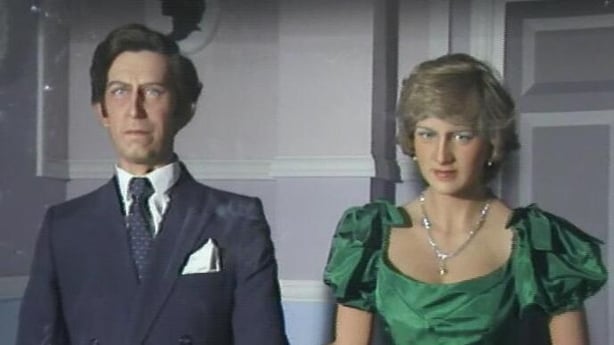
Wolfe Tone's arm was broken off, and he received a gash to the side of the head. His sword was taken out and stuck into Margaret Thatcher. Quite a few figures in the GAA scene were also destroyed including broadcaster Michael O'Hehir, who was bashed beyond repair.
In total, about 15 figures were destroyed. According to Paddy Fagan, repairs would take about a year and a half, at a cost of between £30,000 and £50,000. There were over 100 figures in the museum, most of which survived. The reporter is Eileen Dunne.
1994: Riverdance steals the show at the Eurovision
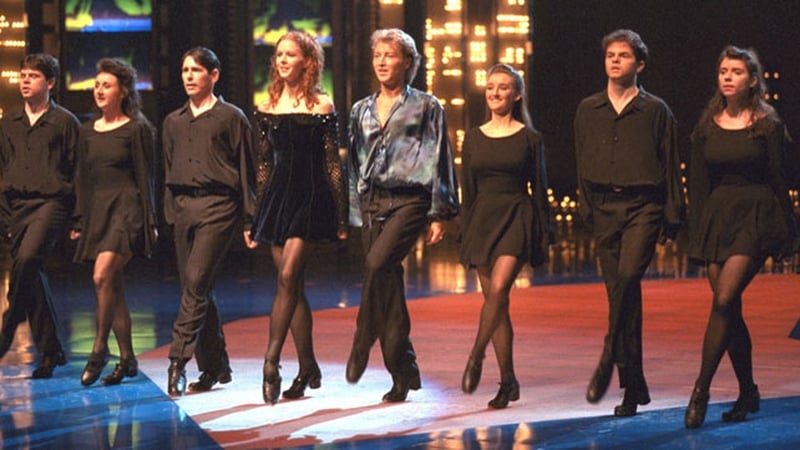
On April 30th 1994, Paul Harrington and Paul McGettigan won the Eurovision Song Contest for Ireland with 'Rock and Roll Kids'. However, it was the Riverdance that stole the show. The performance featured Irish dancing champions Jean Butler and Michael Flatley, the RTÉ Concert Orchestra and the Celtic Choral Group Anúna with a score by Bill Whelan. Riverdance was produced and directed by husband and wife team John McColgan and Moya Doherty. As the audience response shows, it was an instant hit. "Was that not the most spectacular performance you have ever seen?" cried co-host Gerry Ryan.
'Riverdance' mixed traditional and modern music, choral singing and Irish dancing, and presented them in a totally new way. Over 300 million European television viewers were watching and out of this initial performance came ‘Riverdance’ the show.
In February 1995, the world premiere of ‘Riverdance’ the show was held at the Point Theatre, Dublin. ‘Riverdance’ went on to become an international commercial success around the world.
The 1994 Eurovision Song Contest was presented by Cynthia Ní Mhurchú and Gerry Ryan.
This week in sports
1969: Mícheál Ó Muircheartaigh on the All Ireland Colleges Senior Hurling Final
Highlights from the All Ireland Colleges Senior Hurling Final was broadcast on 'Sports Club' on 29 April 1969. The commentator was the inimitable Mícheál Ó Muircheartaigh. The match was played at Thurles two days earlier and St Finbarr's College of Farranferris, Cork defeated St Kieran's College, Kilkenny, to become champions for the second time. The score was 5-15 to 2-1.
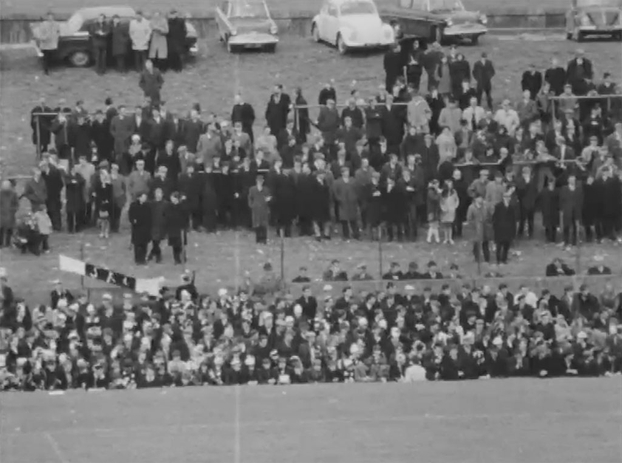
'Sports Club' was a magazine series for young viewers, featuring action, competitions and guests from the world of sport. It was edited and presented by Brendan O'Reilly.
1983: a busy Belfast marathon
Over three thousand runners took part in the Guinness Belfast City Marathon on Monday 2 May 1983. The runners talking part in the 26 mile race were cheered all along the route. Among those out to support the runners was Olympic gold medal winning athlete Mary Peters.
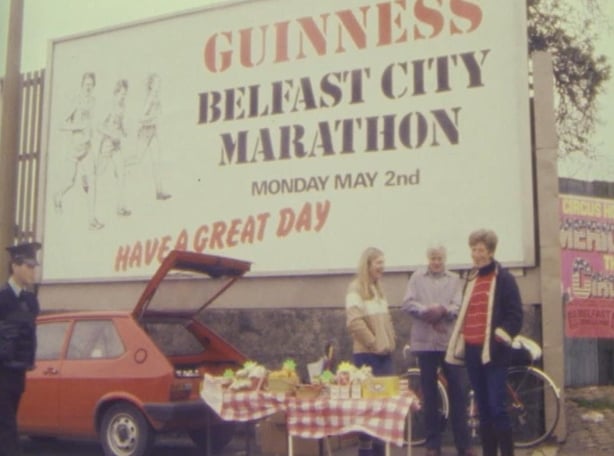
The winner of the Belfast marathon was 25 year old Paul Craig from Derry in a record time of two hours 20 minutes and 14 seconds. Marty Deane from Belfast finished in second place with Rodney Stone from Lennoxtown near Glasgow in third. The first woman across the finishing line was 25 year old Roma McConville from Newry in a time of two hours 58 minutes and 09 seconds.
What was Number 1 in Ireland this week?
1976: 'Fernando' by ABBA
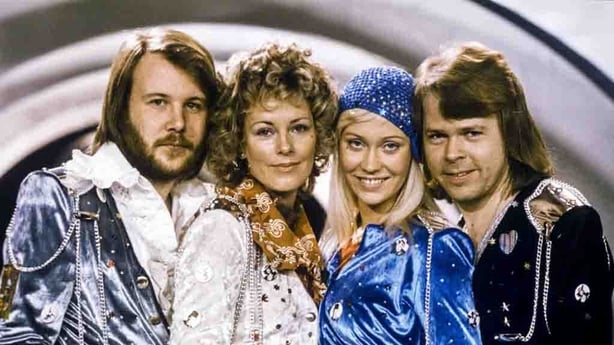
Having topped the Irish charts in February 1976 with 'Mamma Mia', Abba were number one again a few months later with the plaintive 'Fernando'.
1981: 'Making Your Mind Up' by Bucks Fizz
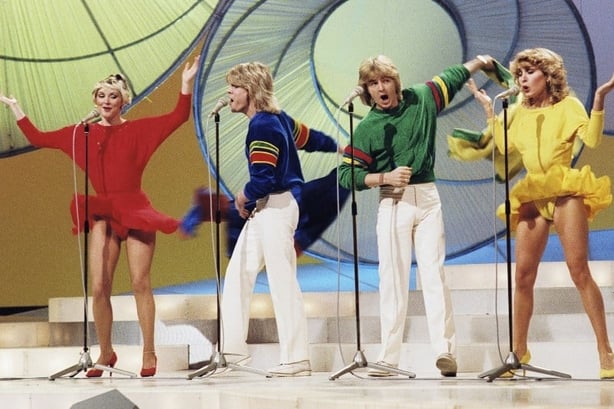
The British foursome's skirt-ripping performance at the Eurovision caused a sensation in 1981, and their winning song was number one in Ireland for two weeks.
1990: 'The By-road to Glenroe' by Mick Lally
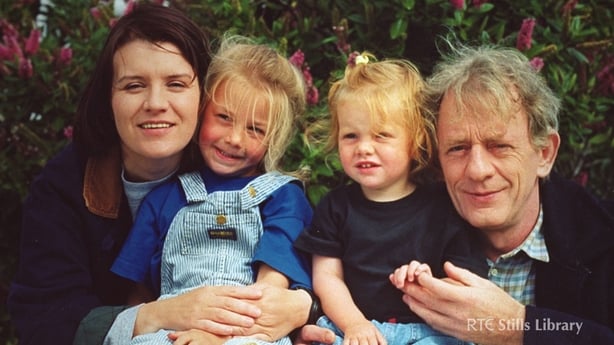
The artist also known as Miley Byrne from the legendary rural Irish soap Glenroe topped the charts for five weeks in 1990 with this song, which was sung in character as Miley.
Famous Irish names celebrating birthdays this week
Kian Egan
The Westlife singer turns 46 on April 29th.
Daniel Day-Lewis
The Oscar-winning actor will be 69 on April 29th.
David O'Leary
The football manager and former player turns 68 on May 2nd.
