



On This Week: Irish moments from history (16th - 22nd March)
Welcome to On This Week, where we delve into the standout stories from the years gone by, featuring standout news stories, major sporting events, and pop culture highlights that helped shape Irish life. Here's your dose of Irish history from 16th-22nd March.
This week in Irish life and news
1958: Does the Ploughing Championship have a future?
In 1958, when asked about the future of the National Ploughing Championship, co-founder J.J Bergin had faith in the future of the event. John James Bergin, known as J.J, was Managing Director of the National Ploughing Association, and one of the founders of the organisation. Follow his death in March 1958, an episode of Provincial News Round up paid tribute to Bergin in an episode that aired on March 16th.
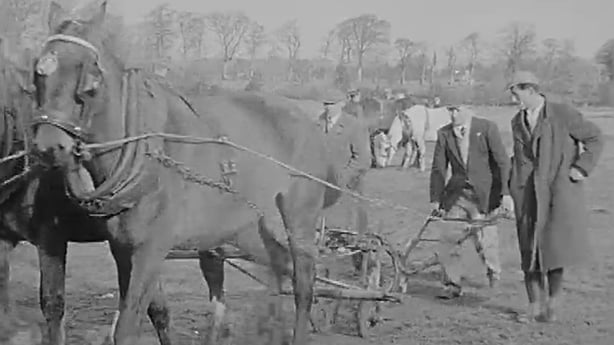
Seen as one of the greatest figures in Irish agriculture, J.J. Bergin, from Athy, County Kildare, along with his friend Denis Allen, founded the National Ploughing Association in 1931. The first National Ploughing Championship took place in Athy in February of that same year.
Speaking to reporter Kevin O'Kelly at the National Ploughing Championship in Tramore, County Waterford, J.J. Bergin had spoken about his confidence in the the future of the championships, declaring they were never more necessary.
A man who can adjust and handle a plough will invariably handle and adjust any other machine.
He spoke of what the National Ploughing Championship event has become.
It is now an annual reunion between all sorts of farming classes and rural people and industrialists and commercial men.
Broadcaster Fred Desmond remembered J.J. Bergin's faith in Irish farming, and his commitment to the idea that
Irish farming was dynamic, developing and progressing more and more each year
He cites J.J. Bergin's idea of inviting girls to compete in the National Championship as typical of his belief in young people. The Championship is still going strong nearly seventy years later, and is one of the largest outdoor events in Europe. This episode of Provincial News Round Up was presented by P.P O'Reilly and the reporters were Kevin O'Kelly and Fred Desmond.
1965: St Patrick's Day Parades
These days, a St Patrick's Day Parade has a carnival atmosphere. That wasn't the case 61 years ago. On a wet and gloomy St Patrick's Day in 1965, RTÉ News looked at festivities around the country and across the water in London. In Dublin, there were many bands and a lot of industrial products on the back of lorries. There was no parade in Belfast, and, it was reported, few of the usual shoppers from south of the border.
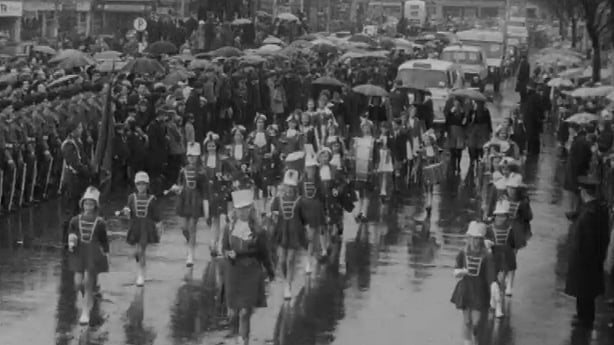
In London, reporter Joe Fahy declared that,
any Irishman in London feels ten feet tall on this St Patrick's Day.
There was also footage from Limerick, Cork, Galway and Armagh. The RTÉ reporters were Joe Fahy, Anne Binchy, Cecil Deeney, Kevin O'Kelly and Eoin Leeson who reported from various parades and Mike Burns reporting from Downpatrick Cathedral.
1976: Getting older in Ireland
Fifty years ago this week, the programme Seven Days asked the question 'What's it like to be old and to be lonely in a big city?" The programme examined attitudes to ageing and the elderly, and the loneliness and isolation experienced by many older citizens in Dublin.
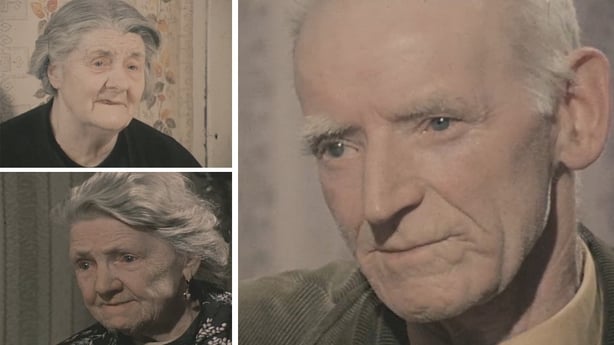
This excerpt from the programme featured young people around Dublin city centre commenting on growing old and what old age meant to them. Some of those interviewed never think about growing old, others live in the moment, and for others, it is not a worry.
If you're 19 or 20 or perhaps even twice that age, you probably don't think very much about getting old. But we're all going to get old whether we like it or not.
Reporter Forbes McFall examined the experience of loneliness and isolation that remains a reality for many older people. One extreme case was that of Mattie Kelly, 65, who lived on his own and died on his own. He was dead for four days before he was discovered.
1986: Waterbeds and rescue ladders at the Brighter Homes Exhibition
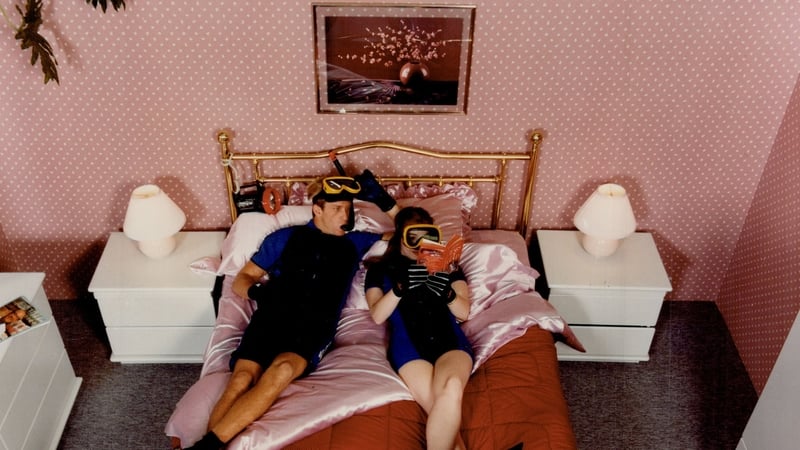
What did the home of the future look like forty years ago? On March 16th 1986, RTÉ News reporter Michael Ronayne visited the annual Brighter Homes and Do-It-Yourself Exhibition at the RDS in Dublin to find out.
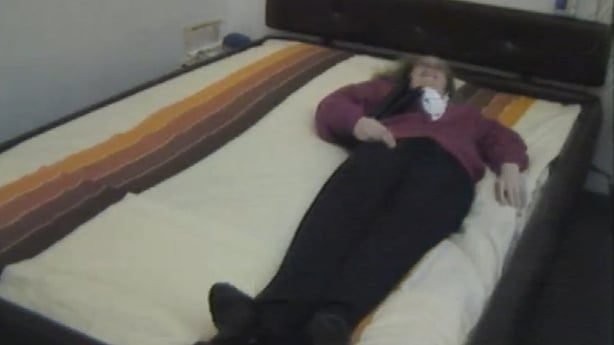
Thirty eight new household products were on display, including a rescue ladder, providing an escape route from your home in the event of fire. Waterbed sales were also apparently on the rise, with double versions costing between £500 to £600.
This week in arts and entertainment
1970: Irish portraits in London
1970 was a tense time for Anglo-Irish relations, but that didn't stop the National Portrait Gallery in London hosting a touring exhibition of Irish portaits, 'Irish Portraits Exhibition 1660-1860'. On March 16th 1970, the RTÉ programme Anthology showed viewers what was on display.
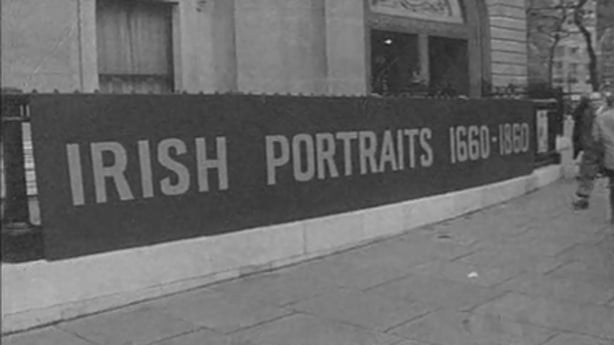
The exhibition visited London from 30 October 1969 to 4 January 1970, having previously been housed at the National Gallery of Ireland and then moving on to the Ulster Museum in Belfast. A full catalogue of this exhibition was published by Anne Crookshank and Desmond Fitzgerald, the Knight of Glin, in 1969 through the Paul Mellon Foundation for British Art.
1980: Strumpet City airs on RTÉ
The adaptation of James Plunkett's classic novel about Dublin life around the time of the 1913 Lockout remains one of the most ambitious Irish TV dramas ever made.
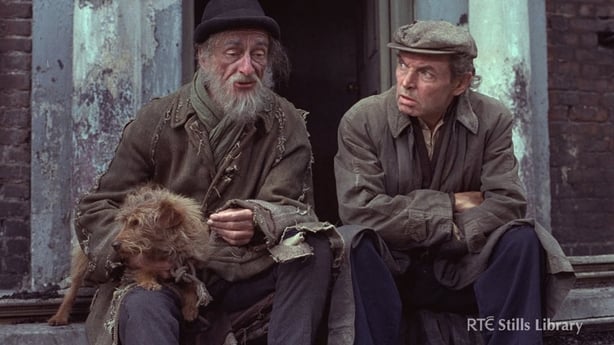
Adapted for RTÉ Television by Hugh Leonard, Strumpet City was broadcast as seven episodes in 1980.The series was directed by Tony Barry and among the notable cast were Peter O'Toole, Peter Ustinov, David Kelly, Bryan Murray, Donal McCann and Angela Harding. It first aired on March 16th 1980.
This week in sports
1986: American football in Blackrock
On March 126th 1986, Ireland's only first and only American football team the Dublin Celts took on Cheshire's Wirral Wolves in Blackrock. A crowd of around two thousand were in Stradbrook, Blackrock to watch the match.
"It may not have been the Super Bowl but for the growing band of followers of American football in this country, it was the next best thing," said reporter Charlie Bird. The Dublin Celts even had a supportive squad of cheerleaders.
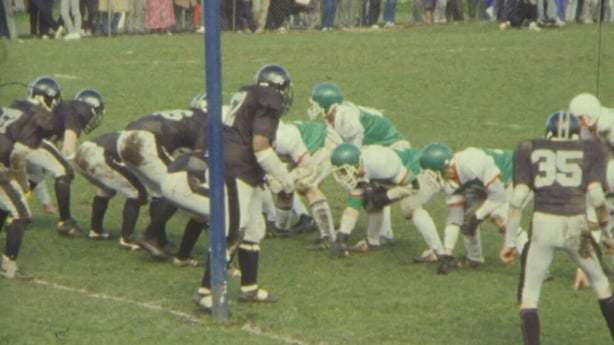
The Dublin Celts had a team of 35 players including five US marines and two Gardaí. To the delight of the Dublin fans, the Dublin Celts won by 14 points to nil. One optimistic local supporter said that if the success of the team continued, they might end up playing the Chicago Bears in the Super Bowl in about 20 years.
2001: Foot and mouth disease crushes Irish Cheltenham hopes
25 years ago this week, the foot and mouth disease outbreak in Britain put a halt to the hopes of Irish racegoers and trainers who had been planning to go to Cheltenham the following month. The festival had already been moved from March to April in an attempt to deal with the foot and mouth crisis. Chairman of the Irish Racehorse Trainers Association (IRTA) Willie Mullins said that having met with the Department of Agriculture, they reiterated that they did not want Irish horses travelling to Aintree or Cheltenham. Furthermore, they did not want Irish supporters travelling either.
Willie Mullins supported the advice from Minister Joe Walsh not to travel, but was hopeful that domestic racing would be back running by Easter and hoped that there would be extra races with additional prize money to compensate for missing out on the British meetings.
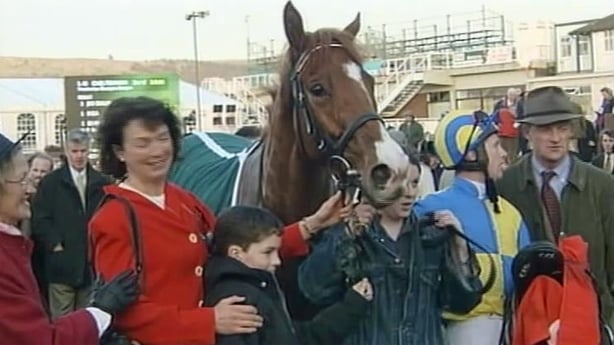
On Maqrch 20th 2001 Edward Gillespie, Manager at Cheltenham Racecourse, told RTÉ that the plans for the festival would go ahead so long as the racecourse remained outside the infected area. However, he is disappointed that Irish horses are unlikely to take part. He said that "any continued spread of the disease closer to the racecourse would mean the end of hope of staging the festival." Less than two weeks later, on April 1st 2001, it was announced that the festival would not take place at all that year.
What was Number 1 in Ireland this week?
1971: 'Another Day' by Paul McCartney
The Irish charts were topped by George Harrison's 'My Sweet Lord' for all of February and half of March 1971. But George was toppled from the number one spot by his old bandmate Paul McCartney, whose solo single 'Another Day' stayed at number one for one week.

It was McCartney's first single as a solo artist.
1997: 'Mama/ Who Do You Think You Are?' by the Spice Girls
A double A-side single from one of the most popular girl groups of all time was top of the charts on this week in 1997.

In February of that year, the Spice Girls opened the BRIT awards with a performance of 'Who Do You Think You Are?' during which Geri Halliwell wore the Union Jack mini-dress that subsequently became synonymous with the star. The single remained at the top of the Irish charts for four weeks.
2003: 'Beautiful' by Christina Aguilera
Written by Linda Perry, this Grammy-winning ode to self-love and acceptance remained at the top of the Irish charts all through March 2003.

The song has since been covered by everyone from Elvis Costello to Chaka Khan.
Famous Irish names celebrating birthdays this week
Aisling Bea
The comedian and actor turns 42 on March 16th.
Hozier
The musician whose full name is Andrew John Hozier-Byrne turns 36 on March 17th.
Michael O'Leary
The businessman turns 65 on March 20th.
