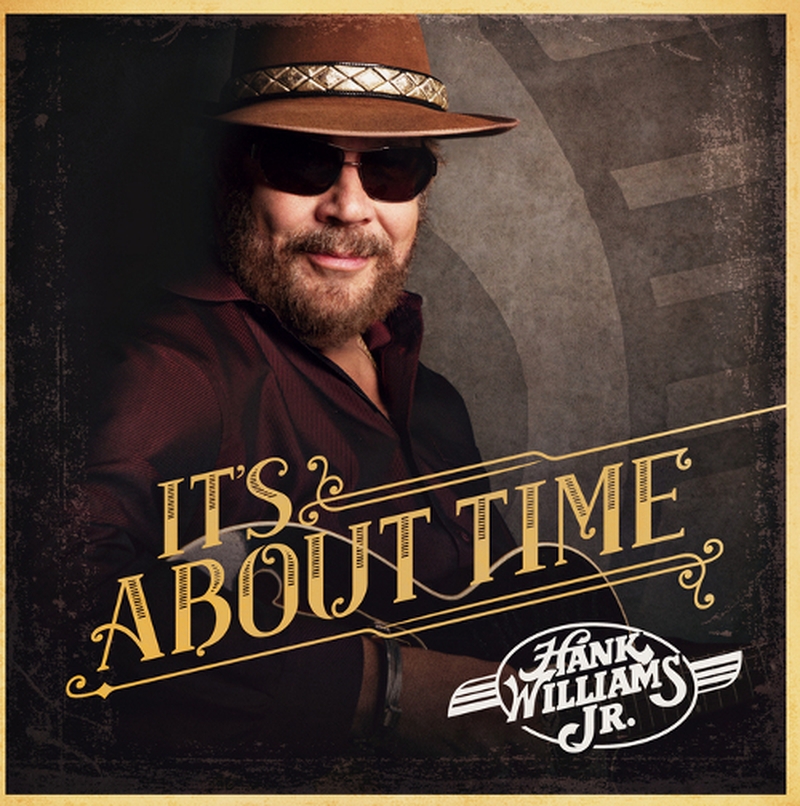
It’s hard to resist the Southern swagger and charm of Hank Williams Jr, but his album lacks cohesion in that it somehow doesn't marry its unashamed rock-out thing comfortably with its more tender moments.
Granted, what can you do - you have a bunch of high-octane country rock tunes and one or two less hectic things - how can you make 'em all sit well together? Well, they should have figured that one out in the production, because it sounds a bit like as if songs from a different album had wandered into the middle of the jamboree party stomper that is It's About Time.
Now 66, young Hank has enjoyed ten number one singles in his long career and his 21 albums have all attained at least gold status, so a nit-picky review is hardly gonna bother him. But he does tend to sing in one register most of the time. It's a kind of self-deprecating, insouciant snarl and his lyrics are a bit rushed-looking.
Randolph Hank - nicknamed Bocephus - is, of course, the son of the original Hank Williams and the father of Hank Williams III. He started singing his legendary dad’s songs at eight and one of the best things he ever did was the video for that moving, eerie duet of Tear in My Beer, which married black-and-white footage of his dad singing along with him .
But there is no mention of pops on this lively rascal of a record that stomps its way through on a slick country feed of growling, grungy guitars, fiddle and pedal steel, with wailing black female singers and a judicious use of brass. Heck, it ain’t pretending to be anything more than what it is and the lyrics essay down home values with no doubt a tongue firmly in cheek. God Fearin’ Man - not his song, incidentally - goes as follows: Just your ordinary, everyday/ One woman lovin'/baby raisin’//Blue collar God fearin’ man.
I prefer the way he sings “Dont call me an icon/I don’t care about the Hall of Fame” on his calling card, Just Call Me Hank, where he readily admits that he has been blessed, though with a dark hint too of the price paid. “God knows I thought I’d never shed the lovesick blues, " he sings.
Another of his own songs, Born to Boogie, unashamedly plays up the fun-loving side of the man. “I was put here to party and I was born to boogie." However, as the song nears its exhausted end, the Louisiana-born musician drops a terse reference to the cost of hedonism. He comes on kind of Steve Earle, in fact, which is no bad thing. “Aw yeah, heard that Hank Williams Jr Bocephus/High Pressurised OD in Denver/You know I knew it was a family tradition/Nice/Oh yeah." There is something strikingly sad and potent about that line - You know I knew it was a family tradition.
Incidentally, the album opens with a version of Neil Young's Are You Ready for the Country? which adds nothing of value to the song we know. There is too one truly awful song, a cover of a 2009 Lynyrd Skynyrd's God and Guns, which is simplistic in its dreadful pieties. And not, one feels, meant ironically at all. Phew. Why in tarnation you put that one in, Hank?
The best songs on the album are his strutty version of Reverend Charlie Jackson’s gospel classic, Wrapped Up, Tangled Up in Jesus (God’s Got It). Or there’s the vindictive curse which the jilted lover casts upon his ex in the Mel Tillis song, expertly revived with due feeling. “Now I hope that train from Caribou, Maine runs over your new love affair.” They just don't sing 'em that poisonous and rattlesnakey anymore.
Paddy Kehoe