
Two brothers spend a rare day with their father against the tense backdrop of Nigeria's 1993 election in this semi-autobiographical immersive debut from Akinola Davies Jr.
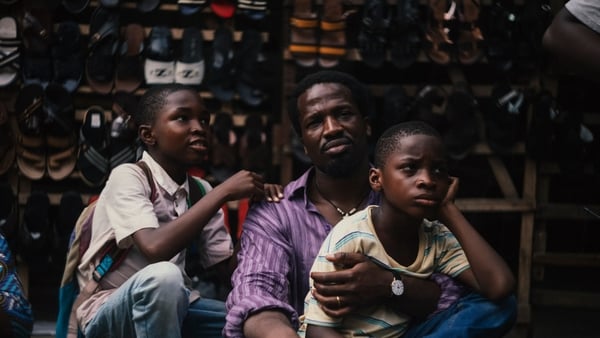
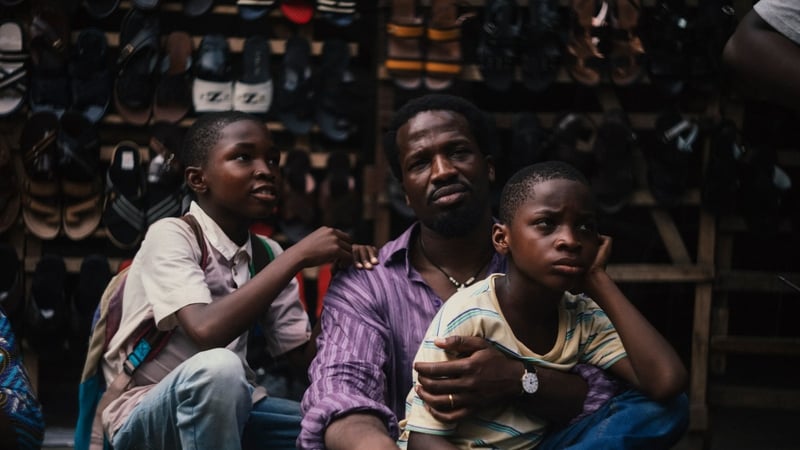
It's not immediately obvious that My Father’s Shadow is a period film, we open in dusty village outside Lagos where two young brothers, Aki and Remi (Godwin Chiemerie Egbo and Chibuike Marvellous Egbo), play wrestling using hand drawn paper cut outs. Only when they begin naming WWE wrestlers does the early 1990s setting click. That’s when their largely absent father, Fola (Sope Dirisu), appears, after some pleading he agrees to bring them with him to his workplace in Lagos.
The journey itself establishes the film’s attention to detail, on a crowded minibus, with Aki sat on a silent stranger’s lap, one of many small, unremarked cultural moments of texture scattered throughout the day. Fola is in the city to collect four months of unpaid wages, a process that leaves him waiting and anxious. Nigeria waits too. It’s result day for the first election since the 1983 military coup. The city and its ever looming soldiers carry the dreadful sense that something is about to tip.
As we wait, the boys and their father spend the day together. The camera stays close to the brothers, watching Fola with them, studying him, you can feel the desperate need to know this mysterious figure as he becomes a tour guide, pointing out landmarks, recounting stories of his past, and offering advice. The bonding is genuine if rushed.
The film feels driven by a need to understand the father at its centre, to catch glimpses of him character amid a busy setting. It’s subtle and its restraint is deliberate, and at times quite frustrating. Something that will divide audiences. This is not for everyone.
For those willing to meet it on its own terms, My Father’s Shadow offers something quietly devastating. Its impact is helped by the very raw feel of its cinematography, voyeuristic and documentary like, giving a very real grit to proceedings. An impressive and confident debut.