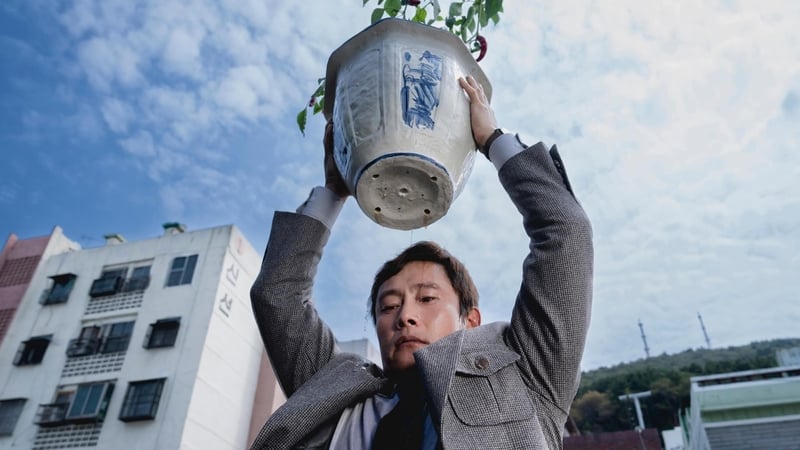

After losing his job, a struggling family man devises a murderous route back to gainful employment in Park Chan Wook's latest black comedy.
South Korean writer-director Park Chan-wook may have one of the most eclectic careers of any of his contemporaries. Many viewers in this part of the world were introduced to him via his action thriller with a twist, Oldboy. Since then, he has dabbled in surrealist sci-fi with I'm a Cyborg, But That’s OK, very dark horror with Thirst, Southern Gothic with Stoker, the erotic period thriller The Handmaiden, and the breathtaking neo-noir romance Decision to Leave. Suffice it to say, you never quite know what genre or subgenre you are going to get with a Park Chan-wook film, but you are guaranteed something engrossing and unpredictable. No Other Choice is no exception.
Man-su (Lee Byung-hun) is a long-standing employee of a paper-making factory. The job has provided Man-su and his wife Min-ri (Son Ye-jin) with a good life. He has been able to purchase his childhood home and pay for music lessons for his daughter, a neurodivergent cello prodigy. However, when the paper company is bought out by American investors who begin making drastic cuts, Man-su suddenly finds himself jobless. As his severance pay dwindles, reality starts to kick in. The dogs, the house, the cello lessons: they all cost money.
A desperate Man-su comes across a paper factory manager with his ideal role and begins to consider murder, only to realise that, in order to secure the position for himself, he would also need to knock off all the other ideal candidates. He identifies them by setting up a fake recruitment advertisement. There should probably be a question mark at the end of this film’s title.
For some, work is merely a means to an end. For others, it becomes identity. Park Chan-wook is interested in what happens when that identity is stripped away. No Other Choice captures the psychological freefall that follows, as well as the cruelty of a system where entire lives hinge on the financial decisions of distant executives.
Many films tackling these themes would place a Ken Loach-style, man-of-the-people hero at the centre, but this is a Park Chan-wook film, and Man-su is a deeply flawed and selfish protagonist. He prepares a righteous speech defending the employment of his team, but barely gets a word out before one of the new owners physically pushes him aside. From that point on, it’s everyone for themselves.
What follows is a very dark, but deeply funny caper, as Man-su, a man who seems to know nothing outside of the paper industry, awkwardly positions himself as a hitman. He’s bumbling, occasionally successful, and increasingly unhinged.
Absurd to the point of surrealism, with several laugh-out-loud moments delivered through the deadpan humour we have come to associate with South Korean cinema, No Other Choice packs an enormous amount into its running time. It raises plenty of questions about society, though perhaps not many answers. There are rarely clear answers when faced with the stubbornness of those who believe they have no other choice, whether that means laying off an entire factory, refusing to imagine a life beyond a single industry, or becoming a serial killer in pursuit of employment. You will be thinking about this one for weeks to come.