


In his infamous 1932 meditation on Spanish bullfighting Death in the Afternoon, Ernest Hemingway outlines what has since become the go-to piece of advice for aspiring writers everywhere. Popularly referred to as iceberg theory or the theory of omission, Hemingway tells us:
"If a writer of prose knows enough of what he is writing about he may omit things that he knows and the reader, if the writer is writing truly enough, will have a feeling of those things as strongly as though the writer had stated them. The dignity of movement of an ice-berg is due to only one-eighth of it being above water. A writer who omits things because he does not know them only makes hollow places in his writing."
A Beautiful Loan by Mary Costello is a near-perfect example of how this can be achieved. I don't mean that Costello’s writing has the emotional detachment of Hemingway (arguably his greatest weakness) or that we are left floundering for inferences which otherwise should’ve been told to us outright. I mean that Costello’s narrator speaks to us from the vantage of having got her life under control; that she does not need to test her own recall by padding the narrative with physical detail, so sharp are the outlines at work in her own mind.
We need your consent to load this rte-player contentWe use rte-player to manage extra content that can set cookies on your device and collect data about your activity. Please review their details and accept them to load the content.Manage Preferences
Listen: Mary Costello talks to RTÉ Arena
Beginning in 1980s Dublin, A Beautiful Loan is ostensibly about a series of unfurling relationships between the protagonist Anna and (in the first instance) her older and more worldly husband Peter. It has the emotional clarity of a monologue delivered in a psychoanalyst’s office, which has been stripped of all judgment, complexities laid bare. The writing does not wait for the therapist’s nod of approval, but expands naturalistically like a patient experiencing a breakthrough.
"The climate of the psyche, I might call this, the tropisms of the mind, the subtle vibrations of the soul that affect and, in some instances, determine the outcomes that constitute the historical data."
Where iceberg theory really comes into play is in the assumption that the reader knows - or at least has some passing familiarity with - the socio-political climate of Ireland in the not too distant past. This was a country in thrall to the Catholic Church, after all; a quasi-theocracy that not only devalued its women but effectively locked them into lives of domestic servitude. Contraception would not become fully available until 1985, and divorce would not be legalised for a further decade hence.
It is therefore unsurprising that the book’s central relationship begins following a probable sexual assault, or that Anna feels embarrassed about disclosing certain intimacies with friends. Her expectations as a young woman would’ve had little frame of reference and she would have been constitutionally obliged to endure her suffering behind closed doors. "As a couple, we do not function well in public," Costello writes. "We are at our happiest in private."
Against this backdrop, Anna finds herself stuck. She miscarries a pregnancy and is met with unremitting coldness from her husband, who even bars her from turning to her parents and siblings for support. At this, her lowest ebb, she reflects on the painful lot of Irish women, hinting at the lineage passed down to her from her mother, and (it is implied) from her mother before that:
"I was aware of her awareness of the end of hope. In her voice and her movements and in the air around her, it was possible to discern delicate shifts and vibrations, emanations that hinted at what love had once promised, and now was lost."
But A Beautiful Loan is not just about pain. There is redemption, too; a decisive break from that cycle of hopelessness, and discovery of the self against the strictures of national and domestic statehood.
Costello has been quietly ploughing her own furrow within Irish letters for the best part of 15 years, so it would be reductive to suggest that this - her fifth book - will appeal to fans of Edna O’Brien, or Louise Kennedy’s Trespasses, or Sally Rooney’s Intermezzo. What I will say is that this is yet another triumph in Costello’s illustrious career, and will hopefully bring her the plaudits that she so richly and fully deserves.
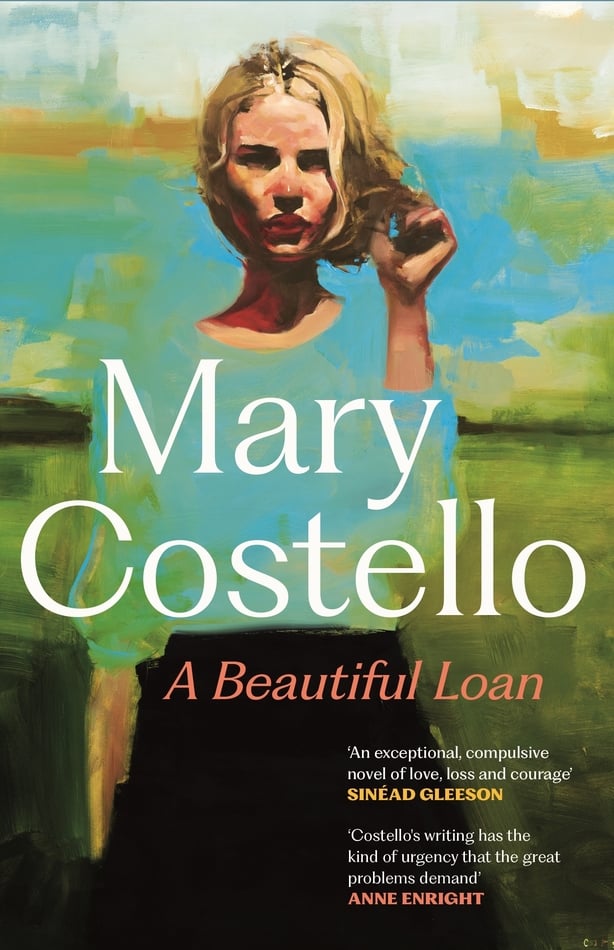
A Beautiful Loan is published by Canongate - read an extract here
The views expressed here are those of the author and do not represent or reflect the views of RTÉ
