


We present an extract from A Beautiful Loan, the new novel by Mary Costello, author of The China Factory and Academy Street.
In 1985 Dublin, nineteen-year-old Anna Hughes is in thrall to Peter Gallagher, an older, worldly man. Anna is introverted and naïve, and Peter's experience, wide circle of friends and thirst for adventure captivate her. Her obsessive longing for him leads to marriage and, eventually, a crushing betrayal. As Anna’s life becomes less predictable, she uncovers deeper layers of herself. Her journey gives an intimate portrait of a woman embracing herself as she is, claiming the life she yearns for.
His name is Peter. I can barely hear him above the din in the night club. I frown and shake my head and point to my ear and am about to move away when he says something in Irish that I do not fully catch, but which seems to indicate defeat, or retreat. Something a parent or teacher might say before moving on to the next child, something like, Maith an cailín. Whatever the words, the switch to Irish piques my interest, and I reply in kind, in barely adequate Irish.
There follows a rudimentary exchange, half shouted at each other's heads. Cad is ainm duit? Cárb as tú? Céard a thug anseo thú? Cén obair atá agat féin?
And then, Cén aois thú, Áine?
—Nineteen, I say, I’ll soon be twenty.
—How can you be finished college and a teacher at nineteen? he asks.
—My mother sent me to school at three – she wanted rid of me.
—I don’t believe that for a second, he says.
—Agus tú féin, a Pheadar, cén aois thú?
—Guess, he says, and I guess twenty-six, twenty-seven.
—Close, he says.
After a few minutes, we revert to English. He is originally from Donegal, and retains a touch of that warm precise accent. Handsome too, the more attention I pay, with brown eyes and clear, unblemished skin. Later, I will identify the moment he uttered those words in Irish as the moment that came to shape my life.
My longing to be with him starts immediately, and is relentless. From the pay phone in the hall outside my bedsit in Phibsborough, I dial his number over and over and, finally, he answers. On Saturday night he takes me to a barbeque at his friends’ house on the south side of the city. The weather is balmy, and I wear a yellow summer dress and white sandals. In the back garden Mike, the host, tends the barbeque, turning steaks and potatoes wrapped in tinfoil. His wife Alison pours me wine. I try to remember the names: Con and Maeve, Pat and Michelle, Jane, Richie. I can feel their eyes on me. They’ve known each other for years, perhaps since university. Some of them have children and baby-sitters at home. Maeve has been to a kibbutz; I think this a kind of cooperative farm in Israel, where young people go to work or volunteer. Con says something to Peter, or perhaps about Peter, that I cannot catch, and they all laugh. At Peter’s expense, I think, or maybe mine. I drink the wine quickly, and Alison refills my glass. Peter moves off down the garden, and I am not sure if I should follow him. I remain alone for a while until Alison returns, and I am so grateful and so nervous that I unleash a torrent of talk and gratitude. But soon, again, I am on my own. I drink more wine. There are lights on in the upstairs windows of the houses backing onto the garden, and I narrow my eyes, like I used to do as a child, until the lights blur and blend and double, and I feel dizzy and drunk. Suddenly I miss home. My father and mother, my sister and brother, will be in the kitchen, watching TV now. Ordinary life there and everywhere, happening without me. Back in my bedsit, the book I was reading earlier lies open on the table. The thought of it makes me less lonely. It has a black cover with a purple vertical stripe – and is not so much a book, I think now, as some gently-living thing. Poems 1955-1959 and An Essay in Autobiography. There is a photograph of the author, Boris Pasternak, on the front cover; he is wearing a belted overcoat and a cap, and he looks so ordinary, so rural – like the men I know from home, even like my father. He has an anguished look on his face, and he holds his hand to his heart as if he is pleading or appealing to someone. I know he has suffered. One night, years ago, long before I knew who Boris Pasternak was, my father and I watched Doctor Zhivago on TV. It was late and my brother and sister were in bed and my mother was moving around the house absorbed in her chores. My father and I forgot each other for a long time, and then, towards the end, I looked over at him and there were tears running down his face.
We need your consent to load this rte-player contentWe use rte-player to manage extra content that can set cookies on your device and collect data about your activity. Please review their details and accept them to load the content.Manage Preferences
Listen: Mary Costello talks to RTÉ Arena
I wake up in Peter’s bed, my yellow dress bunched around my waist. Instantly, I know. I can feel the pain. I close my eyes, then reopen them, hoping for a different reality. He is asleep on the other side of the bed. I remember nothing, or almost nothing. I am sick and panicked at the realisation of what has happened. I slide out of the bed and tiptoe unsteadily out of the room. In the bathroom, I begin to shake, and then vomit. My head is pounding. I cross the landing to another room in this strange house and get into a bed with no sheets. I cannot stop this shaking, or the rapid beating of my heart. Outside, it is Sunday morning. The street is quiet. After a while, a car starts up, and children come out to play. I turn and face the wall.
Then I feel him coming into the room.
—What’s wrong? he asks.
I cannot look at him.
— Are you upset?
Mortified, and still facing the wall, I tell him.
—I’m sorry, he says. I didn’t know.
When I turn around, I see he is naked, and I turn to the wall again.
—I didn’t want to do that, I say. I might get pregnant.
—There’s nothing to worry about, he says.
I cannot eat or sleep; I am paralysed with fear. Last year, a fifteen-year-old girl died giving birth alone in a church yard. Her baby died too. The whole country knew about it. I cannot call home; my mother will know from my voice that something is wrong. Or Kathy, my closest friend, because she has never had sex with Seán, her boyfriend. There are nine or ten days left in my cycle. In three weeks’ time, I will start my first job, teaching sixth class in a primary school in the west of the city. Now, the excitement and anticipation of that new life is ruined. Everything is ruined. If I am pregnant, it will be the end of the world. Worse maybe than death. I cannot say the word drunk, or bear to think of that night, so great is my shame. I had imagined a different kind of giving, an occasion of love, of love-making. Not this. Not this. But it is my own fault. I did it, I gave myself to him. I lie on my bed, going over everything. This has to mean something, he has to mean something. I have to make it mean something. I get up and go to the pay phone in the hall and call him.
I go to the bathroom ten times every hour to check. I go to the church every day and pray, until, finally, the danger has passed.
—I told you, Peter says when I call him, jubilant, that night. I told you there was nothing to worry about.
He drops by, sporadically, after work. I never know when he’s coming, so I stay in after school every evening, afraid even to go to the shops in case I miss him. My heart jumps when the doorbell rings and there he is, in his suit and tie, tall and lean and narrow, with long legs and not an ounce of fat on him, the kind of body I will always love in a man. Brown-eyed, dark-haired, clear-skinned. I would like us to go out, do normal things together. I would like to cook dinner, but he never stays long enough, and I’m certain my culinary skills and the rudimentary cooking facilities in my bedsit fall far short of what he is accustomed to. We lie on my single bed, and kiss and press against each other and touch each other, like Kevin my old boyfriend and I used to do. When things start to go further, I push him away. But I know it cannot go on like this, that he will not stand for it.
One Friday evening, he picks me up and we drive across the city and do a big shop in Superquinn, and continue on to his house. When I enter, I push through the air in the hall and force away all thoughts of my previous time in this house. I am changed now, I am an adult. Together, we cook dinner; I set the table and make a salad; he grills the steaks and opens the wine. I look around the kitchen, at the yellow cabinets and the patterned floor tiles, and when he turns and smiles and clinks his glass against mine, I see the tree in the back garden and the little shed in the corner, and finally, I feel calm. But when we go to bed and I do not let him go all the way, he grows impatient and turns away.
In the morning, I expect he will dismiss me, but he is his usual self again. When he says, See you this evening, as he goes off to climb mountains with his friends, I am elated.
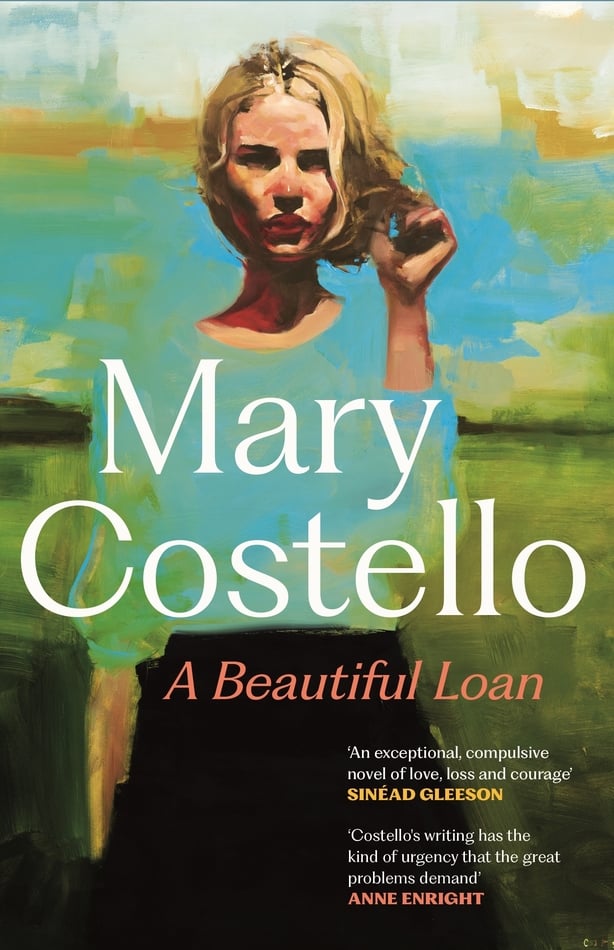
A Beautiful Loan is published by Canongate
