

Analysis: NASA are talking big about human presence on the Moon, but their ambitious plans face many technical, practical and political challenges
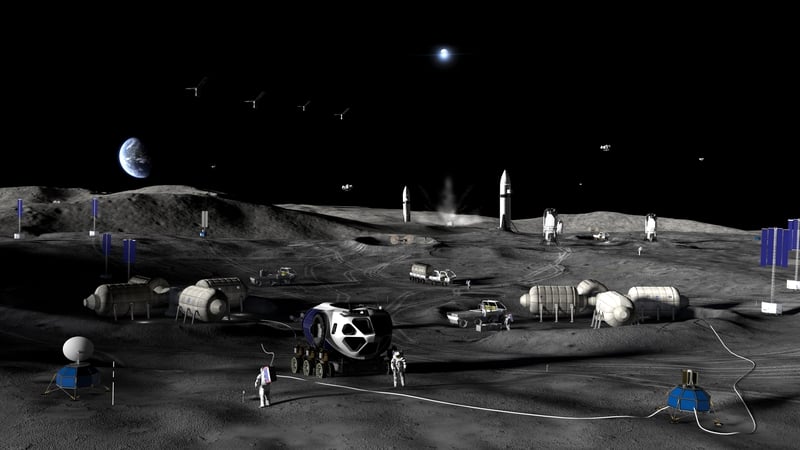
This week, NASA announced a three phase plan to establish a major Lunar Base in the south pole region of the Moon. If ultimately successful, this will see the US and international partners such as Europe, Canada, Japan and the UAE establish a permanent human presence on the Moon by the mid 2030s
Similar ambitions by the Chinese to land humans on the Moon by 2030 and to establish a similar lunar base at the Moon's south pole by 2035 means that a new geopolitically motivated space-race is underway. All of this is supported by significant commercial interest and participation along with the belief that we are technologically ready for such unprecedented feats of human space exploration.
We need your consent to load this rte-player contentWe use rte-player to manage extra content that can set cookies on your device and collect data about your activity. Please review their details and accept them to load the content.Manage Preferences
From RTÉ Radio 1's Morning Ireland, Kevin Nolan from TU Dublin on NASA's plan for a base on the Moon
NASA on a high
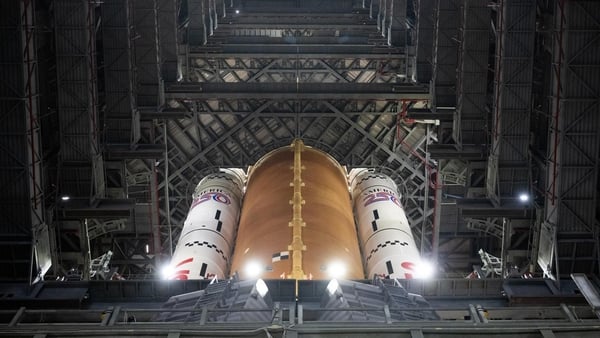
NASA's announcement comes on the back of the success of their recent Artemis II mission, which saw four astronauts successfully circle the Moon and return safely to Earth. A feat of extraordinary human endeavour, this mission proved the operational capabilities of the huge Space Launch System (SLS) rocket needed to bring people to the Moon, as well as the Orion crewed spacecraft and the European Space Agency-built European Service Module which propelled them on their 10 day mission from Earth-orbit to the Moon and back again.
If NASA is ready to send people to the Moon and back again for the first time in over 50 years, they view SpaceX's gargantuan Starship as a vital part of a permanent presence on the Moon. With twice the power of Saturn V and largely reusable, it is capable of bringing humans and huge payloads to the surface of the Moon. While beset with setbacks, the launch of Starship Version 3 earlier this month has enabled NASA to feel more confident about its future participation. However, the US Federal Aviation Administration (FAA) declared the launch a mishap and is launching an investigation before it can take to the skies again.
We need your consent to load this rte-player contentWe use rte-player to manage extra content that can set cookies on your device and collect data about your activity. Please review their details and accept them to load the content.Manage Preferences
From RTÉ News, coverage of the successful return to Earth by the Artemis II crew
Chinese ambitions
China's plans for the Moon are equally ambitious and recent activity has been noteworthy. This includes the development of their own super-heavy lift Long March 10 rocket, Mengzhou crewed spacecraft (similar to NASA's Orion used in Artemis II) and Lanyue Lunar Lander (which is further along the development path than NASA's equivalent landers).
Earlier this week, China launched three astronauts to their Tiangong Earth-orbiting space station with one of those astronauts staying for more than one year in space with a view to long-term stays on the Moon through the 2030s. All of these factors has lead to NASA sharpening its ambition toward getting boots back onto the Lunar surface by 2028 and establishing a permanent lunar base by the mid 2030s.
The moon brought to you by....Toyota?
While the timelines may be ambitious, the various components to make it happen are taking shape. Artemis/SLS gets astronauts to the Moon and home again and a successful Starship enables large payloads to be set onto the Moon at minimal cost.
We need your consent to load this rte-player contentWe use rte-player to manage extra content that can set cookies on your device and collect data about your activity. Please review their details and accept them to load the content.Manage Preferences
From RTÉ Radio 1's Today with David McCullagh, Dr Shane Bergin from UCD's guide to the moon
NASA's new Commercial Lunar Payload Services will see a plethora of private companies such as Jeff Bezos's Blue Origin, Intuitive Machines and even Toyota developing low cost means to bring payload to and from the Moon. There will also be the development of a range of technologies to utilise the Moon's natural resources, such as pressurised rovers for astronauts to travel for days on end across the lunar surface (Toyota), lunar mobile-phone based communications and the construction of lunar habitats to establish a permanent base.
What happens next?
NASA's new plan involves three phases. The first phase - Learn, Test, Build - will see NASA and partners develop new technologies and conduct many unmanned lunar landings to test those technologies across resource utilisation, travel across the lunar surface and communications, among others.
Targets here include getting Blue Origin's Endurance unmanned lander, Astrobiotic's Griffin-1 lander (which will carry several lunar rovers on board) and Intuitive Machines' IM3 Lander all to land near the lunar south pole. In total, 25 lunar unmanned missions will take place by 2029 to lay the foundations for the establishment of a human base. It's anticipated that Artemis IV will land two humans on the lunar surface, also near the south pole, in 2028.
From Toyota, a scale model Lunar Cruiser exhibited at the Japan Mobility Show in 2023
Phase Two - early habitation - will commence in 2029 and involve the deployment of 60 tonnes of payload onto the lunar surface in the form of a JAXA/Toyota pressurised rover. This will include the infrastructure for human stays on the Moon - nuclear power in the form of radioisotope thermoelectric generators - a well tried and tested power generation system, implemented most famously on the Voyager 1 and 2 space probes now in interstellar space. Solar power units and surface communications based on mobile-phone telecommunications technology will also be implemented.
The final phase - sustained human presence - will continue into the 2030s with the annual deployment of up to 30 tonnes of cargo, including the first habitats which ESA will likely have a serious role in. All of this will build towards a more sophisticated lunar base for ever longer stays, the setup of lunar resource utilisation and the return of significant scientific payloads from the Moon back to Earth.
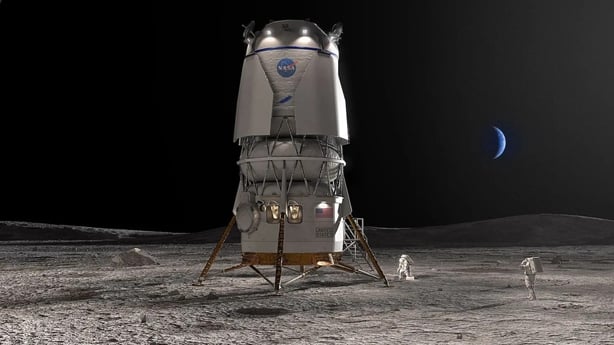
Of course, human landings will require the operation of SpaceX's Starship and associated Human Landing System as well as Blue Origin's Blue Moon human lander. If all goes to plan, we may well see astronauts, including some from Europe, on the lunar surface for prolonged stays by the mid to late 2030s.
Health warnings
This ambitious plan does come with some health warnings. Firstly, this three-phased process is arguably not as new as NASA administrator Jared Isaacman would have us believe. While this new phased approach is new and succinct, the individual components - robotic drones, rovers and hoppers, pressurised rovers and so forth - were all announced over the past 10 years and are underway in any case and much of it at a slower than projected pace. No significant increase in budget has been provided to NASA to achieve all of this ambitious plan. That said, they can achieve at least the first two phases with existing budgets and are banking on increased commercial interest into the future.
There is also the issue of MAGA politics driving much of this program. Placing people back onto the Moon by 2028 is surely motivated by US president Donald Trump leaving office in 2029, and also because there is a realistic possibility of China achieving this feat by 2030 to 2032.
While NASA claim that scientific exploration is a major objective of this program, Trump's recent proposal for a staggering 46% cut to NASA's science budget for 2027 does call this into question. A similar cut was proposed for this year, but was defeated in Congress after massive campaigning across the US. This time, those massive cuts are supported by Trump-appointed NASA administrator and billionaire entrepreneur Isaacman, the first time ever a NASA boss has supported a cut in the organisation's budget.
From PBS News Hour, how the Trump administration's plans to slash NASA's budget will impact science
Much of this program hinges on the success of SpaceX's gargantuan Starship rocket and the viability of such a gigantic rocket for safe human spaceflight remains questionable. Indeed, the viability of the proposed Human Landing System (HLS) - the upper stage of Starship over 50m in height, almost a high as Dublin's Liberty Hall - to land on the Moon, is just as debatable.
Then, there is the issue of the ever-changing nature of NASA's goals which has undergone radical changes on a regular basis depending on who is in the White House. Significant programs are now shelved, including Mars Sample Return and the Lunar Gateway space station, both of which the ESA spent billions of euro on.
Whatever the motivations, challenges and timelines, it is now clear that we are going back to the Moon
Indeed NASA's reliability as an international partner beyond a four-year timespan is now up for debate, with the NASA-ESA relationship almost as fractious as the general US-Europe relationship. All of these factors leave many wondering if this new and ambitious program can even survive the next presidential election.
But whatever the motivations and pace, it is now clear that we are going back to the Moon. Most pessimistic timelines see this happening by the mid 2030s, with the emergence of permanent bases on the Moon through the late 2030s and on towards the 2040s. The future in space we've talked about for 60 years is finally coming.
Follow RTÉ Brainstorm on WhatsApp and Instagram for more stories and updates
The views expressed here are those of the author and do not represent or reflect the views of RTÉ