





Analysis: Be it bottlers, chokers or the yips, a failure to perform under pressure is often part of the story of teams and players who become champions
For the first time since the "Invincibles" season of 2003/04, when Arsène Wenger's Arsenal team went the whole season unbeaten, the club have been crowned Premier League champions. For Mikel Arteta's team, feelings of joy and pride in their accomplishments may aptly describe the experience as many of the players lifted their first Premier League trophy.
But amidst the celebrations, one powerful feeling may have prevailed amongst the emotional cocktail: relief. Arsenal’s road to triumph was paved with many disappointments. Perennial bridesmaids, they had finished runners-up the last three seasons in a row, twice to Manchester City, having been top of the table with seven games remaining both times. These past failings have prompted fans and pundits to label the team as "bottlers", a common term used to describe a team or athlete who fails to perform under pressure.
While often used disparagingly, some of the greatest athletes of all time have been branded with this tag. LeBron James was roundly labelled as a "choker" (the American equivalent) following playoff failings during the pursuit of his first NBA championship. Similar criticisms were levelled at Rory McIlroy as he searched for his first major championship since 2014, particularly after a final-day collapse during the 2024 US Open. One common thread between these cases is that "choking" or "bottling" seems to be a crucial part of the journey towards success.
We need your consent to load this rte-player contentWe use rte-player to manage extra content that can set cookies on your device and collect data about your activity. Please review their details and accept them to load the content.Manage Preferences
From RTÉ Radio 1's Morning Ireland, Arsenal crowned Premier League champions for first time in 22 years
The prevalence of choking within professional sport has prompted a wealth of psychological theorising from both media and academia. While there may be many explanations for this phenomenon, one possible explanation lies in the typical pattern of skill development which tends to progress from cognitive to associative to automatic processing.
In the earlier stages, athletes exert cognitive or "conscious" effort on their technique, akin to a young footballer looking at their feet to ensure the football is controlled properly. As athletes develop, associations between actions and outcomes become learned and repeated (e.g. receive ball, pass to X).
Finally, at the top-level, performance is automatic; previous attentionally demanding movements and actions are now replaced with automatic processes which are faster, smoother and more energy efficient. Importantly, attention can now be directed away from an athlete's internal movement mechanics (known as interoception) towards a more detailed focus on events unfolding on-field (known as exteroception).
From RTÉ Sport, highlights of Arsenal's 1-0 win over Atletico Madrid to reach the Champions League final against Paris St Germain
Faced with the unrelenting psychological pressure that comes with chasing the top prizes in professional sports, athletes tend to regress from automatic to cognitive performance, relying upon the internal processes which got them to where they are. However, experiments have shown that this shift from external to internal focus is detrimental to performance and disproportionately affects higher-skilled athletes.
The empirical evidence also aligns with anecdotes from the athletes mentioned previously. McIlroy, speaking about his double bogey on the 13th hole during his 2025 Master’s victory, remarks on how he overcorrected a wedge shot, sending the ball to the right into the greenside creek. Now revered as one of the greatest basketball players ever, James openly admits to "overthinking everything" during his dismal performance in the 2011 NBA Finals, where he averaged seven points fewer than he did in the regular season.
For Arsenal, this pressure-induced shift in focus came at a potentially fatal moment this season, when Gabriel Martinelli decided to press high against Manchester City, leaving Nico O'Reilly with acres of space to run into and set up the game-winning goal. As outlined by analyst Jamie Carragher, Martinelli's internal focus on his specific role when defending (e.g. press high) may have reduced his ability to process the dangerous situation unfolding externally.
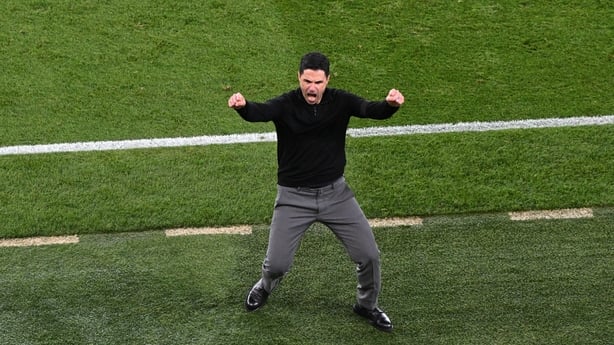
But pressure affects everyone involved on the road to success, not just the players. Following setbacks during the season, Arteta's response was to train harder and seek to regain control of what may have appeared to be a spiralling campaign. However, as Miguel Delaney reports, Arsenal's summer recruit, Eberechi Eze, sensed a tense atmosphere and advocated for lighter training and space to decompress.
Arteta took this advice on board, training sessions were lightened and the squad were given additional days off. While these changes undoubtedly help manage the physical toll the season was taking on the players, the psychological benefits cannot be underestimated. Eze displays an intuitive grasp of something scientists are still trying to understand in greater detail: that overtraining can reduce performance under pressure.
The most extreme and well-understood example of this is the "yips", a phenomenon in golf where players experience involuntary wrist spasms just as they are about to putt. Some of the greats of the game have been affected by the yips, such as Bernhard Langer, Ben Hogan and Tom Watson.
We need your consent to load this rte-player contentWe use rte-player to manage extra content that can set cookies on your device and collect data about your activity. Please review their details and accept them to load the content.Manage Preferences
From RTÉ Radio 1's Drivetime, how top sports stars cope with pressure
The involuntary wrist spasms associated with the yips are referred to as focal dystonia in scientific literature. Research suggests that repetitive motor activity may trigger focal dystonia through abnormal changes in brain regions involved with motor control, such as the basal ganglia and motor cortex. These findings suggest that feelings of choking under pressure may not be purely psychological, and that responding to pressure by upping training intensity may exacerbate rather than alleviate these feelings.
Ultimately, there is no one-size-fits-all solution to handling pressure in elite-level sport. The best coaches have an instinct for when to light a fire under their players and when to cool the temperature of the room. Arteta’s ability to strike that balance with his team in the years and title races to come will determine whether this Arsenal side is remembered as a one-hit wonder or a modern-day Premier League dynasty.
Follow RTÉ Brainstorm on WhatsApp and Instagram for more stories and updates
The views expressed here are those of the author and do not represent or reflect the views of RTÉ

