
Analysis: Over 40 years since its publication, Ann Brady's No Mate for the Magpie has sparked renewed interest and attention thanks to her unique writing style
There is no shortage of female writers writing about life in Northern Ireland at the moment. Award winners such as Anna Burns, Jan Carson and Lucy Caldwell, to name just a few, explore aspects of life in that part of the island in their work. Going back around 40 years ago, however, there was a smaller pool of women writers treading that path. Ann Brady was one author who stood out because of her unique writing style. Her debut novel, No Mate for the Magpie, was one of the more unusual books to appear during the Troubles.
Written in a hilarious deadpan style of humour and published in 1985, this satirical novel offered a wry semi-autobiographical account of a young woman growing up in Northern Ireland during the 1950s and continued up to the start of the Troubles. The main character is Ann Elizabeth McGlone, a Catholic from Derry, who was born with what she called a "wee screwed up protestant face an' a head of black hair".
Published under the penname of Frances Molloy, it was written in what has been described as the "rich vernacular of working-class Derry". In an effort to explain the novel’s unusual style, Maeve Binchy said that it was written "in a language that looks like code at first, but after a page you wonder why everyone doesn’t speak like this". It is told in the first-person but instead of I being used as the first-person pronoun, 'a’ is used in its place. My becomes ‘me’, with the narrator stating that "a was called after me two grannies", to explain how she got her name.
We need your consent to load this rte-player contentWe use rte-player to manage extra content that can set cookies on your device and collect data about your activity. Please review their details and accept them to load the content.Manage Preferences
From RTÉ Radio 1's Sunday Miscellany, Green shoots of hope in the darkest days of the Troubles, Belfast in the mid-1970s
Along with poverty, violence and prejudice, religion is an ever-present theme in the book. Episodes from childhood are recounted through the innocent eyes of a child. Ann tells of arranging to meet up with her young Protestant friend, June, in advance of an Orange Order march. Their aim was "te stap protestants an’ catholics fightin’ on the twelfth of July". Ann thought that June was great fun to be with because she "wasn’t always goin’ on about how iverthin’ was a sin" like some of her other friends. Ann got caught up in the march, convincing herself that she could put "a stap te all the squabblin’ that went on aroun’ the twelfth". Ann’s mother laughed at her daughter’s childlike innocence.
No Mate for the Magpie has been labeled a picaresque novel, that is, one that follows the exploits of a roguish hero, usually of low social class. The family had to move house after her father was arrested by "polismen" and B specials. He spent four years in jail after refusing to sign a document to say that he would have nothing more to do with the IRA (which he had nothing to do with anyhow). At one time, they lived in an area nicknamed ‘Korea’, as the neighbours were "always fightin’ an’ throwin’ bricks an’ bottles through each others windows". When Ann’s father returned, he was unrecognisable to the young girl, who was convinced that he was an imposter.
The book presents tales of everyday life growing up in a divided society but there are moments of light relief. Ann went to see Brendan Boyer and the Royal Showband do the Hucklebuck. She made a plan to never wash her arm after he autographed it but she had to relent when she entered the convent. After a couple of years as a nun, Ann left the nunnery and sought work in Belfast. Facing discrimination on account of her religion, she moved between jobs including a stint as a machinist in a pajama factory. It was festooned with banners bearing slogans such as "DEATH TO ALL PAPISTS" and "GOD SAVE KING BILLY". She left the following day. She also worked as a Catholic priest’s housekeeper.
We need your consent to load this rte-player contentWe use rte-player to manage extra content that can set cookies on your device and collect data about your activity. Please review their details and accept them to load the content.Manage Preferences
From RTÉ Radio 1's Oliver Callan, Author, Wendy Erskine, on her book based in post-troubles Northern Ireland
Some of the key political personalities of the time such as Bernadette Devlin and Ian Paisley feature in the novel. Paisley was described in the author’s inimitable style as a "shockin’ big important high-up man", who attracted attention by trying to stop university students who were demanding basic civil rights for Catholics. Devlin was labeled this "wee student girl outa Cookstown" who would be on television almost every night "talkin’ rings roun’ the lot of them", according to the narrator.
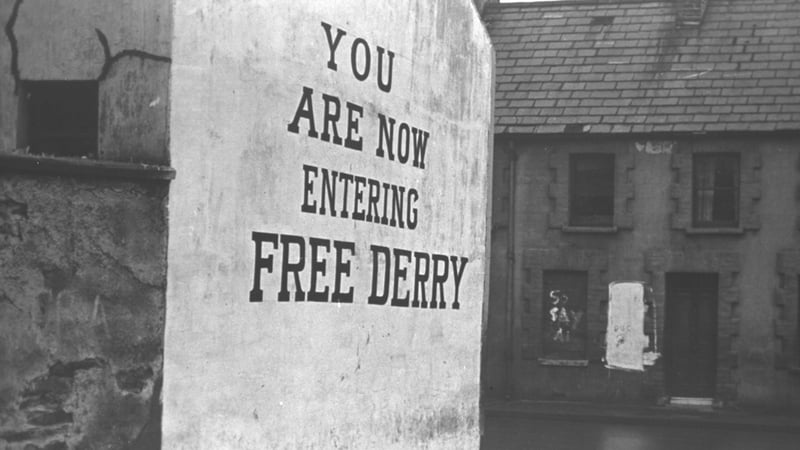
Moments from the start of the Troubles also feature in the book such as an account of the RUC baton charging civil rights marchers in Derry in October 1968. The loyalist ambush on a civil rights march organised by People’s Democracy at Burntollet Bridge in Derry in January 1969 is also mentioned.
The book’s author, Ann Brady (née McGill), was born in Dungiven, Co. Derry in 1947. Her life story mirrors the tale told in the book. After what she termed a "patchy education", she left school at 15 to work in a pyjama-making factory. She became a nun but left the convent after a number of years and went to live in England. She died there in 1991.
We need your consent to load this rte-player contentWe use rte-player to manage extra content that can set cookies on your device and collect data about your activity. Please review their details and accept them to load the content.Manage Preferences
From RTÉ Radio 1's Arena, Abie Philbin-Bowman on how the Troubles have inspired popular music.
The 40th anniversary of this perceptive book’s publication in 2025 led to renewed interest in it. A symposium to discuss its impact, organised by Dr Stefanie Lehner of Queen’s University Belfast and Dr Laura Kennedy of UCC, was held in the Museum of Free Derry in November. A new biography of the author entitled, Frances Molloy: The Portrait of a Postwar Northern Irish Woman Writer, was published by Prof Jennifer M. Jeffers.
Follow RTÉ Brainstorm on WhatsApp and Instagram for more stories and updates
The views expressed here are those of the author and do not represent or reflect the views of RTÉ