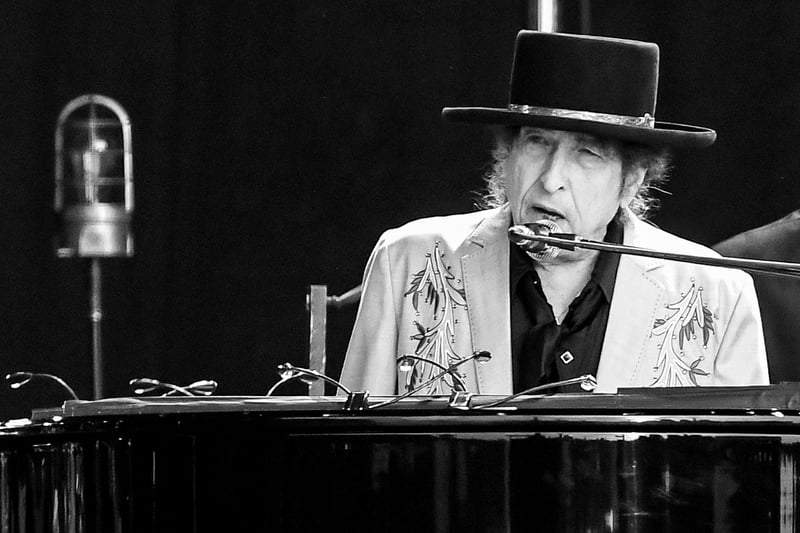


Analysis: In the same way that we still read Joyce, Shakespeare and Homer, we will doubtless listen to Dylan for years to come.
When Bob Dylan won the Nobel Prize in Literature in 2016, becoming the first songwriter to do so, fellow poet-musician Leonard Cohen was asked for a response. Awarding Dylan the Nobel, Cohen retorted, was "like pinning a medal on Mount Everest for being the highest mountain."
The legendary US singer-songwriter turns 85 this week. In attempting to assess his legacy for the occasion, the Everest metaphor is worth returning to. Like the sheer undeniability of the height of that famous mountain, Dylan's musical impact is beyond question. How can one attempt to capture the contribution of the man often referred to as the voice of his generation, who performed both at the March on Washington, alongside Martin Luther King, Jr. and, half a century later, in the White House, for America’s first Black president? In this one man runs the sweep of modern American history.
The Nobel Committee’s citation is perhaps a good place to start. Dylan won the award, they wrote, "for having created new poetic expressions within the great American song tradition." Look through music history and Dylan’s imprint is clear. Sam Cooke was inspired to write his civil rights anthem, A Change is Gonna Come, after listening to Blowin’ in the Wind. Joni Mitchell arguably needed to hear Dylan before she could write her confessional album, Blue. "There came a point when I heard a Dylan song called Positively 4th Street and I thought 'oh my God, you can write about anything in songs’."
We need your consent to load this rte-player contentWe use rte-player to manage extra content that can set cookies on your device and collect data about your activity. Please review their details and accept them to load the content.Manage Preferences
From RTÉ Radio 1's Arena, Séan spoke to Sean Latham, Director, Institute of Bob Dylan Studies, songwriter Mick Flannery and Music Journalist John Meagher, about the life and music of the great music artist.
The songs are doubtless his most tangible legacy. He has written more than 600 of them (closer to 1,000 by his own estimate), among which one, Like A Rolling Stone, holds the accolade of best-ever record. In the same way that we still read Joyce, Shakespeare and Homer, we will doubtless listen to Dylan for years to come. In being awarded the Nobel, the Committee assured Dylan’s place in the great literary canon.
What makes Dylan’s songs so successful is partly the chimerical quality of the lyric, how they manage to flit between the surrealistic and the mundane. "You lose yourself, you reappear" he sings on It’s Alright Ma, which could mean both everything and nothing. He also has his fair share of the vulgar, as on the aptly titled Idiot Wind: "You’re an idiot, babe/ It’s a wonder that you still know how to breathe". Paul Simon put it well, when he said "everything he sings has two meanings. He's telling you the truth and making fun of you at the same time."
The troubadour’s songs are partly so special for their musical quality, too. The songs manage both to connect with, and yet break from, the great American musical tradition: country, blues, rock and folk. Dylan soaked up these great sounds of his youth, and let them out in an alchemic, frenzied, blended, incomparable style. "I opened my heart to the world and the world came in", he sings on False Prophet. Yet, when asked what his songs are about, Dylan returns, in typically confounding style, to the mundane: "some are about four minutes; some are about five, and some, believe it or not, are about eleven or twelve."
We need your consent to load this rte-player contentWe use rte-player to manage extra content that can set cookies on your device and collect data about your activity. Please review their details and accept them to load the content.Manage Preferences
From RTÉ Radio 1's Arena, Arts journalist Pat Carty looks at Bob Dylan's album Desire 50 years on
Dylan confounded even to the Nobel Committee. After announcing the awarding of the prize to Dylan, the troubadour was uncontactable for weeks. Everyone, including the Committee itself – was unsure whether he would even accept the award. In the end, he did. But he did not attend the prize-giving ceremony in Stockholm and gave his lecture – upon which the nearly $900,000 prize money depended – with more than a little help from SparkNotes. This is the enigmatic nature of Dylan. He wins the largest prize in Letters, bunks the ceremony and gives a semi-ripped-off lecture for the prize money. As he sings on a song of the same name: "I contain multitudes."
Dylan won the prize for a lifetime’s worth of work. Yet his legacy is often reduced to the big, early moments: arriving in New York as Robert Zimmerman, a scrawny young upstart; playing the folk clubs in Greenwich Village as a disciple of Woody Guthrie and changing his name to Dylan; becoming the voice of youth protest: pro-civil rights, anti-war; and finally betraying his roots by going electric at the Newport Folk Festival in 1965. The average listener would think Dylan’s career ended in the mid 60s.
Dylan has had remarkable longevity, however. Since receiving the Nobel, Dylan has released one of his most acclaimed albums, Rough and Rowdy Ways (2020), and a book of music criticism, The Philosophy of Modern Song (2022). Most remarkably, Dylan has continued his so-called 'Never Ending Tour’, averaging 100 shows per year since 1988. Last year alone, he played more than 80 concerts across 13 countries, finishing with two nights in Killarney and a night in Dublin. Where others have lamented their Nobel as the end of their career – with Dylan favourite, T.S. Eliot, seeing it as "a ticket to one’s funeral" – the troubadour seems unphased by his award.
We need your consent to load this rte-player contentWe use rte-player to manage extra content that can set cookies on your device and collect data about your activity. Please review their details and accept them to load the content.Manage Preferences
From RTÉ 2FM's Dave Fanning, Sean Latham on his new book, 'The World of Bob Dylan', which chronicles a lifetime of creativity
In thinking, finally, of Dylan’s legacy, we may do well to return to the Everest comparison. On Blowin’ in the Wind, Dylan himself uses the image of a mountain. But he does not convey with it a sense of size, as Cohen intended, but rather of the vast, geologic, time that a mountain embodies. "How many years must a mountain exist/ Before it is washed to the sea?", Dylan sings. Reflecting this sense of time is the fact that, while Dylan performed this song at the March on Washington for civil rights, that same song could today represent so many different struggles. And doubtless more tomorrow. Long after the troubadour departs this stage, the songs will remain. Time passes; the mountain still stands.
Like Everest, then, Dylan’s legacy will be measured in millennia. What form his legacy will take, it would be foolish to guess. The answer, as Dylan knew then, "is blowin’ in the wind".
Five essential tracks
Like A Rolling Stone (1965). Voted the greatest song of all time by Rolling Stone magazine, Bruce Springsteen famously described the opening snare shot as having "kicked open the door to your mind".
From YouTube channel Bob Dylan, Like A Rolling Stone
It’s Alright, Ma (I’m Only Bleedin’) (1965). From the album when Dylan went electric – to the cry of ‘Judas!’ from some fans – this song features some of his sharpest and most surrealistic lyric.
From YouTube channel Bob Dylan, It's Alright, Ma (I’m Only Bleedin’)
Hurricane (1975). Written in protest of the wrongful imprisonment for murder of the boxer, Rubin Carter, Dylan used the song to campaign for Carter’s release. Unique in Dylan’s discography, the song was co-written with fellow songwriter, Jacques Levy.
From YouTube channel Bob Dylan, Hurricane
Not Dark Yet (1997). A slow track with raw, pare lyric, in which the narrator (perhaps Dylan) faces up to their own mortality. The album, Time Out of Mind, won Dylan his first Album of the Year Award at the Grammys.
From YouTube channel Bob Dylan, Not Dark Yet
Murder Most Foul (2020). Dylan’s longest ever song, centring on the assassination of US President JFK, clocks in at 16 minutes and 54 seconds. Unexpectedly released in the early days of the Covid-19 pandemic, the song preceded his 40th, and latest, studio album, Rough and Rowdy Ways.
From YouTube channel Bob Dylan, Murder Most Foul
Follow RTÉ Brainstorm on WhatsApp and Instagram for more stories and updates
The views expressed here are those of the author and do not represent or reflect the views of RTÉ