

Analysis: What are the dangers and risks when global political and military events become financial betting markets?
In April, US prosecutors charged a Special Forces soldier with allegedly using classified information about a military operation in Venezuela to make more than $400,000 betting on prediction markets. According to federal prosecutors, Master Sergeant Gannon Van Dyke allegedly used insider knowledge connected to the operation that resulted in the capture of Venezuelan president Nicolás Maduro.
Prosecutors claim he placed bets on prediction platform Polymarket that Maduro would soon be removed from office and that US military action would occur in Venezuela, wagers that reportedly generated enormous profits once the operation unfolded publicly. The case is believed to be the first insider trading prosecution linked directly to a prediction market - and it may not be the last.
We need your consent to load this rte-player contentWe use rte-player to manage extra content that can set cookies on your device and collect data about your activity. Please review their details and accept them to load the content.Manage Preferences
From RTÉ News, US launches airstrikes on Venezuela and captures president Nicolás Maduro
Around the same time, online traders and investigators were already scrutinising unusual market activity surrounding geopolitical events, elections, tariffs and oil prices. Following several high-profile posts by US president Donald Trump on his social media platform Truth Social, including messages that moved financial markets within hours, questions emerged around whether politically connected traders could exploit rapid information shifts before the wider public fully reacted.
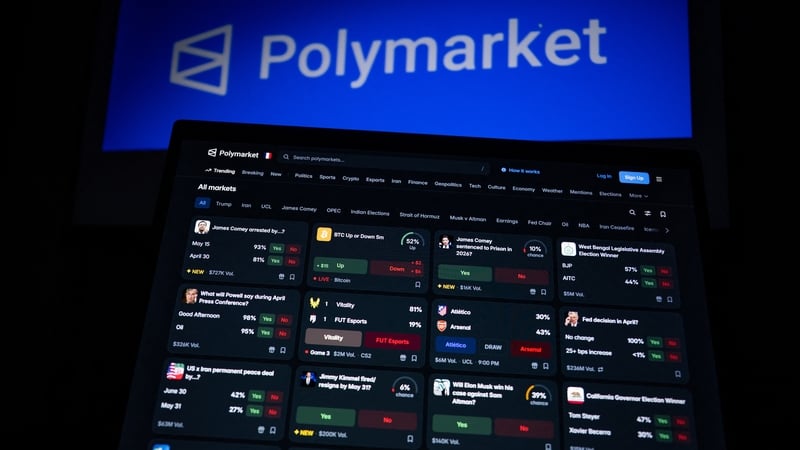
Of course, none of this necessarily proves widespread wrongdoing. But these incidents are forcing regulators, governments and financial observers to confront a strange new reality: what happens when world events themselves become financial betting markets? This question sits at the centre of the growing fascination surrounding Polymarket, one of a number of cryptocurrency-based prediction market platform where users can place wagers on elections, wars, interest rates, political resignations, economic decisions and geopolitical developments.
At first glance, the platform looks deceptively simple. Users buy and sell "Yes" or "No" shares tied to future outcomes. If enough traders believe an event is likely, the price rises. If confidence collapses, the price falls. Suppose there is a market asking: Will Candidate X win the election? If "Yes" shares trade at 70 cents, the market is effectively implying a 70% probability of victory. If the prediction proves correct, those shares settle at $1. If not, they become worthless. In essence, Polymarket transforms uncertainty into a live financial market and users can trade on politics, economics, technology, sport, culture and global affairs in real time.
From RTÉ Radio 1's Brendan O'Connor Show, 'this used to be called insider trading". Liz Carolan from TheBriefing.ie on the rise of online prediction markets
But what makes prediction markets increasingly controversial is not simply the betting itself. It is the possibility that people with superior information may be able to profit from knowing things before everyone else. That tension is exactly what makes prediction markets both fascinating and potentially dangerous. Markets become more valuable when participants possess different levels of information. In traditional finance, this is why insider trading laws exist. Regulators attempt to prevent individuals from profiting unfairly from confidential corporate information before it becomes public.
However, prediction markets operate in a much stranger space. What counts as insider trading when the "asset" being traded is not a company stock, but a war, an election, a diplomatic negotiation or a political event? Suppose someone learns confidential information about an upcoming military operation, sanctions announcement, ceasefire negotiation, interest rate decision or tariff policy. If they place successful bets before the news becomes public, are they making a smart prediction, or exploiting privileged information? That grey area is now becoming a major issue for regulators.
The Van Dyke case shocked many observers precisely because it crossed a psychological line. Prosecutors allege that someone directly involved in planning a military operation attempted to personally profit from the outcome through prediction markets. According to court filings, Van Dyke allegedly placed around $33,000 worth of bets that ultimately generated more than $400,000 in winnings once Maduro was captured and removed from office. The case immediately triggered comparisons to insider trading on Wall Street, except this time the alleged insider information involved geopolitics and military operations rather than earnings reports.
We need your consent to load this rte-player contentWe use rte-player to manage extra content that can set cookies on your device and collect data about your activity. Please review their details and accept them to load the content.Manage Preferences
From RTÉ Radio 1's This Week, an addiction expert has called for prediction markets to be regulated in Ireland
The Venezuela case is not the only example causing concern. In Israel, authorities recently charged two individuals, including an Israeli air force major, with allegedly using classified military information to place profitable bets related to strikes on Iran and Yemen through Polymarket accounts. According to prosecutors, the pair allegedly profited from advance knowledge of military operations and attempted to conceal their activities through anonymous cryptocurrency transactions.
Online investigators have increasingly begun analysing suspicious betting activity surrounding major geopolitical events. On social media platforms and crypto forums, amateur analysts now track blockchain wallets, betting flows and unusual market movements with the intensity of financial detectives. The internet has effectively created a new class of crowdsourced market surveillance.
Part of what makes Polymarket so culturally fascinating is that it sits at the intersection of several worlds simultaneously: finance, gambling, internet culture, politics, cryptocurrency speculation and geopolitics. During the 2024 US presidential election cycle, Polymarket became one of the internet's most closely watched political indicators. Large traders placing multimillion-dollar bets on election outcomes became online celebrities in their own right. One mysterious trader nicknamed the "French whale" reportedly wagered tens of millions of dollars on Donald Trump winning the presidency, helping drive enormous online attention toward the platform.
From Bloomberg, how prediction markets turned the world into a casino
At times, Polymarket odds moved faster than traditional polling. Supporters argue this is precisely the value of prediction markets. Economists Justin Wolfers and Eric Zitzewitz argue that markets can sometimes aggregate dispersed information more effectively than conventional polling because traders continuously react to new developments with financial incentives attached.
But critics argue the same mechanisms can distort public perception. When prediction market probabilities become embedded into social media feeds and news coverage, they can begin to influence public opinion rather than merely reflect it. A candidate shown as having a "75% chance of winning" suddenly appears objectively favoured, even if that probability partly reflects the actions of a handful of wealthy traders.
In highly emotional or politically polarised environments, markets can also become vulnerable to hype, coordinated narratives, herd behaviour and speculative swings. Writing about speculative financial bubbles, economist Robert Shiller warned that markets are often shaped by contagious stories and crowd psychology as much as rational analysis. In the social media era, those dynamics may become even more powerful.
From CBS 60 Minutes, Polymarket CEO Shayne Coplan says his prediction market is "the most accurate thing we have as mankind right now."
There are also broader ethical concerns. Prediction markets increasingly allow users to financially speculate on wars, military strikes, political assassinations, natural disasters and humanitarian crises. Critics argue this contributes to the growing financialization of reality itself, where global instability becomes a speculative asset class.
Yet prediction markets continue growing precisely because they tap into something psychologically compelling. Humans dislike uncertainty. Markets create the appearance of measurable probabilities in situations where nobody truly knows what will happen. Seeing a constantly updating percentage beside an election, ceasefire or geopolitical crisis creates the illusion that uncertainty itself can be quantified. But perhaps the deeper significance of platforms like Polymarket is not about gambling at all. Increasingly, information itself is becoming tradable.
Scholar Shoshana Zuboff has argued that digital platforms increasingly seek to quantify, predict and monetise human behaviour. Prediction markets extend this logic into public events and collective expectations. Belief becomes measurable. Speculation becomes financialised. The future itself becomes an asset.
From BBC News' Top Comment podcast, are prediction markets like Kalshi and Polymarket out of control?
That may explain why regulators are becoming increasingly uneasy. In April, the US Senate unanimously passed a rule banning senators and congressional staff from participating in prediction markets amid growing concern over insider information and ethical conflicts. The move came directly after the Venezuela insider betting allegations emerged.
For decades, insider trading laws focused primarily on Wall Street boardrooms and financial markets. But in the age of prediction markets, the next frontier of insider trading may involve wars, elections, diplomacy and geopolitics. Increasingly, the question is no longer if people can profit from knowing the future first, but how many new markets now exist where they can try.
Follow RTÉ Brainstorm on WhatsApp and Instagram for more stories and updates
The views expressed here are those of the author and do not represent or reflect the views of RTÉ