


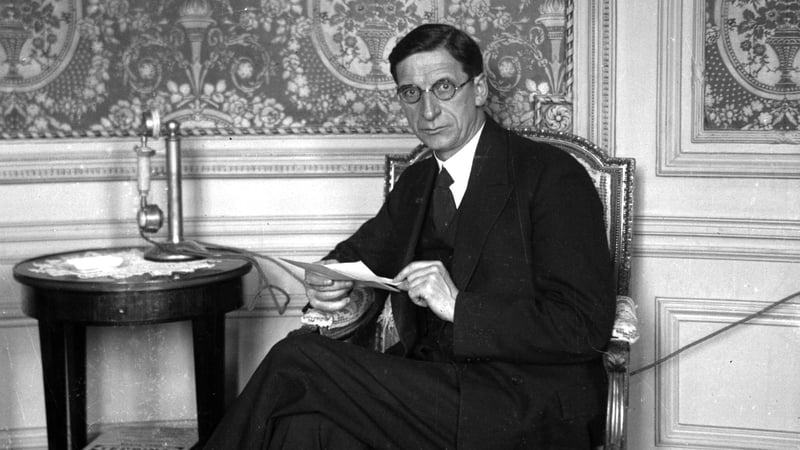
Analysis: The party sought to depict itself as a mass movement, bringing social justice, economic protectionism and Catholicism under the banner of Republicanism
By Stephen Kelly, Liverpool Hope University
This month, Fianna Fáil celebrates100 years since the movement's establishment by Éamon de Valera in May 1926. The immediate origins of the party's establishment date to March 9th of that year when Sinn Féin delegates from across Ireland gathered for a specially arranged extraordinary meeting of the Sinn Féin Ard Fheis to debate the party’s abstentionist policy. By now, a split within the Sinn Féin movement was firmly on the cards, with intelligence reports claiming that "a number of Irregulars are in favour of entry to the Dáil".
Addressing delegates, Sinn Féin president de Valera, proposed a motion that once the admission oaths of the Irish Free State and Northern Ireland assemblies were removed, "it became a question not of principle but of policy whether or not [Irish] Republican representatives should attend these assemblies".
As anticipated, Fr Michael O'Flanagan challenged de Valera’s motion (as did several other attendees), proposing an amendment rejecting entry to the Irish Free State parliament at all costs. It was surely "incompatible with the fundamental principles of Sinn Féin", O’Flanagan implored, "as it is injurious to the honour of Ireland, to send representatives into any usurping legislature set up by English law in Ireland".
From RTÉ Archives, 1976 episode of Seven Days marking Fianna Fáil's 50th anniversary with Jack Lynch, Charles Haughey and Neil Blaney giving their take on the party's history and evolution
After protracted discussions, the resolution to end abstentionism was narrowly defeated by delegates, by 223 votes to 218. Although naturally disappointed, de Valera turned the defeat to his benefit and, in a decisive act, resigned as president of Sinn Féin two days later. On March 29th, 10 leading 'revisionists’, including Seán Lemass, Gerald Boland and Seán MacEntee, also resigned from the Sinn Féin standing committee. Behind the scenes, work was already underway to kickstart a new political organisation.
The establishment of Fianna Fáil
In May 1926, de Valera officially launched a new political party. The choice of the name Fianna Fáil, the 'Republican Party', was significant: the ancient name signified continuity with the ‘spirit and devotion’ of the Irish Volunteers, founded in 1913. It was the name of a short-lived bulletin, edited and largely written by Terence MacSwiney, for supporters of the Cork Irish Volunteers who opposed Irish participation in the First World War. Fianna Fáil’s sub-title, ‘the Republican Party’, was equally important. It denoted the movement’s commitment to establishing a 32 county Republic.
In fact, the choice of name represented a compromise. De Valera wanted Fianna Fáil, but Lemass favoured the Republican Party. De Valera’s younger lieutenant argued that the people would not know what Fianna Fáil meant and he also suspected that their opponents would distort the Irish letters Fáil into the English word ‘fail’. In the end, de Valera’s choice prevailed over Lemass’s less romantic proposal, albeit in a compromise formula, in which both titles were used.
We need your consent to load this rte-player contentWe use rte-player to manage extra content that can set cookies on your device and collect data about your activity. Please review their details and accept them to load the content.Manage Preferences
From RTÉ Radio 1's History Show, interview with author Colum Kenny, about his book Dangerous Ambition: The Making of Eamon De Valera
Initially, times were extremely difficult for the nascent Fianna Fáil organisation. Having left Sinn Féin, de Valera had to find a new office space to work from, eventually managing to rent out a couple of rooms over Jameson's Jewellery Shop on Dublin’s O’Connell Street (formerly Sackville Street). What they lacked in numbers and financial reserves, de Valera believed they made up for in their realistic pursuit of the Irish Republic. Indeed, while they may not have had 'a penny between them,’ this ‘close-knit’ circle of friends threw themselves into the great task of establishing a new political movement.
Under de Valera's watchful eye, Fianna Fáil sought to depict itself as a mass movement rather than simply a political party. Fianna Fáil, thus, was determined to create a political hegemony – to accommodate Republican sympathisers, draw in the petty bourgeoisie and win support from the urban working classes, the small farmers and the rural peasantry.
The party incorporated a powerful blend of social justice, economic protectionism and Catholicism under the banner of Irish Republicanism. In almost every parish, Fianna Fáil rapidly built a loyal rank-and-file support base through the establishment of an impressive network of cumainn (party branches), which, by November 1927, numbered 1,307.
We need your consent to load this rte-player contentWe use rte-player to manage extra content that can set cookies on your device and collect data about your activity. Please review their details and accept them to load the content.Manage Preferences
From RTE Podcasts' What Were We Like, Diarmuid Ferriter and Catriona Crowe trace how Fianna Fáil built one of the most successful election machines in the world
Abandoning abstentionism
Fianna Fáil’s performance at the June 1927 general election, in which the party secured a relatively impressive 44 seats, set off a chain reaction that ultimately witnessed Fianna Fáil abandoning abstentionism and taking the oath of allegiance to a ‘foreign King’. Initially, in the immediate aftermath of Fianna Fáil’s general election success, de Valera refused to enter Dáil Éireann before the oath of allegiance was removed.
Significantly, the assassination of Kevin O'Higgins, minister for home affairs, on July 10th transformed the political landscape. In August 1927, the Irish Free State government introduced legislation requiring elected TDs to take their seats in the Dáil (and thus take the oath of allegiance) or forfeit them. Initially, de Valera reverted to his previous stance. Fianna Fáil TDs, he implored, would never swear an oath of allegiance to the British Crown.
But after much soul searching and secret liaisons with Irish Republican Army (IRA) leadership, de Valera made one of the most important decisions of his political career. Fianna Fáil, he agreed, would enter Dáil Éireann and take the oath of allegiance. The entire spectacle was deliberately low-key. At 11am on August 11th, Boland, Lemass and Frank Aiken, Fianna Fáil's whips, were the first to arrive at Leinster House. They were greeted by Labour party leader Thomas Johnson. Then, as reported by the Irish Times, 'Mr. Colm Ó Murchadha, the clerk of the Dáil, administered the oath of allegiance, to which they subscribed their signatures’.
From RTÉ Archives, how Fianna Fáil deputies used the notion of an empty formula to deal with the oath of allegiance on entering the Dáil
De Valera was the last to arrive. Describing Fianna Fáil’s decision to end its policy of abstentionism as ‘painful and humiliating’, de Valera argued that to do otherwise would have led to ‘civil war’. Accordingly, he entered Dáil Éireann, removed the Bible to a far corner of the room, covered the oath in the register with some papers and signed.
The following day, de Valera escorted 42 of his fellow Fianna Fáil elected representatives through the gates of Leinster House, where they took their seats in the Dáil Éireann chamber. It was an astonishing sequence of events. In a matter of a few months, the once-hated oath of allegiance was transformed from an ‘oath to partition’ into a mere ‘empty formula’. In the words of the Daily News, ‘Fianna Fáil can never be itself again’.
Fianna Fáil's longevity
Within a year, Fianna Fáil had effectively crushed Sinn Féin as the main opposition party in the Irish Free State. After the 1932 election, Fianna Fáil first entered government. Under de Valera’s watchful eye, the party continued to govern the Irish Free State (later Éire) throughout the 1930s and early to mid-1940s, eventually being voted out of office in 1948. In the post-world war landscape, de Valera’s successors as Fianna Fáil leader, including Lemass, Jack Lynch and Bertie Ahern (to name just a few), continued in their founding father’s footsteps, ensuring the party’s relative dominance of Irish politics.
We need your consent to load this rte-player contentWe use rte-player to manage extra content that can set cookies on your device and collect data about your activity. Please review their details and accept them to load the content.Manage Preferences
From RTÉ Radio 1's The History Show, Myles Dungan and guests discuss the life of Eamon De Valera.
Indeed, despite Fianna Fáil’s almost obliteration in the aftermath of the 2011 Irish general election (they won 20 seats, a collapse from its pre-election tally of 78 seats), the party gradually rehabilitated itself. Remarkably, as of April 2026, Fianna Fáil has been in power for approximately 67 years since first taking office in 1932.
Let’s leave the final words to the current leader of Fianna Fáil and taoiseach, Micheál Martin. 'Our founders wanted a party which was open to new people and new policies', he said in a speech to mark the centenary. 'They wanted to show people who had been on the other side in both the War of Independence and Civil War that there was a new party which was willing to work with them to serve the people’.
Follow RTÉ Brainstorm on WhatsApp and Instagram for more stories and updates
Prof Stephen Kelly is Head of the School of Humanities and Professor of Modern Irish History at Liverpool Hope University. His new book, 'The Broken Emerald': Edward Heath and the early years of the Northern Ireland Troubles, 1968-1975, will be published by Bloomsbury in October 2026.
The views expressed here are those of the author and do not represent or reflect the views of RTÉ
