


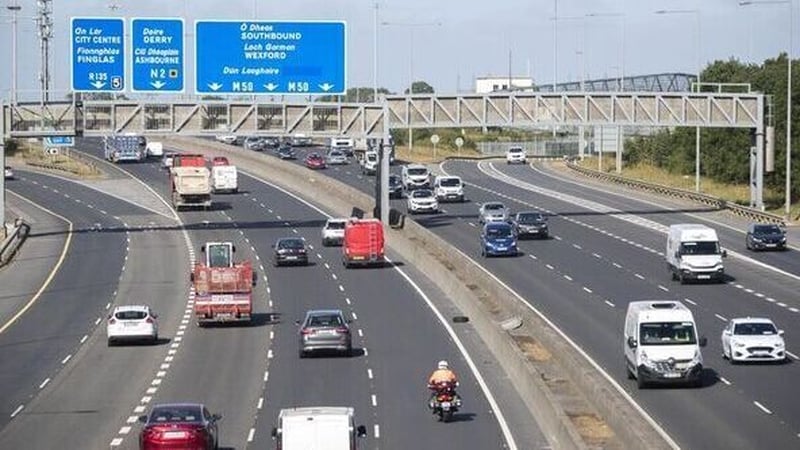
Analysis: The capital city needs this road to operate efficiently, but congestion means the M50 is just not serving the needs of the people of the region.
By Brian Caulfield and Matthew Wood, TCD
The answer to the title of this article? Not quickly and not without many difficult and expensive decisions. Since the M50 opened in the 1990s, it has been a victim of its own success; almost as soon as it was completed in the mid-2000s, a plan was enacted to expand it. This expansion provided some alleviation for a few years, but congestion quickly returned.
The M50 is the busiest stretch of road in the country, with recent figures showing almost 190,000 people using the motorway daily. This vital traffic artery provides significant connectivity around the capital for both people and freight. Connecting commuters and goods to both Dublin Airport and Dublin Port, its significance cannot be understated.
We need your consent to load this rte-player contentWe use rte-player to manage extra content that can set cookies on your device and collect data about your activity. Please review their details and accept them to load the content.Manage Preferences
From RTÉ Radio 1's Driveime, how do you solve a problem like the M50? With Prof Brian Caulfield from TCD
But it is no longer fit for purpose in its current state. Since it was originally designed, the population of the Greater Dublin Area has increased by 20%, resulting in frequent and prolonged gridlock. Over the same time period we have had roughly a 40% increase in private cars in Ireland.
Why does this matter?
The answer to this question is straightforward: in its current state, the motorway is not serving the needs of the people of the region. Our history has been a cycle of repeating the same traffic mistakes. While many economic models describe how congestion costs the economy billions of euro per year, the unquantifiable costs to individuals make the most compelling case to break this cycle.
Our capital city needs this motorway to operate efficiently. Even if a magic wand existed that could deliver a seismic increase in public transport, it would not remove the need for this vital traffic artery.
We need your consent to load this rte-player contentWe use rte-player to manage extra content that can set cookies on your device and collect data about your activity. Please review their details and accept them to load the content.Manage Preferences
From RTÉ Radio 1's Drivetime, the M50 pulls in €500,00 every working day so where's it all going?
What are the possible solutions to fix this?
One of the most common international solutions for motorway congestion is simply to add extra lanes, but we have already done this. The physical constraints on the motorway mean that adding further lanes would be almost impossible.
Another solution often touted when considering capacity is building an outer orbital route. Yet, if the history of traffic analysis has taught us anything, it is "build it and they will come." In other words, adding more capacity to the road network results in "induced demand," where new traffic quickly rises to fill the extra space.
While an upgrade might reduce congestion in the short run, the longer-term consequences of further urban sprawl and induced traffic would quickly put us back to square one. "Build it and they will come" is also true of public transport, as we see record numbers using buses, trains and trams across the country.
We need your consent to load this rte-player contentWe use rte-player to manage extra content that can set cookies on your device and collect data about your activity. Please review their details and accept them to load the content.Manage Preferences
From RTÉ Radio 1's Today with David McCullagh, how increased tolls on the M50 have done nothing to reduce congestion on the motorway
The long-term solution is to reduce demand. One of the most effective and climate-appropriate strategies would be to expand our public transport network. But we know from experience that delivering high-capacity public transport projects in the capital is often subject to significant delays, resulting in frustration and planning inertia. In international cities that have successfully moved away from such congestion, the key component has always been the provision of these "mega" public transport projects.
Recently, Government plans related to the Critical Infrastructure Bill could provide an expedited process to fast-track these projects. However, the reverse could also be true; more road projects could be approved which could ultimately prolong our dependence on the private car and exacerbate problems nationwide. Short-term public transport measures could also be enacted, such as the introduction of bus-based park-and-ride sites. These have proven very successful internationally, yet Ireland has yet to fully utilise this solution.
Other measures focus on utilising existing motorway space more efficiently. One option is to introduce a carpool lane, allowing vehicles with two or more passengers to enjoy reduced travel times. While this has been successful in North America, Ireland does not have a significant track record in car-sharing, and more research is required.
We need your consent to load this rte-player contentWe use rte-player to manage extra content that can set cookies on your device and collect data about your activity. Please review their details and accept them to load the content.Manage Preferences
From RTÉ News' Behind the Story podcast, the M50 IS officially at capacity but can anything be done to improve journey times?
Another solution could be "multi-point tolling". This would involve varying prices to regulate demand, similar to the system currently used in the Dublin Port Tunnel. At present, there is only one tolling point on the M50 and many argue this is inequitable, as only a certain percentage of motorists pay for the infrastructure they use. While multiple point tolling is theoretically effective, it remains politically divisive.
Finally, improving real-time information and predictive modelling could help regulate demand by estimating congestion times for users. However, given the current levels of congestion, this would likely need to be used in combination with the other measures discussed to have a substantial impact.
Over to you…
Researchers at the Trinity Centre for Transport Research are surveying the opinions of M50 users on potential solutions and how congestion impacts their daily lives over the next four weeks. The results will be collated and made publicly available to help inform this long-running debate. You can add your opinion here.
Follow RTÉ Brainstorm on WhatsApp and Instagram for more stories and updates
Prof Brian Caulfield is a professor in Transportation and Director of the Trinity Centre for Transport Research at TCD. He is a Research Ireland awardee. Matthew Wood is a Research Assistant at the Trinity Centre for Transport Research at TCD.
The views expressed here are those of the author and do not represent or reflect the views of RTÉ
