

Analysis: Researchers are rethinking where and how water safety is taught to help children stay safe in Ireland's lakes, rivers and seas
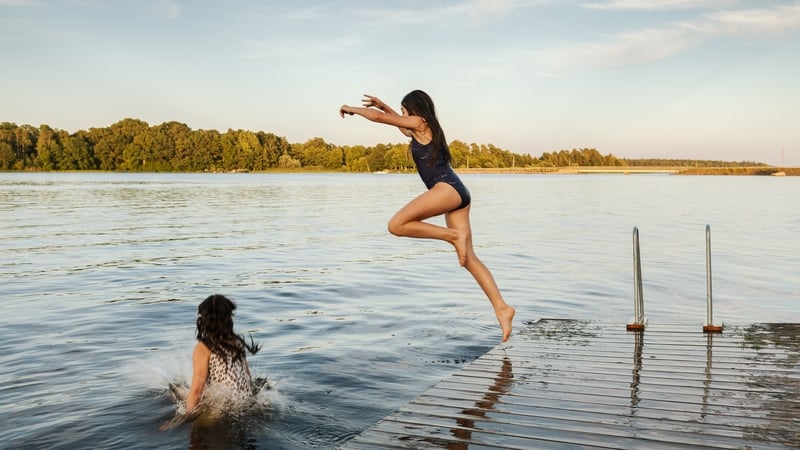
Last summer, Irish communities were shaken by a series of tragic deaths resulting from swimming accidents in Kerry, Donegal, Tipperary and Meath. These incidents serve as a stark reminder of the risks associated with water-based activities and the need for effective water safety education.
The World Health Organisation (WHO) included water safety education within its recommended strategies in its report on drowning prevention in 2024. Water Safety Ireland also emphasise prevention, providing a wide range of water safety courses such as the PAWS (Primary Aquatics Water Safety) programme.
These courses are consistent with a recent paradigm shift in worldwide water safety education, moving beyond teaching swimming strokes to developing broader aquatic competencies. These competencies include safe entry and exit, understanding local hazards, and assessing risks. How can children be best supported to develop these competencies?
We need your consent to load this rte-player contentWe use rte-player to manage extra content that can set cookies on your device and collect data about your activity. Please review their details and accept them to load the content.Manage Preferences
From RTÉ Radio 1's Brendan O'Connor, keeping kids and teens safe at the beach this summer
Although sport science is typically associated with improving athletic performance, it can also plays a vital role in designing and evaluating water safety education. One of the key considerations of this research has been on where water safety education is taking place. Due to the availability of facilities and ease of organisation, many – but by no means all – water safety courses are run indoors in swimming pools.
This decision poses a major challenge for instructors: how to ensure that skills learned in the calm, controlled environment of a pool transfer to the unpredictable conditions of open water? Even for those courses which take place outdoors (e.g., on a beach), how do instructors ensure that the learners leave competent within other environments (e.g., a river, lake or harbour)?
In order to answer questions about what education should look like, we must first examine how competence is assessed. Is a child deemed competent in a pool equally competent in open water? A Norwegian study tested this question by assessing six aquatic skills – water entry, swimming on the front, surface diving, floating/resting, swimming on the back, and water exit – in both pool and lake settings. Crucially for interpreting their results, earlier research had already established that participants attained highly consistent scores when tested twice in an indoor swimming pool.
From RTÉ Archives, participants of all ages obtain a life saving qualification at a water safety course in Killala (1985)
83 children aged 9 and 10 years were tested. Nearly half of the children who were competent in the indoor pool failed to demonstrate the same competence in the open-water lake. This finding underscores the limitations of pool-based assessments; fundamentally, pool-based competence may not translate to open water safety, especially for children.
Assessing children's mastery of water safety and aquatic competence in open water has many advantages, but may not be feasible for many organisations. However, even efforts to simulate unsteady water conditions within a pool environment have been shown to be enough to change children's performance on basic swimming skills and aquatic competencies, and may be an appropriate compromise where outdoor testing is not an option.
Recent studies by Chris Button and colleagues at the University of Otago have explored the design of effective outdoor learning environments for water safety. In one study, children participated in a three-day intensive programme with sessions in beach, harbour, and river settings. Their competency in pool-based tasks and water safety knowledge improved immediately after the intervention and remained high three months later. Parents responded positively, with one noting: "Outdoor swimming is very different to swimming in a pool. All children should have the opportunity to experience the programme."
We need your consent to load this rte-player contentWe use rte-player to manage extra content that can set cookies on your device and collect data about your activity. Please review their details and accept them to load the content.Manage Preferences
From RTÉ Radio 1's Today with David McCullagh, the ordinary people who become extraordinary heroes when they saved a life, including Oisin McGrath who saved 11 year old Michael Shinnick when he was washed out to sea in Lahinch, Co Clare
In a follow-up study, children experienced two pool sessions followed by one outdoor session in each of beach, harbour and river locations. This time, the researchers assessed the children not just in a controlled pool environment but also in an outdoor location. The children were allowed to choose the level of challenge in each element of the outdoor test (i.e., how far to swim, how to float, whether to swim underwater, etc.).
While this meant that their performance could not be compared to the baseline pool test, it is notable that the children set themselves sensible targets that they knew they could achieve; that is, they were able to appropriately judge how far they could swim from a capsized boat in deep water and then able to demonstrate that they could actually swim that distance. Thus, it appears that generally the participants did develop transferable skills to stay safe within the outdoor environment.
Ireland’s waters provide fantastic opportunities for recreation and sport, whether along the coastline, within rivers or in one of over 12,000 lakes. To help children stay safe in these environments, researchers are rethinking where and how water safety is taught. The same sport science principles used to transfer learning from training fields to match-day performance in Gaelic Games, field hockey or rugby are being applied to water safety education. The goal is simple: to ensure that what children learn in training is reliably applied when it matters most.
Follow RTÉ Brainstorm on WhatsApp and Instagram for more stories and updates
The views expressed here are those of the author and do not represent or reflect the views of RTÉ