


Analysis: Current controversies over access to Irish seaweed are a reminder that such disputes are a vivid part of Ireland's colonial past
By Cianna Devitt, TCD
Speaking to the Devon Commissioners in 1844, Co Galway farmer James O'Dowd testified that, as far as his memory could recall, seaweed had always been 'a great cause of litigation between landlords and tenants in this country’. The Commission was tasked with identifying irregularities in land valuations across Ireland and ironing out the ‘daily increasing confusion as to the respective rights and claims’ of tenants and landowners, a confusion in which seaweed was a persistent source of contention.
In recent times, echoes of such confusion have resurfaced, manifesting in a major public challenge to proposals for commercial seaweed harvesting along Irish coasts. Responding to the resurfaced bid for large-scale extraction by Arramara Teoranta (the former semi-state body, sold to Canadian firm Acadian Seaplants in 2014 for an undisclosed sum), a social media petition against the application amassed thousands of signatures in a matter of days.
Alongside ecological considerations, the critical public concern lies with the apparent threat to traditional seaweed harvesting rights. The inherent complexities of advancing commercial interest in foreshore licensing prompted the establishment of the Maritime Area Regulatory Authority (MARA) in 2023, following the passage of the Maritime Area Planning Act of 2021. With multinational corporations targeting Irish coasts – entities whose commitment to public transparency on the matter has, alongside the state itself, proven mixed – the extent to which traditional rights to the foreshore will be upheld remains an open question.
We need your consent to load this rte-player contentWe use rte-player to manage extra content that can set cookies on your device and collect data about your activity. Please review their details and accept them to load the content.Manage Preferences
From RTÉ Radio 1's Countrywide, families who have traditionally harvested seaweed fear changes will favour multinational exporters.
Set against the historical record, these public anxieties are far from unfounded. Ireland has had a long history of attempted coastal enclosure, whether driven by commercial or landed interests, each generating recurring episodes of popular disquiet over coastal access. Contests over the collection of seaweed (as well as other resources such as sand and marl) and purported shoreline trespass were a regular cause of litigation in 19th century Irish courts. In most cases, plaintiffs were powerful landowners prosecuting smallholders or tenant farmers who sought seaweeds, usually the heaps deposited by the tides, as fertiliser.
Rich in nitrogen and potassium, these seaweeds were highly valuable manures for sandy coastal soils. Farmers could rebut such legal challenges by claiming a customary right to the foreshore. That is to say, they (and their forebears) had always collected seaweed without interruption.
One particularly litigious landowner, Lord Conyngham (who owned large coastal estates in Clare and Donegal), successfully prosecuted more than 100 farmers between 1840 and 1843 for trespass and the purported theft of seaweed before the lower court system known as the Petty Sessions. He went on to confirm these rulings at the higher Court of Exchequer in 1874, prosecuting under the name of his lessee. This set a powerful legal example showing that landowners’ exclusive claims to the foreshore were hard to overwrite by counterclaims of customary right.
We need your consent to load this rte-player contentWe use rte-player to manage extra content that can set cookies on your device and collect data about your activity. Please review their details and accept them to load the content.Manage Preferences
From RTÉ Radio 1's Oliver Callan, the health benefits of Irish seaweed
One of the major hurdles that defendants in these cases faced was the underlying colonial evidentiary hierarchies that informed judicial decision-making. During this period, the ownership of the Irish foreshore was asserted by the British Crown, and any party claiming an exclusive right to take resources from the shore needed to prove that such an entitlement had been granted by the Crown.
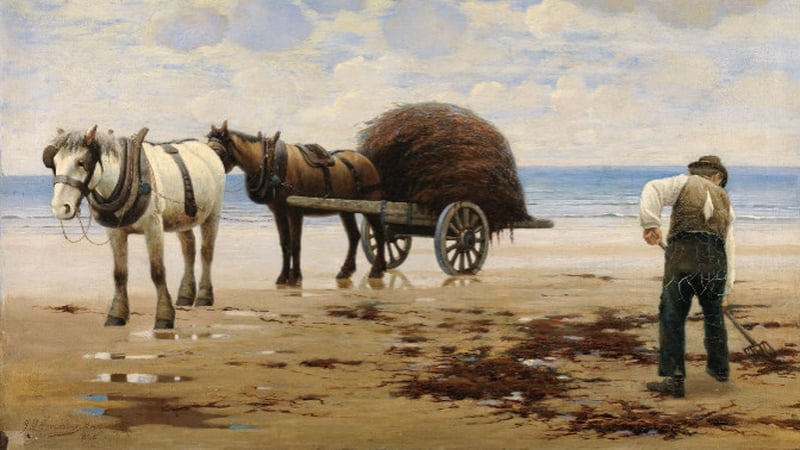
Landowners wishing to demonstrate exclusive claims to the foreshore drew upon written evidence such as ancient Crown grants, patents, rental books and accounts, which articulated an apparently perpetual entitlement to the shore. For defendants, a claim of customary right could usually only be expressed in oral evidence, whereby one would recall a time-honoured habit of leading a horse and cart to the shore and collecting seaweed free of charge.
Yet, these counterclaims could be powerful and threaten the rigid vision of coastal ownership espoused by litigious coastal landowners. For instance, in a case brought before the Belfast Circuit Court in 1886 by Sir Frederick Boyd, landlord of extensive holdings around Ballycastle, Co Antrim, the defendants, three local farmers, successfully argued their case. David Clarke, Patrick McCann, and James Laverty, along with a small number of local supporting witnesses, articulated a common custom of cross-generational seaweed collection, recounting how the men and women of the surrounding area traversed broken fences and dirt tracks to establish their right of way and prove customary use.
We need your consent to load this rte-player contentWe use rte-player to manage extra content that can set cookies on your device and collect data about your activity. Please review their details and accept them to load the content.Manage Preferences
From RTÉ Radio 1, author of The Sea Garden, Marie Power, and Atlantic Irish Seaweed's John Fitzgerald talk about seaweed foraging
However, at a retrial the following spring, the judgement was reversed. Boyd's submission of additional written evidence bolstered his claim that his family’s title to the foreshore could be traced through an unbroken paper trail spanning centuries. This latter judgement once again underscored the difficulty of proving traditional customary rights in profoundly unequal contests of this kind.
While many such legal struggles pre-dated the Great Famine, the matter was brought into sharp focus by agrarian discontent in the latter half of the 19th century. The period witnessed great upheavals in land ownership and agricultural production, with a marked expansion of land-extensive pastoral farming. Enlarged livestock herds enabled commercial farmers to have greater and more regular access to manure, and for those with access to cash, guano or other early artificial fertilisers could be obtained. However, for poorer farming classes working on small plots of land and without livestock, both manure and money were in scarce supply.
One of the major hurdles defendants in these cases faced was the underlying colonial hierarchies that informed judicial decision-making
For small farmers residing along Ireland’s coastal fringe, obtaining a perceivably free sea-sourced manure was a matter of survival. Yet, amid ever-increasing land agitation, landowners were committed to defending and bounding their estates. The price for many coastal communities was access to parts of this island long-held in common.
The long but largely forgotten history of Irish seaweed disputes serves as a striking reminder that today’s controversies over the administration of the Irish foreshore have roots deep in this island's colonial past. With a rising tide of corporate interest on Ireland’s coastal fringe, it becomes pressing to scrutinise which forms of access and user rights our legal frameworks will ultimately recognise, enshrine and uphold.
Follow RTÉ Brainstorm on WhatsApp and Instagram for more stories and updates
Cianna Devitt is a PhD candidate at Trinity College Dublin whose research focuses on coastal environmental history. She is also a Research Assistant in the Trinity Centre for Environmental Humanities in the School of Histories and Humanities at TCD.
The views expressed here are those of the author and do not represent or reflect the views of RTÉ
