


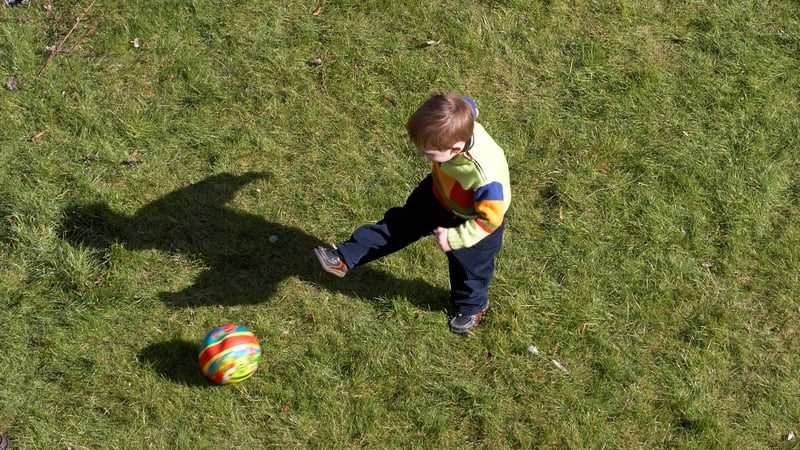

Analysis: We know the role sight plays in learning basic movement skills, but what about the 1,360 blind or visually impaired children in Irish schools?
When we think about it, many of us, adults and children alike, take the role that sight plays in helping us learn basic movement skills during our primary education for granted. Skills such as running, hopping, skipping and jumping are taught early in life, and many of us continue to use them throughout our daily routines and the sports in which we participate.
But how might a child who cannot see learn to run, hop, skip or jump? In the new Primary Wellbeing Specification, these movement skills (including running, hopping, skipping, jumping and kicking) are central components of early physical development. Primary school teachers across the country play a crucial role in teaching them. As a primary teacher myself, I was always aware of the responsibility to equip children with these skills so they could perform them confidently and with quality throughout their lives.
From Perkins School for the Blind, a guide to staff training for physical education for visually impaired children
Given the low movement‑skill proficiency among Irish primary-aged children, it is not surprising that of the 1,360 children who are blind or visually impaired attending Irish schools, many are less physically active than their sighted peers and often spend less time participating in PE. Yet we know that individuals who are blind or visually impaired have the ability to excel to the same level as sighted individuals. Irish Paralympians such as Orla Comerford and Katie-George Dunleavy are powerful examples of this.
Primary teachers frequently rely on demonstration during PE lessons, but this becomes challenging when a child cannot see what is being shown. Fortunately, there are several effective strategies that can be used to ensure that children who are blind or visually impaired can learn movement skills in ways that do not rely on sight.
From LEGO Braille Blocks, how visually impaired children learn through play
Pre‑teaching
Pre‑teaching involves providing background knowledge and targeted instruction related to a specific movement skill. It gives the child additional time to develop the skill, meets them at their current level and gradually builds understanding. Pre‑teaching generally follows three steps:
- Planning which skill to focus on.
- Teaching the skill in isolation.
- Evaluating the child’s understanding and ability to perform it.
This approach can be used for any movement skill, from running to kicking. Below is an example of simple teaching points for jumping for distance, which can be easily adapted for children who are visually impaired:
- Bend your knees.
- Keeping your arms straight, move them back behind you.
- Jump forward (a beanbag may be placed on the floor as a target for visually impaired children).
- Drive your arms forward.
- Land on two feet and bring arms back to your sides.
Within pre‑teaching, tactile modelling is another valuable approach. It allows the child to feel how a body moves during a skill. For example, a child may place their hands on a teacher’s arms to feel how the arms swing during running.
From Sight Scotland, an introduction to guided running with people with visual impairment
Descriptive verbal explanations
Lauren Lieberman is expert in the world of physical activity and sports for individuals who are blind or visually impaired, and others. She believes that "if you’re not speaking the entire time, you’re not speaking enough". This highlights the importance of continuous and descriptive verbal explanation in PE lessons.
Children who cannot rely on vision need teachers to describe what is happening, break down each part of a skill, and explain the actions of others in the group. Clear, detailed verbal instruction helps the child understand, engage and participate meaningfully in both individual skills practice and group activities.
Specialised equipment
A wide range of specialised equipment supports the teaching of movement skills to children who are blind or visually impaired. Two commonly used examples include:
- Bell balls, which contain a bell that rings as the ball moves. These come as footballs, tennis balls, rugby balls and soft foam balls and help children track the ball using hearing and touch.
- Running tethers, which allow a blind or visually impaired child to run alongside a sighted partner. The tether provides gentle directional guidance, helping the child maintain a straight running path and build confidence.
Such equipment allows children to use their remaining senses to engage in movement activities in safe and meaningful ways.
We need your consent to load this rte-player contentWe use rte-player to manage extra content that can set cookies on your device and collect data about your activity. Please review their details and accept them to load the content.Manage Preferences
From RTÉ Brainstorm, why risky play is good for kids
Other considerations
In planning physical activities for children who are blind or visually impaired, teachers should also consider:
- Universal Design for Learning (UDL) principles to promote inclusion for all.
- Colour contrast between equipment and the playing environment, allowing children with low vision to distinguish objects more easily for example, bright equipment on a green pitch, or contrasting bib colours between teams.
- Environment and lighting, including removing potential trip hazards and being aware of glare or bright sunlight which may affect visibility.
Listening to the voice of the child
The most important strategy of all is to listen to the child. Children who are blind or visually impaired are experts in their own lived experience and often know what supports will work best for them in PE. They understand their visual impairment in ways a sighted teacher cannot. When children feel heard, they take greater ownership of their learning, participate more enthusiastically and become more confident movers.
By applying these strategies and considering the specific needs of children who are blind or visually impaired, teachers can ensure that every child has the opportunity to learn essential movement skills. In doing so, we help them to run, hop, skip and jump and perhaps even nurture a future Paralympian representing Ireland.
This research is funded by Vision Sports Ireland
Follow RTÉ Brainstorm on WhatsApp and Instagram for more stories and updates
The views expressed here are those of the author and do not represent or reflect the views of RTÉ
