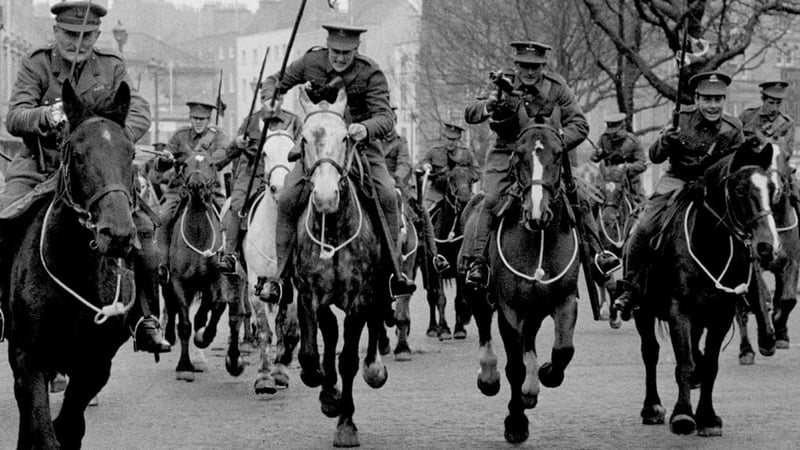


Analysis: Insurrection reported the Easter Rising as a contemporary news broadcast over eight nights, as if the events were unfolding in real time
In 1966, Ireland marked the Golden Jubilee of the Easter Rising, a moment of commemoration that coincided with the early years of RTÉ, then known as Telefís Éireann, established in 1962. The broadcaster had been envisioned by Minister for Posts and Telegraphs Kevin Boland as "a service that is Irish in origin and character, that will enrich the lives of our people."
The 50th anniversary of 1916 presented an ideal opportunity to fulfil that ambition and contribute to a developing sense of cultural identity in a modernising Ireland. The result was Insurrection, an eight-part television series broadcast over eight consecutive nights. It did more than simply recount history - it reimagined how Irish audiences could experience it.
How TV news would have covered 1916
The defining feature of Insurrection was its format. Rather than a traditional historical drama, it was presented as a contemporary news broadcast, reporting the events of Easter Week as though they were unfolding in real time.
From RTÉ Archives, how Insurrection was the centre piece of RTÉ's commemoration of the Easter Rising's 50th anniversary
This approach had precedents. In the United States, You Are There had pioneered the "faux-newscast" style, bringing viewers into historical events through the familiar language and tone of current affairs reporting. Fronted by Walter Cronkite - long regarded as "the most trusted man in America" - the programme blurred the lines between past and present, allowing audiences to feel like participants rather than observers.
The same principle underpinned Culloden, directed by Peter Watkins for the BBC in 1964. That film's stark depiction of the 1746 Battle of Culloden between British forces and Jacobite rebels used handheld cameras, direct address and "interviews" with participants, to strip away the "comfortable distance" of period drama.
Irish audiences responded strongly to Culloden, which was rebroadcast several times by RTÉ. Its sympathetic portrayal of a defeated people resonated in a country with its own history of colonisation, where parallels between Scottish and Irish struggles were readily apparent.
We need your consent to load this rte-player contentWe use rte-player to manage extra content that can set cookies on your device and collect data about your activity. Please review their details and accept them to load the content.Manage Preferences
From RTÉ Radio 1's History Show, actors from Insurrection share their memories of the show
Telling a nation’s story
Given the success of Culloden, it is hardly surprising that RTÉ adopted a similar approach for its flagship Golden Jubilee production, using Watkins as its director. His style fully embraced the concept that the viewer is watching a live broadcast, complete with the breaking of the fourth wall.
In Insurrection, this effect was amplified. With Ray McAnally as news anchor, figures long fixed in textbooks - Pádraig Pearse, James Connolly and others - were reanimated as living participants in unfolding events. The familiarity of the news format allowed audiences to connect with them as they would with contemporary figures seen on nightly bulletins.
As Taoiseach Seán Lemass put it, the goal was "to bring home to them some sense of the heroic drama of that week." By collapsing historical distance, Insurrection made that drama immediate and accessible, particularly for a younger generation coming of age in a rapidly changing Ireland.
Episode 1 of Insurrection
'A hugely ambitious project'
Insurrection was the product of months of meticulous work. Its creators faced the formidable task of condensing a complex, city-wide rebellion into four hours of coherent television.
Accuracy was paramount. The production team were determined that style would not come at the expense of substance. To this end, RTÉ’s Director-General Kevin McCourt enlisted Kevin B. Nolan of Trinity College Dublin as historical advisor, ensuring that the script remained grounded in established scholarship. The writing itself was shaped by playwright Hugh Leonard, whose adaptation helped translate complex historical material into a script that balanced authenticity and dramatic momentum.
The emphasis on realism extended beyond the page. Insurrection relied on relatively unknown actors, many drawn from theatre and radio, avoiding the distraction of star power. More striking still was the production’s commitment to physical authenticity. No wonder it was described by RTÉ as "a hugely ambitious project,"
From RTÉ Archives, a clip from the second episode of Insurrection showing Ray McAnally as the studio anchor reporting on the events of April 24 1916.
In recreating the destruction of the General Post Office - the symbolic heart of the Rising - real explosives were used, with the assistance of the Irish Defence Forces. The resulting scenes of the GPO in flames carried a visceral impact rarely seen on Irish television at the time, reinforcing the immediacy that the newsreel format sought to achieve.
A landmark legacy
Looking back, Insurrection stands as a landmark in Irish broadcasting. It demonstrated that television could do more than entertain or inform and could shape how a nation understands itself. By presenting history through the lens of contemporary media, it invited viewers to engage with the past not as distant memory, but as lived experience.
Its endurance is evident in the fact that the series was carefully restored and rebroadcast by RTÉ in 2016 as part of the centenary commemorations of the Easter Rising. Yet even that revival now feels a decade removed.
From RTÉ Radio 1's Arena, Lorcan Clancy spoke to some of the actors who appeared in 'Insurrection'
But in today’s Ireland - diverse, outward-looking, and still negotiating its relationship with its own past - the questions raised by Insurrection remain relevant. What does it mean to be Irish? How should history be remembered, and by whom? And how can storytelling bring those answers to life for new audiences shaped by digital media?
In this content-saturated era, Insurrection reminds us of the enduring power of well-crafted storytelling, capable of making the past speak directly to the present. A further rebroadcast in 2026 would not simply be an exercise in nostalgia, it would offer another generation the chance to experience a groundbreaking piece of television.
The author's new book, Benchmarkers; Female Firsts in the Irish Judiciary, is due out this autumn
Follow RTÉ Brainstorm on WhatsApp and Instagram for more stories and updates
The views expressed here are those of the author and do not represent or reflect the views of RTÉ