




Analysis: More than tradition or decoration, the simple act of painting eggs captures something essential about how we think and create
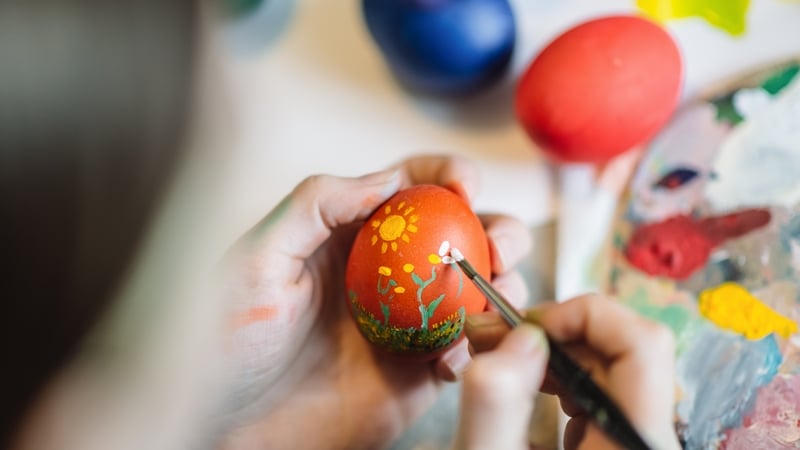
Every spring, kitchens and classrooms fill with the same activity: eggs are boiled, dyed, painted and carefully decorated. Hands get stained with colour, patterns emerge slowly, and no two eggs turn out quite the same.
But why do we paint Easter eggs at all? Part of the answer lies in where and how this practice takes place. Traditionally, eggs were decorated at home in the days leading up to Easter, often with family or neighbours. The activity was woven into the rhythm of the celebration itself. Painting eggs wasn't just preparation, it was part of the main event.
One reason we decorate eggs is to mark the moment. The act itself signals that something special is happening. It’s also how traditions are kept alive: through small, repeated gestures that connect generations. Even simple dyed eggs made with children today follow the same basic logic as more elaborate versions made elsewhere.
We need your consent to load this rte-player contentWe use rte-player to manage extra content that can set cookies on your device and collect data about your activity. Please review their details and accept them to load the content.Manage Preferences
From RTÉ Radio 1's The Business, food historian Regina Sexton on the historic tradition of Easter eggs
But Easter eggs do more than carry tradition. They also engage the way we see and think. Look closely at decorated eggs and you'll notice patterns everywhere: lines, crosses, stars, repeated shapes. These are not random. Humans are naturally drawn to symmetry, contrast and rhythm. Patterns help us organise what we see, guide our attention and make objects more memorable. That is part of what makes decorated eggs so satisfying to look at.
At the same time, these designs often carry meaning. Sometimes this meaning is explicit, as with religious symbols. Other times it is simply implied: decoration itself becomes a sign of celebration, renewal or care. Even when we don’t consciously interpret a pattern, we recognise that it "means something".
Decoration also plays a social role. Styles vary across places, families and even individuals. Over time, people come to recognise certain ways of working: the particular lines, colours or compositions that belong to someone. In this sense, decorated eggs both express individuality and locate it within a shared practice.
We need your consent to load this rte-player contentWe use rte-player to manage extra content that can set cookies on your device and collect data about your activity. Please review their details and accept them to load the content.Manage Preferences
From RTÉ 2FM's Dave Fanning, the origins of Easter
There is also a more practical side to it. Patterns help organise the act of decorating itself. Dividing an egg into sections, repeating motifs or following lines makes the process manageable. The design is not just the result, it guides the making. All of this helps explain why we have painted Easter eggs for centuries. But it does not fully explain why we still do it.
Today, in many homes, egg decoration is simpler: dipping eggs in dye, adding stickers, drawing quick designs. The symbolic meanings may be less explicit, and the techniques less complex. Yet the practice continues.
One reason is that it remains easy to join in. Anyone can do it, regardless of age or skill. There are clear expectations – decorate the egg, use colour – but also plenty of room to experiment. This makes it a natural activity for families, schools and workshops, where children and adults alike can explore, try things out and learn by doing.
From RTÉ Archives, Anything Goes visits the Bewley's chocolate factory in 1985 to see where Easter eggs are handmade and decorated
More importantly, decorating Easter eggs offers something that is increasingly rare: a chance to think through our hands. The egg is not an easy surface. It is small, curved and fragile. You can’t draw on it in the same way you would on paper. Every line requires adjustment. Every decision matters. And this is precisely the point.
Working within these limits encourages a particular kind of creativity, one based on variation rather than invention from scratch. Patterns are repeated, adjusted, combined and transformed. You don’t start from nothing; you start from what is already there and make something new out of it.
This is how much of human creativity has always worked. In practices like Easter egg decoration, what looks like repetition is actually a space for exploration. Familiar designs are reworked, small differences accumulate, and new patterns emerge over time. Creativity is not separate from tradition here, it grows out of it.
We need your consent to load this rte-player contentWe use rte-player to manage extra content that can set cookies on your device and collect data about your activity. Please review their details and accept them to load the content.Manage Preferences
From RTÉ Radio 1's The History Show, Rhona Tarrant looks at Easter traditiins in Kerry and Catherine Cleary discusses the history of Irish Easter food
Seen this way, Easter eggs are more than decoration. They are part of a long history of making things by hand, of learning through shared practices, and of exploring ideas through materials. Long before digital tools and instant images, people were already experimenting with colour, pattern and form on one of the most constrained surfaces imaginable.
That is why we still paint Easter eggs. Not just to celebrate or to decorate, but because this simple act captures something essential about how we think and create: we work with what we have, within limits, together, and, in doing so, we discover, expand and enjoy new possibilities.
Follow RTÉ Brainstorm on WhatsApp and Instagram for more stories and updates
The views expressed here are those of the author and do not represent or reflect the views of RTÉ
