


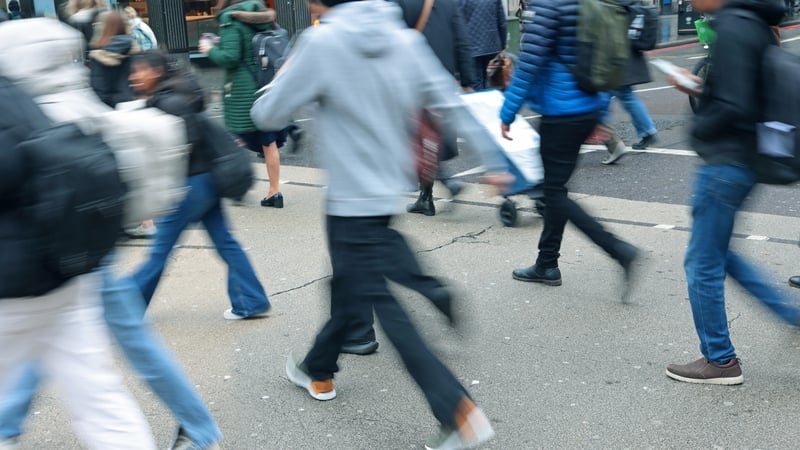
Analysis: Research conducted with 100,000 rail passengers found those travelling alone tended to take the same path as the person immediately ahead of them
By Ziqi Wang, Eindhoven University of Technology
Think about the last time you stepped off a busy train. Within seconds, you had to decide which way to walk. Left or right? Straight ahead or around an obstacle? You probably felt you made a quick, sensible choice: the shorter route, the clearer path, the faster exit. It felt like your own decision, but what if it wasn't entirely?
Our research, carried out over three years at Eindhoven Centraal railway station in the Netherlands, suggests that when people face quick decisions in a crowd, they often rely on something surprisingly simple: they follow the stranger directly in front of them. Not a friend. Not a family member. A complete stranger. And they do it even if that choice leads to a longer route or into a denser crowd.
What we observed on a Dutch train platform
We analysed the movements of around 100,000 passengers between March 2021 and March 2024 at Eindhoven Centraal station.
The situation we studied was straightforward. After getting off the train, passengers encountered a clear split on the platform. One route led more directly towards the exit. The other curved around a kiosk and was slightly longer. There were no barriers. No instructions forcing people one way or the other. Both options were visible.
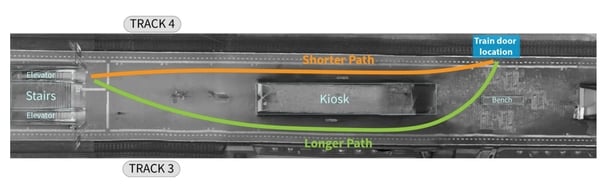
On paper, this looks like a simple rational choice: take the shorter path. But that is not what consistently happened.
Passengers travelling alone - not in groups - showed a strong tendency to choose the same path as the person immediately ahead of them. It did not matter whether that path was shorter or less crowded. What mattered most was what the previous person had just done. The stranger in front acted as a signal.
How small choices turn into crowd waves
This behaviour might sound trivial but it isn't. Once one person chooses a path, the next becomes more likely to choose the same one. If two or three people in a row make that same decision, the signal grows stronger. It begins to feel like the 'normal' direction. And that is how a chain starts.
We found that these chains can form in bursts. Several people in a row take exactly the same route. A small initial fluctuation, for example, one person turning left instead of right, can trigger a cascade, with many others doing the same. There is no leader. No announcement. No discussion. Just a quiet, almost automatic response to the movement ahead.
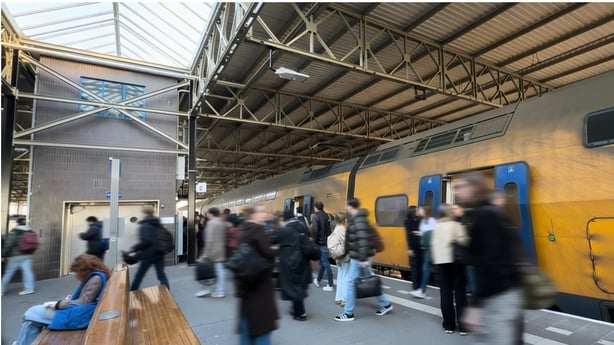
It works a bit like an avalanche. One small shift can ripple outward and reshape the overall flow of the crowd.
Why do we do this?
In a busy station, you do not have time to calculate the optimal route. You may not even have enough information to know which route is truly better so your brain takes a shortcut.
The person in front appears to have already made the decision. Following them reduces uncertainty. It may also feel physically easier: they clear a small space as they move, creating a ready-made path. In uncertain, fast-moving situations, copying becomes efficient.
This kind of behaviour is not about panic or irrationality. It is about dealing with limited time and information. When conditions are ambiguous, other people become cues.
Why this matters beyond train platforms
A railway station is just one example. Similar fast, visible decisions happen everywhere: at airport security, in traffic, in queues, at festivals, even online. Whenever we are uncertain and others' actions are visible, we are influenced by them.
We need your consent to load this rte-player contentWe use rte-player to manage extra content that can set cookies on your device and collect data about your activity. Please review their details and accept them to load the content.Manage Preferences
From RTÉ Brainstorm. why do some people have no sense of direction?
What surprised us was how far that influence can travel. One person’s decision can ripple through dozens of strangers who will never speak to each other.
This matters for how we design public spaces. Most crowd models focus on physical factors: density, speed, available space. These are important. But our findings show that subtle, moment-to-moment social influence between strangers can be just as powerful.
If the first few people all choose one side, they can unintentionally trigger an imbalance. A slightly longer route can become temporarily overloaded simply because it was chosen first.
What can be done?
The good news is that small design changes can make a difference. Clear signage at choice points can reduce uncertainty. Real-time information, for example, indicating that both routes are equally fast, can weaken the impulse to copy. Even subtle visual cues, such as floor markings that emphasise both directions equally, may prevent early clustering on one side.
The key insight is simple: the first few choices matter disproportionately. If we manage those early moments well, we can prevent unnecessary congestion later.
From BBC World Service, why do crowds move us?
A different way of seeing crowds
We often imagine crowds as chaotic, unpredictable or even dangerous but what we see instead is something more human. Crowds are made up of ordinary people making small decisions under mild uncertainty. A quick glance. A small step. An assumption that 'they probably know' and suddenly, a pattern emerges.
There is no invisible leader directing the flow. No hidden plan. Just a series of tiny, connected choices. Understanding this does not just help us design better stations. It changes how we think about collective behaviour. Large-scale patterns do not always need strong forces or loud instructions. Sometimes, all it takes is one person turning left.
And the rest of us quietly following.
Follow RTÉ Brainstorm on WhatsApp and Instagram for more stories and updates
Ziqi Wang is a postdoctoral researcher in the Department of Applied Physics & Science Education at Eindhoven University of Technology
The views expressed here are those of the author and do not represent or reflect the views of RTÉ
