


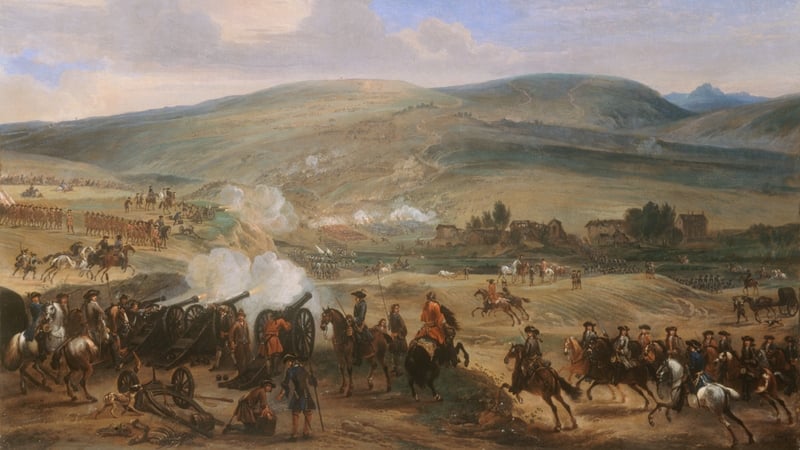
Analysis: Catherine Luttrell, widow of the former Jacobite governor of Dublin, found herself convicted of foreign treason through the efforts of her brother-in-law.
By Frances Nolan, UCD
The War of the Two King's in Ireland (1689-91) profoundly shaped the course of Irish history. The defeat of James II by William III resulted in the final decline of the Catholic nobility on the island and the rise of the Protestant ruling class.
Approximately 4,000 of James’s supporters (known as Jacobites) were outlawed for their role in the war; many were landowning Catholics and the forfeiture of their estates caused Catholic landownership to fall from 22 per cent at the outset of the war, to 14 per cent in 1703. The vast majority of those convicted were male – a circumstance that reflected their military service and civil employment, as well as a contemporary disregard for women as meaningful political actors.
The outlawry of Irish Jacobites was primarily achieved through a series of legal actions at county assizes; a bill of indictment was issued first, followed by a warrant demanding that the accused person appear for trial by judge and jury. If the accused did not appear, a second warrant was issued before they were declared non est inventus ('he is not found’). The court then produced a writ of exigent, ordering the sheriff to have the accused’s name read aloud on five successive county-court days; if they did not appear at that point, they were automatically declared ‘outlawed.’
We need your consent to load this rte-player contentWe use rte-player to manage extra content that can set cookies on your device and collect data about your activity. Please review their details and accept them to load the content.Manage Preferences
From RTÉ One's The History Show, Myles is joined by Dr Harman Murtagh, author of a new book telling the story of Ireland's largest pre-modern army.
The ‘Book of Outlawries’, which is held in Trinity College Dublin's archives, lists 57 persons who were outlawed for high treason in England, 2,603 individuals who were outlawed in Ireland and 1,261 individuals who were convicted for foreign treason. A total of 22 women are named in the book. This low number does not reflect the political activities of women during wartime, however, with many observed to be acting in support of both the Jacobite and Williamite armies.
On the Jacobite side, this included Sarah Stafford, who directed a Jacobite spy network in County Antrim from her home in Dublin; Mary Bellew, the wife of John, Baron Bellew of Duleek, who was described as a ‘cunning, intriguing woman [who] is very violent against the Protestants’; and Frances Sarsfield, Viscountess Kilmallock, who managed communications for her officer husband, Dominick, as well as ordering the manufacture of soldier’s uniforms and the repair of muskets.
These women – and others like them – were not prosecuted for their activities because they were understood to be acting out of wifely duty and in a domestic (i.e. not political) capacity. The majority of the 22 women who were actually convicted of treason after the War of the Two Kings were Catholic heiresses or property-owners, who were targeted by people with a competing claim on their estate.
We need your consent to load this rte-player contentWe use rte-player to manage extra content that can set cookies on your device and collect data about your activity. Please review their details and accept them to load the content.Manage Preferences
From RTÉ Podcasts' Brainstorm, how Medieval Ireland's scholars and ideas had an impact on France
These women were not technically outlaws, however, because a woman could not actually be outlawed under common law. As the prominent medieval jurist and judge Henry de Bracton put it: ‘[a woman] cannot be outlawed because she is not under the law, but […] she may well be waived and regarded as one abandoned, for waif is that which no one claims.’
In a material sense, waivery amounted to male outlawry and the two terms were often used interchangeably. If there was some room for confusion over legal terminology, there was no room for error when prosecuting a woman for treason, however.

Significantly (and unlike in civil suits where the naming of a woman’s husband was sufficient) a woman had to be tried as a named individual in a criminal case. This was evidenced by the case of Catherine Luttrell, widow (from 1698) of the former Jacobite governor of Dublin, Simon Luttrell.
Catherine travelled to James II's exiled court in France in 1692 and was afterwards convicted of foreign treason through the efforts of her brother-in-law, Henry, who sought first to bar her claim to a separate estate worth £350 per annum, before frustrating her claim to her jointure (widow’s entitlement), which was worth £750 per annum. Appealing to the English government in 1699, Henry accused Catherine of being ‘a very intriguing woman’ who ‘went for France […] on a very intriguing message.’
We need your consent to load this rte-player contentWe use rte-player to manage extra content that can set cookies on your device and collect data about your activity. Please review their details and accept them to load the content.Manage Preferences
From RTÉ Radio 1's The History Show, medieval Irish historian Gillian Kenny traced laws and practices surrounding marriage in medieval Ireland.
Despite Henry Luttrell’s best efforts, Catherine was restored to her property because of the omission of her forename from legal documents that confirmed her waiver. Included in the list of outlawries for foreign treason is an entry for ‘_____ Luttrell, wife of the said Simon’.
This echoed the absence of Catherine’s forename in the writ of exigent that was issued after the War of the Two Kings, which ordered the appearance of ‘Symon Luttrell of Luttrellstown in the County of Dublin and [blank] Luttrell, spinster uxor predict [spinster and wife of the aforesaid]’. This error was repeated in the judgement on the case, ‘whereby Symon Luttrell [is declared] outlawed and _____ Luttrell spinster [is] waviata [waived].’
The absence of Catherine’s name was a clerical error, but it was enough to render her conviction for treason legally void. Several years after those proceedings, Catherine’s lawyer Sir Stephen Rice argued this point at a court of claims in Dublin. The court, which sat at Chichester House, the old parliament building on College Green, was presided over by the board of trustees for the Irish forfeitures; this was a 13-member statutory body established by the English parliament in 1700, under legislation to resume the ‘exorbitant’ land grants that had been made by William III after the war.
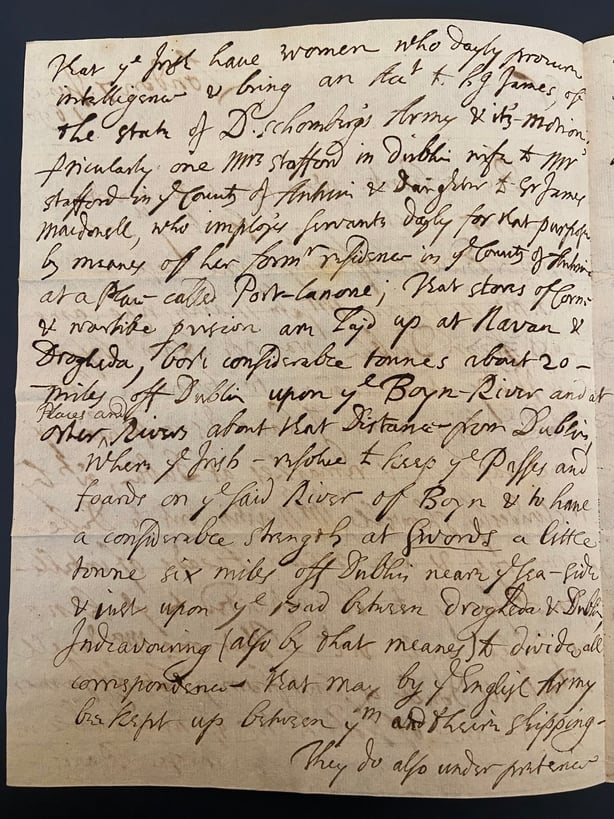
The Act of Resumption allowed anyone with a title to property on a forfeited estate that predated 13 February 1689 – the date of William III and Mary II's accession to the throne – to argue their case before the court of claims; over 3,100 claims were submitted and adjudicated on between 1700 and 1703.
Returning from France, Catherine Luttrell appeared before the trustees to claim her jointure, which was derived from lands forfeited by Simon in Dublin and Kildare.
We need your consent to load this rte-player contentWe use rte-player to manage extra content that can set cookies on your device and collect data about your activity. Please review their details and accept them to load the content.Manage Preferences
From RTÉ Podcasts' Brainstorm, what was it like to go to a doctor in medieval Ireland?
Catherine’s title long pre-dated February 1689, with the relevant deeds being executed at the time of her marriage to Simon in 1672, and post-nuptially in 1675. This meant that any argument against her claim depended solely on the validity of her conviction for foreign treason. In a colourful argument, Rice contended that:
the claimant is not named in the record. I do not say there is any error in the record; the parties therein named are outlawed … In our case here [there is] no Christian name unless Luttrell be taken for a Christian name and that is not our Christian name. It may be that Symon had another wife whose Christian name was Luttrell; there may be two contesting wives though but one of them was properly his wife according to our Law … The judgement is not that the wife of Symon Luttrell is waived but that Luttrell Spinster is waived.
Rice’s argument was clever, and it was also legally sound. Despite Henry Luttrell’s efforts to bar her from her jointure, the court adjudicated in Catherine’s favour and her jointure was confirmed in an act for the relief of Henry Luttrell in 1702.
And that is how one woman got away with treason, thanks to a clerical error.
Follow RTÉ Brainstorm on WhatsApp and Instagram for more stories and updates
Dr Frances Nolan is a is a Research Ireland (SFI-IRC) Pathway Fellow and Principal Investigator on the Law versus Practice project in the School of History at UCD. SFI-IRC Award ID: 22/PATH-A/10840.
The views expressed here are those of the author and do not represent or reflect the views of RTÉ
