


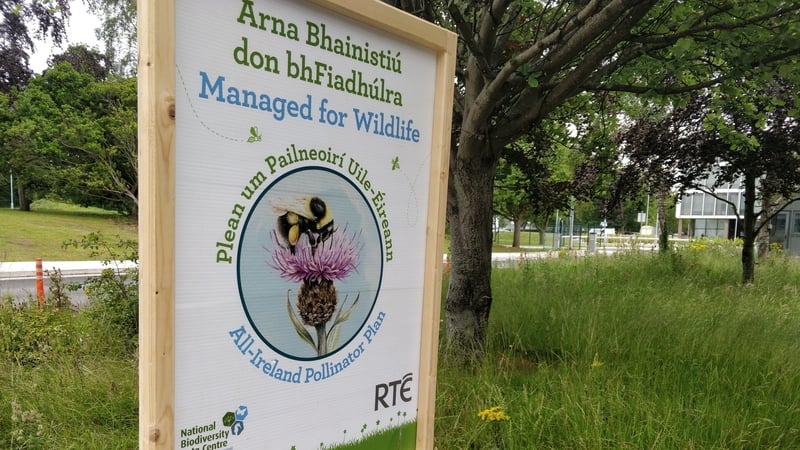

Analysis: Industrial estates are rarely seen as havens for wildlife, yet they could form a vital network of pollinator corridors across the country.
By Adele Smith-Auchmuty and Sujatha Dhanapal, Maynooth University
For years, the conversation around saving Ireland's pollinators has been rooted in our fields, farms, and national parks. However, the most comprehensive roadmap for reversing their decline comes from an unexpected source: a recent research project at Maynooth University.
The surprising opportunity lies in the last place you'd expect: the industrial estate. Sprawling and functional, these zones of concrete and loading bays are rarely seen as havens for wildlife. Yet, because they are everywhere, the forgotten patches of ground within them could form a vital network of pollinator corridors across the country.
So, why are these industrial estates and business parks currently failing our insects, and how can a simple guide change that?
We need your consent to load this rte-player contentWe use rte-player to manage extra content that can set cookies on your device and collect data about your activity. Please review their details and accept them to load the content.Manage Preferences
From RTÉ Radio 1's Oliver Callan, rewilding a five acre farm and what wild Ireland was like before humans took it over
The Problem in Plain Sight
The scale of the opportunity is massive. With more than 30 of our 100 native bee species now threatened with extinction, every acre counts. Yet, a huge portion of Ireland’s developed land is locked away in these industrial zones, spaces that have, until now, been completely ignored in our national biodiversity conversations.
In these estates, nature has been pushed to the edge. With short leases and multiple tenants, these sites often suffer because no single person is responsible for land management. When you add tight maintenance budgets, limited wildlife knowledge, and a cultural obsession with 'tidy' landscaping, nature is left with very little room to breathe.
Our research found that vague, one-size-fits-all 'green’ plans don’t work here. Whether it's a modern site in Dunboyne, a sprawling multi-tenant estate like Huntstown, or a cramped, built-up zone like Robinhood, each faces its own hurdles. Without practical guidance, even the most well-intentioned companies struggle to take the first step.
We need your consent to load this rte-player contentWe use rte-player to manage extra content that can set cookies on your device and collect data about your activity. Please review their details and accept them to load the content.Manage Preferences
From RTÉ Radio 1's Today with Claire Byrne, what exactly does rewilding mean?
From Research to Action
To bridge that gap, we created a simple guide to help industrial estates take practical steps toward becoming more pollinator friendly. We examined three types of estates to reflect real-world conditions, not ‘perfect’ designs. The guide offers flexible options through three clear levels:
Level 1: Quick Wins – Simple, low-cost actions like bee hotels and ‘no-mow’ patches, perfect for older estates with very little space.
Level 2: Building Up – Moderate steps like planting verges, adding climbing plants to fences, or using raised planters in existing concrete areas.
Level 3: The Masterplan – Larger features like hedgerows, grassy drainage channels, and green buffer zones for bigger sites or those still in the planning phase.
We need your consent to load this rte-player contentWe use rte-player to manage extra content that can set cookies on your device and collect data about your activity. Please review their details and accept them to load the content.Manage Preferences
From RTÉ Lyric FM's Daybreak with Evonne Ferguson, Ireland has over 100 bee species, of which 77 are solitary bees.
From Plans to Real Changes
Each site can start small and build over time by following five simple steps:
Get people onside: Start with ‘quick wins’ like bee-friendly signs or allowing a few verges to grow. This shifts the culture from ‘untidy’ to ‘intentional’.
Walk the site: Map out sunny verges, unused corners, or drainage edges. A rough sketch is usually enough to start identifying where nature can take hold.
Decide what’s realistic: Match your ambition to your budget. This could mean anything from simple planters to new native hedgerows.
Work in phases: Get contractors, facility managers, and tenants to agree on who does what. Clear roles keep the project moving.
Track progress: Use simple tools like photo logs or basic wildlife counts. This provides solid evidence that a site can be both a productive workplace and a thriving habitat.
We need your consent to load this rte-player contentWe use rte-player to manage extra content that can set cookies on your device and collect data about your activity. Please review their details and accept them to load the content.Manage Preferences
From RTÉ Radio 1's Countrywide, the native bee is uniquely adapted to the conditions on this island.
Making it Pay
This approach is affordable. Depending on the size of the estate, practical measures can be implemented for amounts ranging from €1,000 to €50,000. Case studies from Intel Ireland and BMW show that you don't need a massive upfront investment; starting small and adding changes over time allows the budget to stretch further. In many cases, allowing verges to grow naturally can reduce maintenance costs while creating a habitat for pollinators.
A Good News Story for Business
For businesses concerned about expense, costs are often balanced by practical benefits. Low-mow zones reduce maintenance bills, and visible action shows a company’s real commitment to the environment.
This links a company’s bottom line to the health of the local area. Firms can track progress by measuring how much new habitat is created or by encouraging staff to log bee sightings through citizen-science apps. These results can inform sustainability reports and demonstrate how firms are supporting Ireland's National Biodiversity Action Plan (2023–2030) and the UN's "Life on Land" goal.
Ultimately, this research shows that ecological recovery isn’t just about government policy or vast protected lands. It’s about empowering everyday businesses to take small, practical steps in overlooked places.
By changing our minds about what an industrial estate can be, from a concrete barrier to a buzzing, green stepping-stone, we can open up thousands of acres of new habitat and give Ireland’s pollinators a fighting chance.
Follow RTÉ Brainstorm on WhatsApp and Instagram for more stories and updates
Dr Adele Smith-Auchmuty is a Lecturer in Management and Programme Director of the MSc Business Management in the School of Business at Maynooth University. Sujatha Dhanapal holds an MSc in Business Management from Maynooth University.
The views expressed here are those of the author and do not represent or reflect the views of RTÉ
