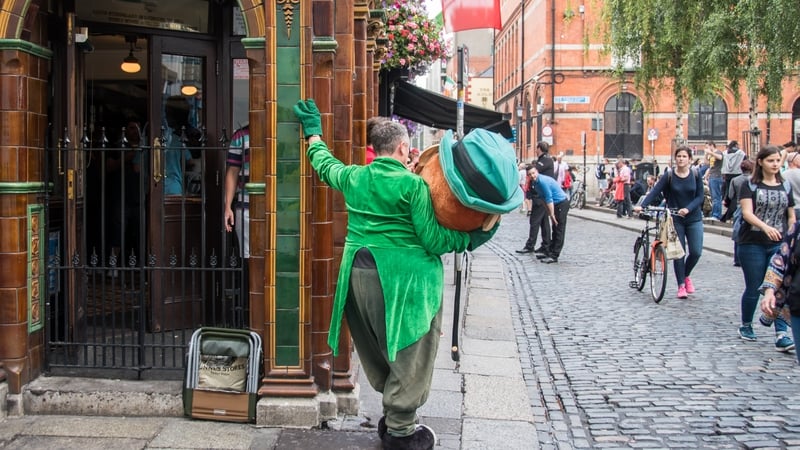


Analysis: Much of what Americans know, or think they know about Ireland comes from films portraying the Irish Irish as boastful, sentimental, and mischievous.
St. Patrick's Day is approaching, and in the United States, this means a series of green beer fests with huge parades and boys, girls, men, and women their "Kiss Me, I’m Irish" getup. The sooner it is over, the better. For one day, almost everyone with some plausible connection to Ireland celebrates this, then forgets about it as soon as their hangovers go away.
Americans love Ireland. Many of us trace grandparents, great-grandparents and other relations back to the Emerald Isle, and when we visit, we are as likely as not to bore our Irish hosts with claims of being half Irish or 75% Irish or some other fanciful number.
We are, apparently, in the middle of Irish American Heritage Month, a recognition of the large number of Americans with Irish heritage (this announcement from the White House got lost in the blizzard of other Trump pronouncements, and it is a shame). Yet Americans know very little about Ireland, its politics, its culture, its problems, or its promise. I blame this largely on John Ford.
We need your consent to load this rte-player contentWe use rte-player to manage extra content that can set cookies on your device and collect data about your activity. Please review their details and accept them to load the content.Manage Preferences
From RTÉ Radio 1's Arena, Ruth Barton looks at the 1935 John Ford film "The Informer"
John Ford was a prolific film director, and many of his films dealt with Ireland or featured what he represented as Irish characters. Some of these were very good films that dealt with serious issues, such as The Informer (1935) and The Plough and the Stars (1936). Others presented painfully whimsical visions of Ireland, such as The Quiet Man (1952) or The Rising of the Moon (1957). Other dealt in stereotypes (e.g., The silent film, Mother Machree, 1927) or prominently presented stereotypes of the Irish. My favorite example of a walking stereotype would be Victor McLaglen, a British-American actor who embodied the "Oirish".
Voctor McLaglen was a fine actor whose portrayal of Gypo Nolan in The Informer won him a well-deserved Oscar (Best Actor). However, in several of Ford’s films, he took on a thick brogue and spent much of his time drinking, fighting and trying to hoodwink his superiors. His role as a cavalry sergeant in Fort Apache (1948), She Wore a Yellow Ribbon (1949) and Rio Grande (1950), originally named Mulcahy and later Quincannon led many Americans to believe McLaglen was Irish, and their understanding of Ireland and of Irish norms, culture and behavior are in large part shaped by these films.
John Ford is not the only person to push stereotypes of the Irish as boastful, sentimental, mischievous, addicted to drink, and quick with their fists; actors ranging from Errol Flynn to Barry Fitzgerald traded on stereotypes of the Irish in numerous films.
Unfortunately, much of what Americans know, or think they know about Ireland comes from these films.
Occasionally, something like Riverdance introduces Americans to some parts of Irish culture, and Irish festivals in America are often quite popular and quite good. My daughter spent several years learning and competing in Irish Dance, with a teacher from Cork.
Cillian Murphy has helped ramp up the visibility of Irish actors and inspired some Americans to learn more about Ireland. What is missing is any real familiarity with contemporary Ireland. Americans prefer the Ireland of their imagination, and when they visit parts of Ireland that depend heavily on tourism, this is often what they get.
We need your consent to load this rte-player contentWe use rte-player to manage extra content that can set cookies on your device and collect data about your activity. Please review their details and accept them to load the content.Manage Preferences
From RTÉ Radio 1's Documentary on One, 42 American tourists travel around Ireland by coach in 1977. But what attracts them to the Emerald Isle?
I blame John Ford for addicting Americans to a romanticised vision of Ireland, but to be honest, Irish diplomats do not always much better. Just about every year in the weeks preceding St. Patrick’s Day, an Irish diplomat will visit the White House bearing a lovely Waterford bowl full of shamrocks. It is a nice gesture, but how about something that represents the modern realities of Ireland. For heaven’s sake, you have the best butter in the world. How about bringing a few pounds of Kerrygold next time!
From the American perspective, Ireland is a small nation on the edge of Europe, and we would rather dwell on our romantic image of the place than learn about its problems. For example, there is very little awareness in the U.S. of Ireland’s housing problems, of the difficulty affording life in Dublin, or of the availability and use of drugs in Ireland. Alcohol, yes, but drugs? Surprisingly, Americans have little awareness of the outsized role of American multinational corporations in the Irish Economy.
Occasionally, a story will come out describing how some American corporation uses its Irish subsidiaries to avoid their U.S. tax bill, but few Americans have any appreciation of how important Irish divisions and subsidiaries of American corporations are to both countries. I just had my knee replaced, and we drove by the factory where my knee was made on the M7 as we were driving from Dublin to the West.
We need your consent to load this rte-player contentWe use rte-player to manage extra content that can set cookies on your device and collect data about your activity. Please review their details and accept them to load the content.Manage Preferences
From RTÉ Radio 1's Drivetime, how well does Ireland sell itself at home and abroad?
It is a shame so many Americans have a romanticised view of Ireland, because Ireland hardly needs to be romanticised. The people are wonderful, the music is great, the food is top-notch, and it is an easy place to visit and enjoy. A bit less blarney on your side and a bit less yee-haw on our would probably make for better understanding between the US and Ireland.
Follow RTÉ Brainstorm on WhatsApp and Instagram for more stories and updates
The views expressed here are those of the author and do not represent or reflect the views of RTÉ