

Analysis: As Voorhees Law of Traffic shows, small advantages often don't last in systems shaped by randomness like your commute to and from work
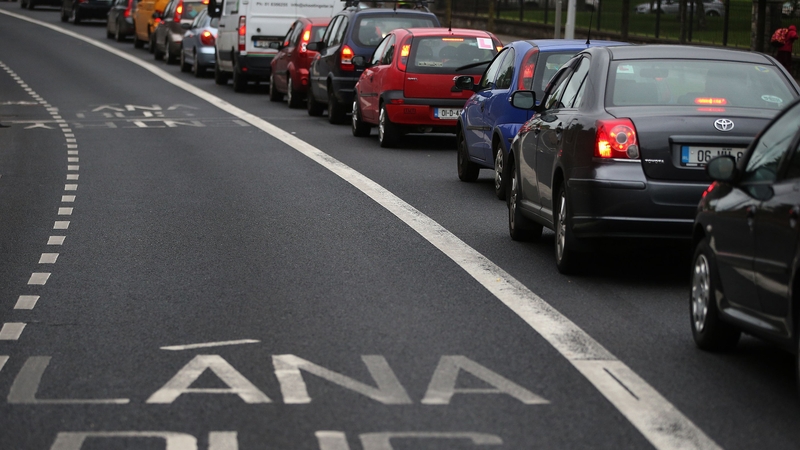
You speed up, overtake and pull ahead. The slow car shrinks in your mirror. Victory. For a moment, it feels like you've escaped the drag on your journey, reclaimed control of the road and gained a tangible advantage.
Then you reach the next red light and there it is again, quietly waiting behind you. Not racing. Not struggling. Just present. As if the overtake never happened.
In the film franchise Friday the 13th, Jason Voorhees doesn’t sprint after his victims. He walks. Patiently. Inevitably. No matter how fast they run, he always seems to be right there. In the films, it’s fallen branches and dark woods that slow people down, erasing whatever head start they thought they had. In traffic, it’s the lights. The red signal acts like a reset button, wiping away the illusion of progress and restoring the original order. This isn’t supernatural, but it is mathematical.
From RTÉ Archives, current affairs programme Week In sent Pat Kenny to find a solution to traffic chaos in Dublin and Cork in 1980
Voorhees Law of Traffic is a playful way of describing a serious idea: small advantages often don’t last in systems shaped by randomness. Classical traffic signal theory has long shown that it is timing and not just speed which determines who arrives first. Movement through a city is not a straight race but a sequence of interruptions, each governed by cycles and probabilities rather than pure velocity.
Imagine two cars approaching a fixed-time traffic light. One is slightly faster and gains a small time lead after overtaking. That lead might only be a few seconds - barely noticeable on the scale of a full journey. Whether it survives depends entirely on when the cars arrive within the light’s cycle, something neither driver controls.
If the faster car reaches the signal during a long red phase, and the red lasts longer than the time gap between them, the slower car simply catches up at the stop line. The overtake is erased in a single reset. The advantage collapses to zero, not because the faster driver slowed down, but because both vehicles were forced into the same pause.
We need your consent to load this rte-player contentWe use rte-player to manage extra content that can set cookies on your device and collect data about your activity. Please review their details and accept them to load the content.Manage Preferences
From RTÉ Radio 1's Drivetime, Brendan O'Brien, Dublin City Council Executive Manager for Traffic, on the capital's traffic issues
If the faster car slips through at the end of green while the slower car is stopped, the lead grows. If both arrive during green, nothing changes. Mathematically, each light produces one of four outcomes: neutral, gain, catch-up, or partial loss. The result depends less on intent and more on alignment with the signal phase.
Over multiple lights, these probabilities compound. Each signal acts like an independent trial - an idea similar to how reliability theory multiplies survival probabilities across components. Research on induced demand shows that even large infrastructure changes often fail to eliminate congestion because new capacity attracts new traffic. In complex systems, local gains are fragile. They survive only if they avoid repeated resets.
In a long corridor of traffic lights, eventual re-encounter becomes statistically likely. Not guaranteed - but common enough to feel inevitable. Each red light is another chance for the slower car to close the gap, another small interruption that cancels momentum. Jason always comes back.
We need your consent to load this rte-player contentWe use rte-player to manage extra content that can set cookies on your device and collect data about your activity. Please review their details and accept them to load the content.Manage Preferences
From RTÉ Radio 1's Today With Claire Byrne, what's the science behind traffic jams?
But mathematics explains only half of the story and it takes psychology to explain the rest. The idea that "bad is stronger than good" suggests that negative or frustrating outcomes linger in memory more strongly than neutral ones. If you pass five cars and never see them again, you barely notice. Those uneventful separations fade instantly. But the one that reappears at the next red light sticks in your mind, sharp and disproportionate.
This connects to the availability heuristic, where memorable events feel more frequent than they are. Because the reappearance is vivid, it feels common. Because it feels common, it feels fated. Other perceptual quirks show similar effects. The so-called adjacent-lane illusion describes how drivers often believe the lane beside them is moving faster, even when the statistics are symmetrical. The same mathematics underlies both experiences: structured randomness combined with selective perception.
Even emerging vehicle technologies illustrate the point. Adaptive cruise control experiments have shown that smoothing small speed fluctuations can reduce stop–start traffic waves. Reduce the noise, and the resets become less dramatic. The system becomes steadier, and the illusion of pursuit weakens.
We need your consent to load this rte-player contentWe use rte-player to manage extra content that can set cookies on your device and collect data about your activity. Please review their details and accept them to load the content.Manage Preferences
From RTÉ Radio 1's Today With Claire Byrne, do you fear driving on motorways?
The lesson extends beyond traffic. In many systems - financial markets, queues, social media dynamics - small gains are repeatedly nudged off course by randomness unless they are large enough to dominate it. Probability does not care about effort; it cares about structure and timing.
So the next time the car you overtook glides back into view, consider it a quiet demonstration of probability in action. Nothing supernatural is happening. The red-light cycle has simply reset the system.
Jason isn’t chasing you. But the mathematics of variability - and the way your mind remembers frustration - can make it feel that way.
Follow RTÉ Brainstorm on WhatsApp and Instagram for more stories and updates
The views expressed here are those of the author and do not represent or reflect the views of RTÉ