


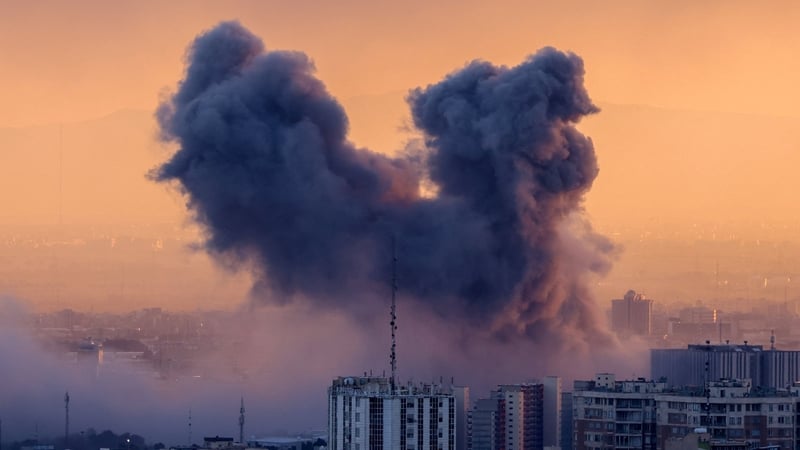
Analysis: History offers few examples of successful 'regime change from the skies' and such air campaigns often make matters worse
By Matthew Powell, University of Portsmouth
The ongoing US and Israel's coordinated air campaign aims to destroy Iran's missile capabilities and navy, curb its ability to develop nuclear weapons and eliminate its leadership. The strikes have been accompanied by calls from US president Donald Trump for the Iranian people to rise up and overthrow their government.
In his statement announcing the start of the operation on February 28, Trump said: "When we are finished, take over your government. It will be yours to take. This will be probably your only chance for generations." It is clear that Trump is hoping US and Israeli air power can weaken the regime in Tehran sufficiently for the Iranian people to finish the job themselves.
We need your consent to load this rte-player contentWe use rte-player to manage extra content that can set cookies on your device and collect data about your activity. Please review their details and accept them to load the content.Manage Preferences
From RTÉ Radio 1's Six News, US launches 'most intense' missile strikes to date on Iran
This approach has been criticised by some world leaders. British prime minister Keir Starmer, for instance, said that his government "does not believe in regime change from the skies". In any case, history offers few examples in which an aerial bombing campaign aimed at enabling regime change has produced positive outcomes.
There are strategic benefits to using air power. It is inherently flexible in how it can be deployed, which allows for the escalation and deescalation of violence with greater ease than is possible with land or naval power. The speed and reach of air power also broadens the range of available military targets, while simultaneously reducing the need to expose troops to risk.
But air power has several limitations. Perhaps the main limitation is that, unlike ground forces, air power is unable to hold and secure territory that would allow for the consolidation of control. This was evident following the Libyan revolution in 2011, where a Nato air campaign supported a rebellion that overthrew the country's ruler, Colonel Muammar Gaddafi.
We need your consent to load this rte-player contentWe use rte-player to manage extra content that can set cookies on your device and collect data about your activity. Please review their details and accept them to load the content.Manage Preferences
From RTÉ Radio 1's Morning Ireland, foreign correspondent and security analyst Borzou Daragahi discusses the latest developments in the US-Iran war
Despite the initial success of the rebellion, Libya soon fell into chaos. Two main competing governments, supported by complex networks of militias, have spent the past decade or so vying for control. This has created a deeply divided, highly fragile state.
This is not to say putting western boots on the ground to help manage a transition would have led to a different outcome. Several years earlier, ground forces were unable to prevent Iraq from descending into civil war after the toppling of Saddam Hussein. But what is clear is that the deployment of air power alone was not sufficient to influence the political direction of Libya once Gaddafi had been removed.
Situation in Iran
The lesson from Libya is that fomenting a revolution when you have little ability to control how events play out on the ground can lead to unfavourable outcomes. This can be applied directly to the current situation in Iran. As was the case in Libya, it is far from clear what will replace the government in Tehran should it fall as Iran's opposition is fragmented and disorganised.
We need your consent to load this rte-player contentWe use rte-player to manage extra content that can set cookies on your device and collect data about your activity. Please review their details and accept them to load the content.Manage Preferences
From RTÉ Six One News, Reza Pahlavi, the exiled son of Iran's last shah, says the Islamic Republic will fall
Reza Pahlavi, the exiled son of Iran's last shah, has positioned himself as a possible successor to the current leadership. But the level of support for him within Iran is unclear. Surveys by the Gamaan group, an organisation that attempts to gauge political sentiment in Iran, suggest roughly one-third of people are strong supporters of Pahlavi and another third strongly oppose him. With no unified opposition ready and able to enact a provisional government if the regime falls, the result is likely to be a power vacuum. This could possibly result in a civil war that further destabilises the region.
At the same time, there is no guarantee that the US-Israeli air campaign will encourage the Iranian people to topple their country's leadership. Rounds of protests in recent years have been met with brutal repression by the authorities, with estimates suggesting tens of thousands of protestors were killed during the latest crackdown in January 2025.
It will remain a significant risk to protest against the Iranian regime, regardless of the damage that has been inflicted on the country's leadership. White House press secretary Karoline Leavitt, said that "49 of the most senior Iranian regime leaders" had been "wiped off the face of the Earth" in the opening US-Israeli strikes.
We need your consent to load this rte-player contentWe use rte-player to manage extra content that can set cookies on your device and collect data about your activity. Please review their details and accept them to load the content.Manage Preferences
From RTÉ Radio 1's Morning Ireland, John Irvine, Senior International Correspondent for ITV News, on IDF claims that Israel is striking 'regime infrastructure' in Iran
The Iranian Revolutionary Guard Corps (IRGC), which operates parallel to Iran's regular armed forces, exists solely to support the regime and answers directly to the supreme leader. It has upward of 190,000 troops under its command and is supported by the Basij paramilitary force, which claims it can mobilise around 600,000 volunteers.
Trump has threatened the IRGC and the Basij with certain death unless they lay down their arms. They are unlikely to take notice of these threats. However, if they do, there is effectively no one to accept their surrender – it is impossible to surrender to an aircraft tens of thousands of feet in the sky.
The removal of the regime in Tehran will be wished for by many across the globe. But there is no guarantee an air campaign will lead to its demise, nor is it clear that what follows will be any better. As Libya shows, what could follow the overthrow of the Islamic Republic is instability and chaos – a situation that could create more problems than it solves.
Follow RTÉ Brainstorm on WhatsApp and Instagram for more stories and updates
Matthew Powell is a Teaching Fellow in Strategic and Air Power Studies at the University of Portsmouth. This article was originally published by The Conversation.
The views expressed here are those of the author and do not represent or reflect the views of RTÉ
