


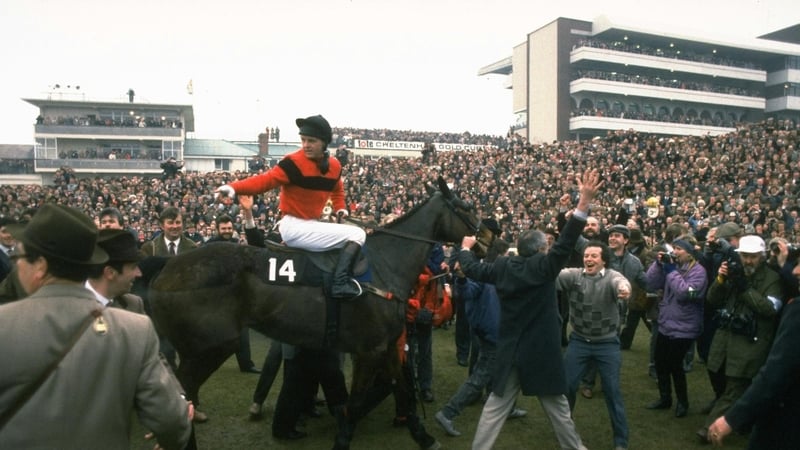
Analysis: She remains the only Irish horse to complete the Champion Hurdle and Gold Cup double, as well as Irish, English and French Champion Hurdles
By Frances Nolan, UCD
National Hunt racing holds a special place in the Irish imagination and the island's people have often looked to the race track to find pride in their identity. The pinnacle of success in jump racing is undoubtedly the Cheltenham Festival, which has been held at the Prestbury Park course since the early 20th century. The first edition of the Cheltenham Gold Cup was run in 1924 and it didn’t take long for the Irish to make their mark, with Ballinode – trained on the Curragh and known popularly as "the Sligo Mare" – finishing first past the post in 1925.
Numerous Irish-bred, British-trained horses enjoyed success at Cheltenham before the Second World War; foremost among them was Golden Miller, who was sold into England before winning five consecutive Gold Cups between 1932 and 1936. With the majority of valuable bloodstock being exported, Irish-trained winners were relatively rare.
Vincent O'Brien broke the mould, however, training Cottage Rake to a remarkable hat-trick of Gold Cups (1948-1950) and Hatton's Grace to three Champion Hurdles (1949-1951). At a time of economic stagnation and mass emigration, O’Brien’s success gave the Irish people a reason to celebrate; more importantly, it served as a source of national pride. O’Brien’s wife Jacqueline later recalled: 'for the first time, Ireland was the best at something … Irish people were able to put their shoulders back, beating the English, it was an astonishing state of affairs.’
From RTÉ Archives, Michael Ryan reports for RTÉ News on the people of Waterford betting big on Dawn Run to win the 1986 Gold Cup
The Irish enjoyed an unprecedented success at Cheltenham in the 1960s and 1970s. That legend of steeplechasing, Arkle, emulated Cottage Rake’s achievement in superior style, winning three Gold Cups between 1964 and 1966. Others Irish-trained winners followed, including L'Escargot and Captain Christy, but it wasn’t until the 1980s – with Ireland again reeling from economic woes – that another true superstar emerged.
A big bay mare who ‘wasn’t cuddly or beautiful’, Dawn Run was sired by Deep Run out of Twilight Slave. Foaled in 1978, she was bought for 5,800 guineas as a three-year-old by Charmian Hill. A singular character, Hill was a fearless amateur rider whose determination to continue riding into older age earned her the nickname the ‘Galloping Granny.’ A then 62-year-old Hill partnered Dawn Run to three wins on the flat before the Turf Club rescinded her amateur licence, and before the mare began her hurdling career.
Dawn Run was trained by Paddy Mullins – father of Willie – at Goresbridge in County Kilkenny. Mullins had registered his first winner in 1953 and enjoyed success in the years that followed, but Dawn Run was different. As Paddy confided to his son and stable jockey, Tony, the mare was ‘the one we have been waiting for all our lives.’ Tony became Dawn Run’s regular rider (partnering her to 15 of 21 wins), but he was not on board as the mare won the Irish Champion Hurdle at Leopardstown or the Champion Hurdle at Cheltenham in 1984; instead, Hill insisted that Jonjo O'Neill take the ride.
From RTÉ Archives, Mary Fanning reports for RTÉ News on Dawn Run making history by winning the Gold Cup at Cheltenham in 1986
Dawn Run won the Champion Hurdle from Cima by three-quarters of a length, delivering a rare Irish success at the Cheltenham Festival. Prestbury Park erupted in celebration, with Hill carried into the winner’s enclosure and tossed into the air by jubilant supporters.
But Dawn Run was only getting started. She was reunited with Tony Mullins before winning the Aintree Hurdle and then the French Champion Hurdle. As the mare raced into the history books at Auteuil, commentator Michael O'Hehir proclaimed: "She’s the queen of hurdle racing in Ireland, the queen of hurdle racing in England, and now the queen of hurdle racing in France, as she comes away to a clear win […] Dawn Run is the queen."
After that, the great mare switched to steeplechasing but was injured after winning her first race over fences and did not reappear until December 1985, when she partnered with Tony Mullins to win at Punchestown. Dawn Run’s chasing inexperience was exposed when she made a mistake at Cheltenham’s January meeting in 1986, however, and Hill again insisted that O’Neill replace Mullins for the Festival.
We need your consent to load this rte-player contentWe use rte-player to manage extra content that can set cookies on your device and collect data about your activity. Please review their details and accept them to load the content.Manage Preferences
From RTÉ Radio 1's Morning Ireland in 2020, Darren Frehill remembers one of Ireland's great sporting memories, Dawn Run's historic Gold Cup win in 1986
On 13 March 1986, Dawn Run delivered a sensational performance to win the Cheltenham Gold Cup. Her prospects did not look good at the last fence, but she rallied up the famous hill, with BBC commentator Peter O'Sullevan excitedly declaring that 'the mare is beginning to get up.' Yards from the finishing post, Dawn Run caught Wayward Lad and won the race by a length.
The crowd at Prestbury Park went wild, with O’Neill reflecting that it ‘was a day in a lifetime … it wasn’t just that she did it – it was the way that she did it. Then it all started; it was unbelievable. All those years I had been riding, this was the first time I could hear the weight of the crowd. I remember thinking if all that lot mobbed me, I was gone – and they almost did.’
After her Cheltenham heroics, Dawn Run appeared at the Punchestown Festival to race against the Mouse Morris-trained Champion Chase winner, Buck House. In a contest dubbed ‘the Match of the Century’, the pair met at level weights over two miles, with Tony Mullins on Dawn Run and Tommy Carmody on Buck House. The public interest was enormous and a reported crowd of 40,000 – the largest since the Royal visit in 1868 – thronged the course. They weren’t disappointed: the two horses jumped the last fence neck and neck, but Dawn Run pulled away in a thrilling finish to win by two lengths.
For those watching on, it was a throwback to the halcyon days of Irish racing in the 1960s and 1970s. The gloom soon returned, however: on 27 June 1986, three months after her Gold Cup triumph, Dawn Run died from a fall while attempting to win a second French Champion Hurdle. Her death shocked the Irish public and was even reported on the front page of the Irish Times.
It was a tragedy for Irish racing; the mare won 21 of 35 races, but her career ended as she reached her prime and she never reached her full potential. It is a testament to her talent that she had already achieved greatness as an eight-year-old.
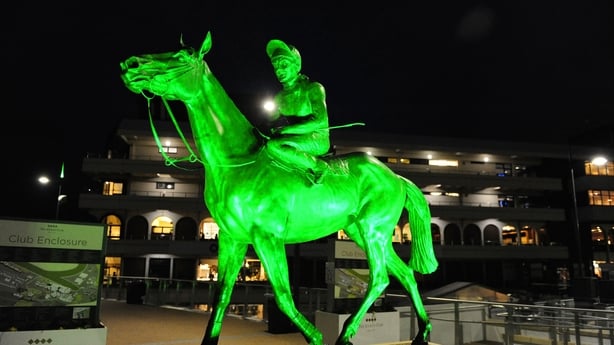
Dawn Run remains the only horse to have completed the Champion Hurdle and Gold Cup double, and to have won the Irish, English and French Champion Hurdles. She was also only the second mare to triumph in the Champion Hurdle, after African Sister in 1939. Today, a statue of the great mare overlooks the parade ring at Prestbury Park – a reminder, if one was needed, that Dawn Run is still the queen of the Cheltenham Festival.
Follow RTÉ Brainstorm on WhatsApp and Instagram for more stories and updates
Dr Frances Nolan is a Research Ireland (SFI-IRC) Pathway Fellow and Principal Investigator on the Law versus Practice project in the School of History at UCD.
The views expressed here are those of the author and do not represent or reflect the views of RTÉ
