



Analysis: There are numerous examples in texts of Irish people showing a sense of belonging to a community defined in relation to Europe
When Bishop Dermait of Armagh died in 852, an annalist (possibly working in the same church) wrote an obituary lauding him as 'the most learned of all the teachers of Europe'. Setting aside the hyperbole, the turn of phrase reflects the annalist’s sense that Ireland and the Irish belonged to Europe. This sense of community with their continental neighbours is often denied to the people of early Ireland, in part by the tendency to label them as Celts.
The use of this term emphasises, and exaggerates, a contrast between the people of Ireland and their ‘post-Roman’ or ‘Germanic’ neighbours, and conjures an image of Ireland as different, distant, and detached from the rest of Europe.
The Irish language and people were only labelled as Celtic for the first time in the 18th century. In the rich and varied textual sources that have survived from early Ireland, including annals, saints’ lives, laws, and sagas about great heroes such as Cú Chulainn and Fionn Mac Cumhail, the words Celt and Celtic do not appear even once.
We need your consent to load this rte-player contentWe use rte-player to manage extra content that can set cookies on your device and collect data about your activity. Please review their details and accept them to load the content.Manage Preferences
From RTÉ Radio 1's The History Show, the quest for the Irish Celt
As scholars have long known, the early Irish had no concept of themselves as Celts and no sense of being linked with other peoples who spoke Celtic languages, such as the Welsh or the Picts. On the other hand, spread across the same body of sources we find numerous expressions of a sense of belonging to a community defined in relation to Europe.
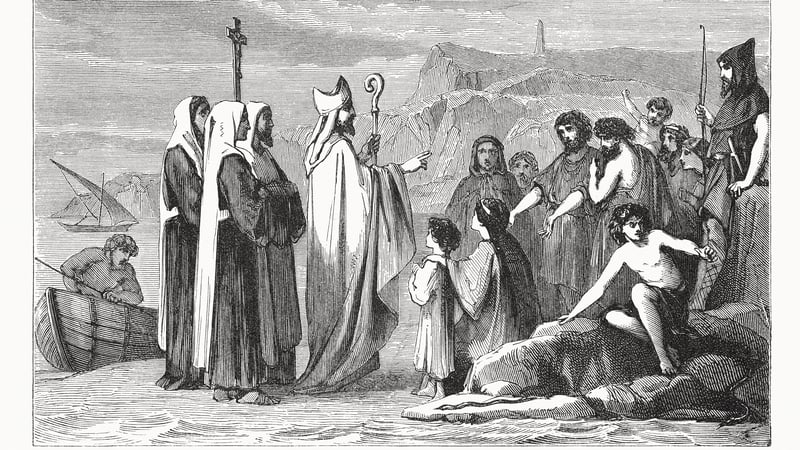
An early example of this European-mindedness appears in the Life of Saint Columba written by Adomnán, abbot of Iona, around the year 700. In referring to an outbreak of plague in the 680s, Adomnán recounted how it had spread across Ireland and Britain as well as ‘other regions of Europe’, including Italy, Gaul, and Spain.
Adomnán, in common with contemporary scholars across early medieval Europe, inherited his knowledge of world geography ultimately from the Greeks, whose learning was transmitted via the Romans and early Christian scholars to the Middle Ages. This was a view according to which the inhabited world was divided into three continents, Africa, Asia, and Europe. Based on his knowledge of this tradition, Adomnán had no qualms about asserting that Ireland was geographically part of Europe.
We need your consent to load this rte-player contentWe use rte-player to manage extra content that can set cookies on your device and collect data about your activity. Please review their details and accept them to load the content.Manage Preferences
From RTÉ Radio 1's The History Show, how piracy, foreign fleets, and climate change transformed Ireland’s coasts in the 14th and 15th centuries
But Europe was more than just a geographical entity for Adomnán. His account of the spread of the plague speaks also to the idea that Europeans had a shared history. Adomnán had survived the plague – he ascribed his survival to St Columba, hence including the story in the saint’s life – and could envisage his experience of the pestilence as something he had in common with contemporary Italians, Gauls, and Spaniards.
Europe was also something more than just a geographical space in the time of Brian Boru. After Brian’s death at Clontarf in 1014, he was commemorated by an annalist as emperor ‘of the whole of north-west Europe’. The title has echoes of one given to the Emperor Charlemagne (d.813) in the same source two hundred years earlier: ‘emperor of the whole of Europe’.
Charlemagne’s realm, which extended across and beyond what is now France, Germany, and northern Italy, was larger than Brian’s, which likely included the Isle of Man and parts of northern Scotland in addition to Ireland. But Charlemagne still did not control the full territorial extent of Europe. These titles, then, were exaggerations intended to reflect the glory of the individual concerned. They nonetheless espouse the belief that Europe – in whole or in part – could potentially provide the framework for institutional or political unity.
We need your consent to load this rte-player contentWe use rte-player to manage extra content that can set cookies on your device and collect data about your activity. Please review their details and accept them to load the content.Manage Preferences
From RTÉ Radio 1's The History Show, The story of Brian Boru and separating fact from legend
It was in relation to religion and learned culture especially that medieval Irish people identified as Europeans. Irish scholars placed great emphasis on their distinct identity as Gaels, and stressed the significance of their language as a cornerstone of their Gaelic identity. They were equally aware of the ethnic and linguistic diversity of neighbouring lands. Yet the description quoted above of Bishop Dermait as ‘the most learned of all the teachers of Europe’ paints Europe as a place where Gaelic scholars conversed, interacted, and even competed with their counterparts from different ethnic and linguistic backgrounds.
In 869, seventeen years after Dermait’s death, Dubthach mac Maíle Tuile died. Dubthach had likely spent time on the continent, where he may have written surviving Latin poetry. In his obituary, Dubthach is described as ‘the most learned of the Latinists of all Europe’. His knowledge of Latin and his experience on the continent undoubtedly influenced the perception of Dubthach.
Another great Irish Latinist who spent much of his career outside Ireland was the famous monastic founder, Columbanus (d.615). When he addressed a letter to the pope as ‘head of the churches of all of Europe’, and when Irish Christians in the ninth century celebrated a feast for ‘all the saints of Europe’, they were likewise expressing a sense of belonging to a religious community that spanned the continent.
We need your consent to load this rte-player contentWe use rte-player to manage extra content that can set cookies on your device and collect data about your activity. Please review their details and accept them to load the content.Manage Preferences
From RTÉ Radio 1's Today With Claire Byrne, Christian Curses in Medieval Ireland
‘Words on the Wave: Ireland and St. Gallen in Early Medieval Europe’, the magnificent recent exhibition at the National Museum of Ireland, reminded us of the presence and the great impact of Irish 'saints and scholars' in centres of learning on the continent. At the same time that Irish emigrants were making their mark abroad, immigrants from Britain and elsewhere were flocking to Ireland to study or pursue religious life.
Merchants likewise connected Ireland to its neighbours, though perhaps the most significant imports in terms of fostering a sense of European identity were books. Gaelic scholars read, and in some cases translated, many of the same texts as their contemporaries on the continent, from accounts of the Trojan War and the wanderings of Aeneas, to the Bible and the writings of Church Fathers such as Augustine and Isidore. It is hardly surprising that they felt a sense of affinity with their fellow Europeans.
Scholars today increasingly view early Irish history in the context of contemporary Europe, acknowledging that distinct features of Gaelic culture existed alongside many others that were shared with broader cultural spheres. This approach aligns more closely with how the people of early Ireland – or at least the learned among them who wrote the surviving sources – thought about themselves: as integral to Europe, not as peripheral or remote.
Follow RTÉ Brainstorm on WhatsApp and Instagram for more stories and updates
The views expressed here are those of the author and do not represent or reflect the views of RTÉ
